What Is the Deeper Meaning of the Name Dakshinamurti
By Pt. Abhishek Sharma
How the name Dakshinamurti reveals Shiva’s guru form, silent wisdom and inner awakening
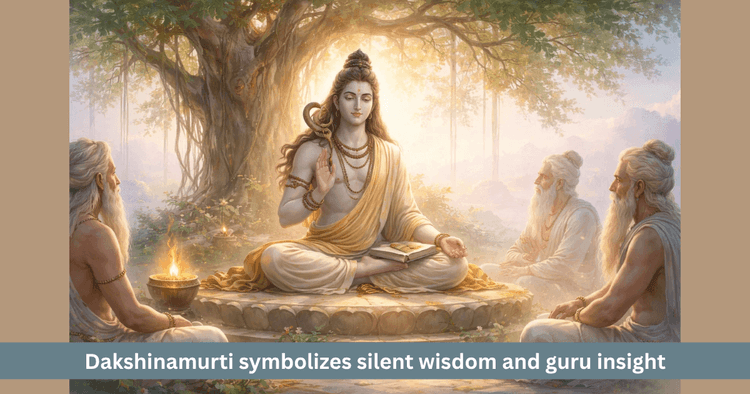
Table of Contents
When the name Dakshinamurti is remembered, many people first think of Shiva facing the southern direction. That meaning is not wrong, yet it is certainly incomplete. The importance of the name Dakshinamurti is not limited only to direction. In Sanskrit tradition, the word dakshina does not mean only the south. It is also associated with skill, cleverness, competence and subtle understanding. For this reason, the name Dakshinamurti should not be understood only as a directional indication but as a profoundly spiritual title.
This name leads us to that form of the Guru who can quiet the doubts of the disciple without excessive speech. The one who teaches not only by words but through presence, silence, vision and inner awakening, is truly Dakshinamurti. That is why this name does not merely identify one form of Shiva. It also reveals the highest secret of the Guru principle.
Why is it not enough to understand it only as a reference to the southern direction
In Indian divine tradition, direction certainly has importance and in the context of Dakshinamurti it is also said that his face is toward the south. Yet if the meaning is limited only to that, the spiritual depth of the name becomes very small. The form of Dakshinamurti is not that of an ordinary deity. He is established as the Adi Guru, the teacher of silence and the giver of Self knowledge. In such a case, the meaning of the name cannot remain merely geographical.
When in Sanskrit the word dakshina is linked with skill, capability, subtle wisdom and proper guidance, then the name Dakshinamurti suddenly appears in a new light. It becomes clear that what matters here more than direction is the Guru capacity by which the darkness within the disciple is removed without increasing confusion and without creating unnecessary complexity.
What is the deeper Sanskrit meaning of the word dakshina
Words in Sanskrit often carry many layers of meaning. The word dakshina is one such word. It does not indicate only the southern direction. It is also linked with skillfulness, competence, capacity, intelligent method, discernment and at times appropriate conduct. For this reason, the name Dakshinamurti carries a very beautiful union of meanings.
On one side there is the indication of direction. On the other side there is that divine consciousness which leads the disciple to truth with complete skill. If a teacher speaks much yet no clarity arises in the disciple, that is only an expansion of speech. But the one who removes the disciple’s doubt in a few moments is worthy of this higher meaning of dakshina.
Main meanings associated with the word dakshina
• The sense of skillfulness
• The indication of competent guidance
• The power of subtle intelligence and right insight
• The capacity to give inner clarity
Why is the one who removes doubt without speaking called Dakshinamurti
This idea is the very soul of the name Dakshinamurti. An ordinary teacher gives knowledge through words but a great Guru does not rely only on speech. Within such a Guru there is a silent knowing that can quiet the confusion arising in the mind of the disciple. This teaching is not merely the giving of information. It is a transmission of consciousness.
The silence of Dakshinamurti is revered for this reason. The true doubt of the disciple is often not merely intellectual. It is existential. It concerns life, the Self, the world, maya, death and truth. Such doubt cannot be fully answered by argument alone. There, one needs the presence of a Guru who can unite the disciple with the truth already present within. This is the wonder of Dakshinamurti.
Why is the Guru form of Dakshinamurti considered so great
Dakshinamurti is understood as that form of Shiva in which he appears not as the cosmic destroyer or the deity of divine dance but as the embodiment of knowledge, the embodiment of silence and the embodiment of the Guru. The disciples who sit near him do not come merely to hear teachings. They come so that their inner ignorance may melt. That is why the image of Dakshinamurti holds extraordinary importance in Indian philosophy, Vedanta and the Guru tradition.
His greatness lies in the fact that he does not give knowledge as an outer acquisition. He gives it as the recognition of one’s own true nature. He does not say that truth lies somewhere far away. He enables the disciple to experience that truth is already within and only the layers of ignorance and doubt must be removed. The one who does this in the most skillful way is rightly called Dakshinamurti.
Is Dakshinamurti connected only with Vedanta
Dakshinamurti is especially associated with Self knowledge, Vedanta, the path of knowledge and silent instruction, yet his importance does not remain limited to one philosophical system. Any seeker who longs for inner clarity, any disciple who wishes to be free from confusion and any human being who seeks the touch of truth beyond words can find living meaning in Dakshinamurti.
Here Vedanta does not mean book knowledge alone. It means knowing oneself. Dakshinamurti is the guardian of that Self knowledge. He does not ask the seeker to run away from the world. He gives the right understanding through which one can remain steady even in the midst of the world.
Spiritual qualities associated with Dakshinamurti
• Teaching through silence
• The ending of doubt
• The light of Self knowledge
• The highest form of the Guru principle
How does the Dakshinamurti Upanishad deepen the meaning of this name
The Upanishadic tradition linked with Dakshinamurti does not confine this name to devotional reverence alone. It also grants it philosophical height. The memory connected with the Dakshinamurti Upanishad suggests that Dakshinamurti is the one who reveals the subtlest truth in such a way that the ignorance within the disciple begins to disappear. Here the Guru does not remain only an outer personality. He becomes the radiant principle of knowledge itself.
In this Upanishadic vision, the name Dakshinamurti belongs to a Guru who does not burden the disciple. He does not entangle the disciple in unnecessary words. He removes doubt directly from its root. That is why the meeting of the skillful meaning of dakshina and the Guru form of murti makes this name profoundly meaningful.
Why is silence so central in this name
Silence does not mean merely not speaking. In spiritual tradition, silence often symbolizes complete knowing, freedom from unnecessary words and the presence of inner truth. That is why silence is so central to Dakshinamurti. His silence is not emptiness. It is fullness. It is not vacant. It is silence saturated with meaning.
Only the Guru who is inwardly clear can teach even through silence. The silence of one who is inwardly confused would be mere emptiness. The silence of Dakshinamurti is powerful because it is knowledge filled silence. In it, truth is present before words arise.
What is the practical meaning of the name Dakshinamurti for a seeker
For a seeker, this name is deeply useful and inspiring. It reminds one that spiritual growth does not happen merely by hearing more, reading more or speaking more. Often real progress begins when inner confusion is quieted by one right vision. Dakshinamurti is the divine form of that right vision.
The practical meaning of this name is also that the seeker should search for a kind of knowledge that does not make life more complicated but more simple, more clear and more steady. Knowledge that increases ego is still incomplete. Knowledge that brings humility and peace is the knowledge that leads toward Dakshinamurti.
Main teachings of the name Dakshinamurti for the seeker
• Learn to listen inwardly to truth
• Let knowledge become clarity, not ego
• Understand silence not as emptiness but as spiritual presence
• Seek that Guru principle which cuts doubt instead of increasing confusion
Is Dakshinamurti only a form of Shiva or something more
Yes, Dakshinamurti is a form of Shiva but not only a form. He is the revelation of that dimension within Shiva where knowledge, silence, Guruhood and Self realization appear together. To understand Dakshinamurti is therefore not merely to know one aspect of Shiva but also to understand one of the most subtle secrets of the Guru principle.
Dakshinamurti is unique because he shows that ultimate truth is not only an object of worship. It is also something to be directly realized. And to reach that realization, one needs more than words. One needs a living presence. That living presence is Dakshinamurti.
A simple table to understand this theme
| Element | Deeper meaning |
|---|---|
| Dakshina | Skillfulness, cleverness, capable guidance |
| Murti | Manifest form, living divine presence |
| Dakshinamurti | The Adi Guru who removes doubt through silence |
| Silence | Knowledge filled presence, teaching beyond words |
| Disciple’s doubt | Ignorance, confusion and the search for Self knowledge |
Why does the relevance of the name Dakshinamurti increase in the present age
Today the human being is full of information, yet inwardly restless. Much is known, yet it is not clear what truly needs to be known. In such a time, the name Dakshinamurti becomes deeply relevant. It teaches that real knowledge does not create noise. It reduces inner confusion. It does not burden the mind. It makes it simple and pure.
Perhaps the greatest need of this age is to return to that knowledge which reconnects the human being with the Self. The name Dakshinamurti is an invitation to that return. It tells us that the true Guru is not the one who only keeps speaking but the one who unties the knot within us.
The timeless teaching of the silent Guru
The deeper meaning of the name Dakshinamurti finally leads us toward a very beautiful truth. The highest Guru form of the Divine is that which gives direction, skill, silence and freedom from doubt together. Dakshinamurti is the name of that complete Guru principle. That is why remembering him is not only worship. It is also an invitation to inner contemplation.
When the seeker begins to understand this name, one also begins to realize that the spiritual journey does not advance through the burden of words but through the simplicity of truth. The Guru who awakens that simplicity without speaking is Dakshinamurti. This is the deepest and most enduring teaching of the name.
Frequently asked questions
Why should the name Dakshinamurti not be linked only with the southern direction
Because in Sanskrit dakshina means not only direction but also skill, cleverness and capable guidance.
Why is Dakshinamurti called the silent Guru
Because he is regarded as that Guru form who removes the doubts of the disciple without excessive speech.
Is Dakshinamurti a form of Shiva
Yes. Dakshinamurti is the knowledge filled and Guru form of Shiva.
What is the connection between the Dakshinamurti Upanishad and this name
The Upanishadic tradition sees Dakshinamurti as the Adi Guru who reveals subtle truth within the disciple.
What is the greatest message of the name Dakshinamurti for a seeker
That true knowledge is the knowledge which brings inner clarity, peace and freedom from doubt.
Get your accurate Kundali
Generate KundaliDid you like it?
Author

Pt. Abhishek Sharma (63)
Experience: 20
Consults About: Family Planning, Career
Clients In: Punjab, Haryana, Delhi
Share this article with friends and family
About ZODIAQ
ZODIAQ is an online Vedic Astrology platform. It connects clients seeking astrological advice to experienced astrologers with deep knowledge. Our users also generate kundali and perform kundali milan for free. ZODIAQ also offers services to the Astrologers. Astrologers utilize various offerings by ZODIAQ to serve their clients effectively.
If you are a User
Consult with experienced astrologers and seek their guidance. You can also order handwritten Janm Patrika report with life prediction prepared by experienced astrologers. Generate accurate Kundali, perform Kundali Matching and check horoscope and muhurat. Utilize our online library for all the necessary astrological and spiritual information.
If you are an Astrologer
Create accurate kundali for your clients and perform Kundali Matching for up to 5 people at a time. Write comprehensive Janm Patrika report for your clients with ZODIAQ. Check client details anytime by saving it in client directory. Become more productive by tracking how many clients you guide every day.
WELCOME TO
ZODIAQ
Right Decisions at the right time with ZODIAQ
