Moon and Ganga in Dakshinamurti: Symbol of Wisdom and Purification
By Pt. Narendra Sharma
Understanding the spiritual meaning of moon and Ganga in Shiva’s form
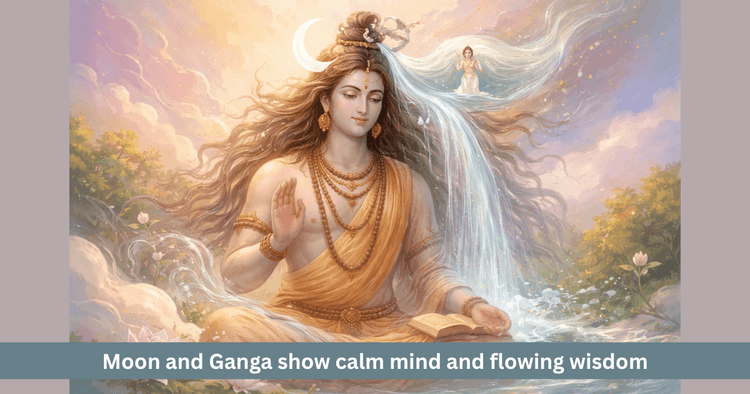
Table of Contents
Lord Dakshinamurti is not seen in Indian spiritual tradition merely as one form of Shiva but as the divine embodiment of the Guru principle, Self knowledge and teaching through silence. Every aspect of his form, every gesture and every symbol is linked to a profound philosophical meaning. In particular, the moon resting in his matted locks and the Ganga flowing from there are not ornaments alone. They reveal the subtle secret of the Guru in which, on one side, there is the compassion that quiets the mind and on the other, the stream of wisdom that washes away ignorance and leads one toward Self realization. This is why the presence of the moon and Ganga in the locks of Dakshinamurti becomes a unique spiritual language.
When a seeker contemplates the image or meditative form of Dakshinamurti, what is seen is not only the beauty of Shiva. One sees a living teaching in which the moon symbolizes peace of mind and the Ganga symbolizes the continuous current of knowledge. This current is not merely an outer river. It also signifies the grace of the Guru flowing toward the disciples, washing away doubt, confusion and ignorance. That is why this union of the moon and Ganga in the matted locks of Dakshinamurti becomes a powerful expression of spiritual wisdom.
Why is the gentle form of Dakshinamurti considered so important
Shiva has many forms. In one he is the destroyer, in another the yogi, in another the cosmic dancer and in another the fierce one. Yet in the form of Dakshinamurti, he is especially the Guru. Here his form conveys more peace than fear, more stillness than movement and more silence than speech. In such a Guru form, everything associated with him becomes deeply instructive. That is why the moon and Ganga in his locks are read not merely as mythic features but as symbols of inner spiritual practice.
In this form, Shiva first quiets the mind of the disciple before giving knowledge. A restless mind cannot hold truth. That is why the moon and Ganga appearing together here are profoundly meaningful. One cools the mind, while the other bathes consciousness. This is the gentle sequence of Guru grace.
Why is the moon placed in his matted locks
In Indian spiritual symbolism, the moon is generally associated with the mind, coolness, rhythm, feeling, gentleness and the soft inner light of awareness. In the context of Dakshinamurti, this meaning becomes even clearer. Here the moon is not only part of Shiva’s identity. It indicates that in the presence of the Guru, the restless mind of the disciple gradually begins to become calm.
When the mind is disturbed, even heard wisdom does not remain steady. It falls into doubt, fear or instability. That is why the moon here represents peace of mind. Dakshinamurti teaches that the first condition for Self knowledge is the cooling of the mind. Where there is too much inner heat, impatience and imbalance, subtle truth does not stay. The moon becomes the divine symbol of this cooling grace.
Symbolic meanings of the moon
• Peace of mind
• Gentleness of feeling
• A soft restraint over restlessness
• Preparation for inner receptivity
Why is Ganga called the stream of knowledge
In Indian tradition, Ganga is not merely a river. She is the symbol of purity, flow, upliftment, cleansing and grace descending from above. In the context of Dakshinamurti, calling Ganga the stream of knowledge is deeply meaningful. The Guru’s knowledge is not like stagnant water. It flows, reaches the disciple, enters within and carries away what is impure.
Knowledge is called a stream because it is not a piece of information belonging to one moment. It is an ongoing process. Just as Ganga descends from the heights and sanctifies the earth, Guru wisdom descends from a higher plane of awareness into the disciple’s inner being. This knowledge is not merely intellectual. It purifies like a sacred bath. That is why the Ganga flowing from the matted locks of Dakshinamurti is seen as the stream of wisdom moving toward the disciples.
What do the moon and Ganga together signify
The moon and Ganga appearing together in the form of Dakshinamurti offer a very deep teaching. Knowledge becomes fruitful only when the mind is peaceful. And peace of mind becomes steady when it is continuously bathed in knowledge. In this way, the moon and Ganga appear as complements to one another. One stabilizes the mind, while the other illumines and purifies it.
If the mind becomes calm but remains without direction, the person may become passive. If knowledge is given but the mind remains disturbed, that knowledge will not stay. In the locks of Dakshinamurti, the union of these two teaches that true Guru grace first gives peace, then lets wisdom flow and finally transforms the disciple inwardly.
Combined meanings of the moon and Ganga
• Peaceful mind and flowing wisdom
• Coolness and purification together
• Receptivity followed by Self realization
• The gentle and continuous form of Guru grace
What does it mean that the stream of wisdom flows toward the disciples
This idea is especially beautiful, that Ganga does not remain only upon Shiva’s head but is flowing toward the disciples. This means that the Guru’s wisdom does not remain enclosed within him. By nature it wishes to be shared. It flows. It does not remain still. It makes itself available to the worthy disciple. This is the true form of Guru grace.
For the disciple, this means that wisdom is not a closed gate. If there is humility, reverence and receptivity, then that stream may be received naturally from the Guru. This form of Dakshinamurti reassures the seeker that divine wisdom is not the property of a few. It is a flowing grace that can be received when the mind is made peaceful and the heart is kept open.
Is this only a mythic image or also a sign of spiritual practice
This form is not merely a mythic scene. It is also a map of inner practice. Within the seeker, the moon means making the mind cool, simple and restrained. Ganga means continuing to purify oneself through study, reflection on the Guru, silent contemplation and the bath of knowledge. When these begin to happen within, the symbol of Dakshinamurti becomes alive.
For this reason, it is not enough to admire this symbol outwardly. It must also be brought inward. Every seeker must ask, is the mind becoming cool like the moon. Is the Ganga of wisdom flowing within. Is one merely listening or truly changing inwardly. This is the power of the symbol in spiritual practice.
How does the Linga Purana give background to this symbol
The memory connected with the Linga Purana does not treat the symbols of Shiva’s form as outer ornaments alone. Each element is given a spiritual significance. The moon and Ganga in the matted locks of Dakshinamurti are also understood within that tradition as conveying a profound teaching. It becomes clear through this that in Shiva’s gentle Guru form, both peace and wisdom are equally necessary.
The importance of the Puranic view here is that it does not leave the symbols as mere narrative. It turns them into life teaching. That is why even today, the image of the moon and Ganga gives the seeker not only mythic fascination but also inner discipline and spiritual direction.
How can this symbol manifest in the life of a seeker
A seeker can bring this symbol into life in many ways. When one chooses calm reflection instead of reaction, the moon begins to arise within. When one gives daily time to wisdom, meditation, the voice of the Guru or sacred study, the Ganga begins to flow within. When one offers clarity instead of confusion to others, one begins to move nearer to the Guru principle of Dakshinamurti.
This symbol also teaches that before becoming a guide, one must become a disciple. The mind must first be made peaceful like the moon and then one must allow the holy current of Ganga to enter within. Only then does knowledge become not merely studied but lived.
Practical teachings for the seeker
• Without a peaceful mind, knowledge cannot stay steady
• Continuous sacred study keeps the stream of wisdom alive
• Humility is needed to receive Guru grace
• When peace and knowledge move together, Self realization deepens
A simple table to understand this theme
| Element | Deeper meaning |
|---|---|
| Moon | Peace of mind, coolness and receptivity |
| Ganga | Stream of knowledge, purification and grace |
| Matted locks | Held tapas, divine containment and mastery |
| Dakshinamurti | Silent Guru and divine form of Self knowledge |
| Disciple | The seeker receiving peace and wisdom |
Why is this symbol especially relevant today
The modern human being suffers less from lack of information and more from lack of a peaceful mind. There is plenty of data, yet little assimilation. There are many words, yet the inner stream has gone dry. In such a time, the symbol of the moon and Ganga in the matted locks of Dakshinamurti becomes especially relevant. It reminds us that the mind must first be quieted. Only then can wisdom enter life.
This symbol also teaches the modern seeker that reading knowledge is not enough. It must be allowed to flow within. And for that flow, inner space is needed. The moon creates that space. Ganga fills it. Dakshinamurti stands as the divine guardian of this process.
Knowledge flowing through gentleness
The most beautiful teaching of this gentle form of Dakshinamurti is that the highest wisdom does not always descend in a severe or fearsome form. It often arrives in a form that is peaceful, cool, silent and compassionate. The moon symbolizes that compassionate stillness and Ganga symbolizes that wisdom which continues to flow toward the disciples.
When the seeker begins to understand this symbol, one realizes that Guru grace is not present only in words. It is present in atmosphere as well. Sometimes it descends as peace, at other times as the flow of knowledge. The moon and Ganga in the matted locks of Dakshinamurti are these two divine dimensions of grace. This is the deepest and most enduring teaching of the symbol.
Frequently asked questions
What does the moon in the matted locks of Dakshinamurti symbolize
The moon is generally understood as a symbol of peace of mind, coolness and receptive awareness.
Why is Ganga called the stream of knowledge
Because in the context of Dakshinamurti, Ganga is understood as the flow of wisdom toward the disciples, along with purification and Guru grace.
Is this meaning only mythic
No. It also points toward inner practice, where both a peaceful mind and flowing wisdom are necessary.
Why is this symbol important in the gentle form of Dakshinamurti
Because it shows that the Guru first quiets the mind and then lets the stream of wisdom flow.
With which source is this understanding generally associated
It is generally associated with the interpretation linked with the Linga Purana.
Get your accurate Kundali
Generate KundaliDid you like it?
Author

Pt. Narendra Sharma (63)
Experience: 20
Consults About: Family Planning, Career
Clients In: Punjab, Haryana, Delhi
Share this article with friends and family
About ZODIAQ
ZODIAQ is an online Vedic Astrology platform. It connects clients seeking astrological advice to experienced astrologers with deep knowledge. Our users also generate kundali and perform kundali milan for free. ZODIAQ also offers services to the Astrologers. Astrologers utilize various offerings by ZODIAQ to serve their clients effectively.
If you are a User
Consult with experienced astrologers and seek their guidance. You can also order handwritten Janm Patrika report with life prediction prepared by experienced astrologers. Generate accurate Kundali, perform Kundali Matching and check horoscope and muhurat. Utilize our online library for all the necessary astrological and spiritual information.
If you are an Astrologer
Create accurate kundali for your clients and perform Kundali Matching for up to 5 people at a time. Write comprehensive Janm Patrika report for your clients with ZODIAQ. Check client details anytime by saving it in client directory. Become more productive by tracking how many clients you guide every day.
WELCOME TO
ZODIAQ
Right Decisions at the right time with ZODIAQ
