Rosary and Book in Dakshinamurti: Balance of Knowledge and Practice
By Pt. Suvrat Sharma
Understanding the symbolism of scripture and discipline in Shiva’s form
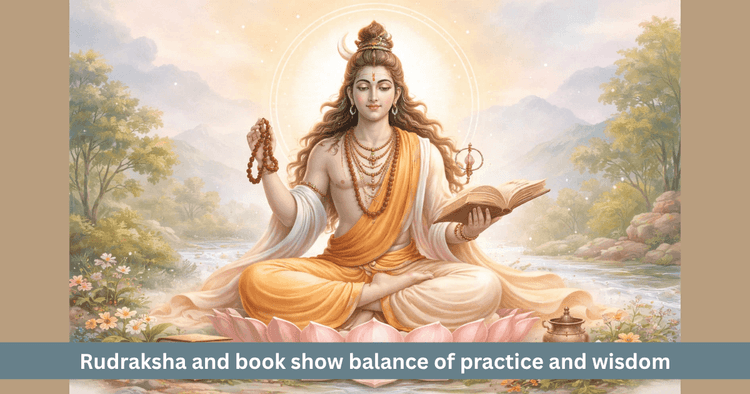
Table of Contents
Lord Dakshinamurti is not seen in Indian spirituality merely as a serene form of Shiva. He is understood as the primordial Guru, the silent revealer of wisdom and the one who illumines Self knowledge. Every symbol in his form offers direction to the seeker. Among the most meaningful of these are the rudraksha rosary in one hand and the book in the other. In one hand is rudraksha, which symbolizes austerity, japa, discipline and inward spiritual practice. In the other hand is the book, which signifies scriptural knowledge, discernment, principle and understood wisdom.
This pairing is not merely symbolic beauty. It teaches the indispensable balance that today people call the balance of theory and practice. This form of Dakshinamurti shows that knowledge is not complete by reading alone and spiritual effort is not complete by practice alone. Only when scripture and austerity, understanding and discipline, thought and experience come together does the light of Guru grace become steady. That is the ancient and timeless teaching of this form.
Why are the symbols in the hands of Dakshinamurti so important
In the form of Dakshinamurti, nothing appears by accident. His posture, his silence, his seat, Apasmara beneath his feet and the objects held in his hands, everything is a medium of teaching. That is why the rudraksha and the book should not be understood merely as worship materials or decorative features. They actually bring forward two indispensable pillars of the Guru life.
A true seeker must both know and live. One must understand and also practice. If one remains only in thought, inward transformation will remain incomplete. If one practices alone without true understanding, direction may become distorted. Dakshinamurti therefore holds both together. He seems to say that the book is needed to keep knowledge alive and rudraksha is needed to make knowledge true.
What does the rudraksha rosary signify
Rudraksha is regarded as deeply sacred in Indian spiritual practice. It is commonly associated with japa, tapas, concentration, discipline, inner purification and the consciousness of Shiva. The presence of rudraksha in the hand of Dakshinamurti means that the Guru does not only teach through words. He also leads the seeker toward practice. He does not say that wisdom is merely something to be studied. He shows that to hold knowledge inwardly, the mind must be disciplined.
The rudraksha rosary also signifies continuity. Japa is not a one time act. Through repetition it deepens the mind. In the same way, spiritual growth does not happen in a single day. It emerges through regular practice. That is why the rudraksha in the hand of Dakshinamurti teaches the seeker that without practice, austerity and inner discipline, knowledge may remain only verbal.
Main symbolic meanings of rudraksha
• Austerity and discipline
• Japa and concentration
• A path of inner purification
• Spiritual practice that brings knowledge into life
The meaning of the book is not only reading scripture
In the other hand of Dakshinamurti is the book. This book is not merely the physical presence of a text. It symbolizes scripture, Vedanta, philosophical reflection, discernment, understanding and the tradition of wisdom. The Guru is not only one who guides a seeker through practice. The Guru also gives direction. Without direction, practice can at times become blind repetition. The book therefore reminds the seeker that one must remain connected with the lineage of wisdom.
The book also has another important meaning, the ordered understanding of truth. Experience is valuable, yet without right principle it may remain unclear. The book represents that intellectual clarity which helps the seeker understand what path is being followed, why it is being followed and what its final aim is. In this sense, the book is the intellectual side of Guru grace, while rudraksha is its practical side.
What do rudraksha and the book together teach
This form of Dakshinamurti teaches very clearly that knowledge and practice cannot be separated. If there is only the book and no rudraksha, a person may know much and yet not be inwardly transformed. If there is only rudraksha and no book, there may be practice without direction or discernment. That is why the presence of both together signifies a profound spiritual completeness.
For this reason, one may say that the rudraksha and the book in the hands of Dakshinamurti form one of the most ancient expressions of the balance between theory and practice. Here theory means understanding, principle, philosophy and scriptural direction. Practice means japa, austerity, disciplined conduct and lived truth. Dakshinamurti joins the two to teach that liberation does not arise from intellect alone, nor does it arise from action alone. The union of both is the Guru path.
Combined meanings of rudraksha and the book
• The balance of scripture and practice
• The union of understanding and experience
• The harmony of discernment and discipline
• Not only reading knowledge but living it
Can this be seen as the oldest Guru teaching of principle and practice
Yes, this symbol may be understood in exactly that way. Today people speak of balancing theory and practice, yet the form of Dakshinamurti has long been teaching the same truth. The book in one hand and the rudraksha in the other show that the path of genuine wisdom has two essential dimensions. On one side, there must be understanding of truth. On the other, there must be practice of truth.
If one studies scripture and life does not change, then that wisdom has remained only in the head. If one practices intensely but without discernment, then that effort remains incomplete. By holding both together, Dakshinamurti points toward that mature spirituality in which thought and conduct do not oppose each other but fulfill one another.
How does Dakshinamurti Samhita give dignity to this symbol
The memory associated with the Dakshinamurti Samhita gives special importance to this symbol. When a posture, gesture or object held by the deity is mentioned in a traditional samhita, it becomes clear that what lies behind it is not artistic beauty alone but a deliberate spiritual indication. In this way, the presence of the rudraksha and the book together makes the Guru form of Dakshinamurti even more meaningful.
This tradition teaches that the Guru path is not merely solitary austerity, nor merely scriptural scholarship. Its nature is complete. It awakens the inner fire of practice and also the outer clarity of understanding. That is why the memory linked with Dakshinamurti Samhita becomes not merely a mythic attraction for the seeker but also practical guidance for spiritual discipline.
How can a seeker bring this symbol into life
This symbol becomes living only when the seeker brings it into life. For example, if someone reads scripture every day but remains restless, reactive and ego driven, then the book is present but rudraksha is absent. If someone performs japa, austerity and spiritual practice but pays no attention to scripture, discernment or right understanding, then rudraksha is present but the book is absent. The teaching of Dakshinamurti is that both must be balanced.
Practically, this means that the seeker should cultivate study, japa, meditation, reflection on the Guru’s teaching and purity of conduct together. When study and practice begin to strengthen one another, the Guru principle begins to awaken within. This is the true grace of Dakshinamurti.
Practical teachings for the seeker
• Daily study of wisdom is necessary
• Regular japa and meditation refine the mind
• Knowledge remains incomplete unless it is brought into life
• Practice remains incomplete unless joined with discernment
Is this symbol meant only for renunciates or for householders as well
This symbol is not meant only for renunciates. In fact, it is perhaps even more necessary for householders. A person living in the world must make decisions, sustain relationships, understand dharma and preserve inner practice. In such a life, the book alone is not enough and the rosary alone is not enough. Both are needed.
For the householder, the book means right understanding, values, dharma and discernment. Rudraksha means inwardness, prayer, restraint and connection with the spiritual center. If the two remain together, life can become more balanced, more patient and more illumined. In this sense, the symbol of Dakshinamurti is profoundly universal.
A simple table to understand this theme
| Element | Deeper meaning |
|---|---|
| Rudraksha | Austerity, japa, discipline and practice |
| Book | Scriptural wisdom, discernment and principle |
| Dakshinamurti | The Guru form balancing knowledge and practice |
| Theory | Understanding, philosophy and scriptural clarity |
| Practice | Japa, tapas, conduct and lived truth |
Why is this teaching even more necessary in the present age
The present age is full of information. People read much, hear much and know much, yet are transformed very little inwardly. On the other hand, some practice intensely but become confused due to lack of right guidance. In such a time, the teaching contained in the hands of Dakshinamurti becomes deeply necessary. It reminds us that knowledge must be joined with experience and experience must be guided by right principle.
One of the great causes of spiritual confusion today is that people become trapped either in thought alone or in practice alone. The form of Dakshinamurti protects us from both extremes. It teaches balance. And this balance leads the human being toward enduring growth.
The light of balance in the Guru’s hands
The sight of rudraksha and the book in the hands of Dakshinamurti offers a deep and timeless teaching. The true Guru is not merely one who knows scripture and not merely one who practices austerity. The true Guru is the one in whom clarity of understanding and the heat of practice are both fully present. Dakshinamurti is the divine embodiment of this wholeness.
When the seeker understands this symbol, one begins to know that wisdom must first be studied, then reflected upon, then brought inward through japa and tapas and finally lived in daily life. This is that ancient balance of theory and practice which Dakshinamurti holds in both hands. This is the most enduring and luminous teaching of the symbol.
Frequently asked questions
What does the rudraksha in the hand of Dakshinamurti signify
Rudraksha generally symbolizes austerity, japa, discipline and inner spiritual practice.
What is the meaning of the book
The book signifies scriptural knowledge, discernment, principle and ordered spiritual understanding.
Is this a symbol of the balance between theory and practice
Yes. It can be understood as a deeply ancient example of the balance in which understanding and practice move together.
Is this symbol important only for renunciates
No. It is important for both renunciates and householders, because life requires both wisdom and right conduct.
With which source is this belief generally associated
It is generally linked with the memory associated with the Dakshinamurti Samhita.
Get your accurate Kundali
Generate KundaliDid you like it?
Author
Pt. Suvrat Sharma (63)
Experience: 20
Consults About: Family Planning, Career
Clients In: Punjab, Haryana, Delhi
Share this article with friends and family
About ZODIAQ
ZODIAQ is an online Vedic Astrology platform. It connects clients seeking astrological advice to experienced astrologers with deep knowledge. Our users also generate kundali and perform kundali milan for free. ZODIAQ also offers services to the Astrologers. Astrologers utilize various offerings by ZODIAQ to serve their clients effectively.
If you are a User
Consult with experienced astrologers and seek their guidance. You can also order handwritten Janm Patrika report with life prediction prepared by experienced astrologers. Generate accurate Kundali, perform Kundali Matching and check horoscope and muhurat. Utilize our online library for all the necessary astrological and spiritual information.
If you are an Astrologer
Create accurate kundali for your clients and perform Kundali Matching for up to 5 people at a time. Write comprehensive Janm Patrika report for your clients with ZODIAQ. Check client details anytime by saving it in client directory. Become more productive by tracking how many clients you guide every day.
WELCOME TO
ZODIAQ
Right Decisions at the right time with ZODIAQ
