Serpent on Dakshinamurti Neck: Symbol of Kundalini Awakening
By Pt. Nilesh Sharma
Understanding Kundalini Shakti symbolism in Dakshinamurti’s divine form
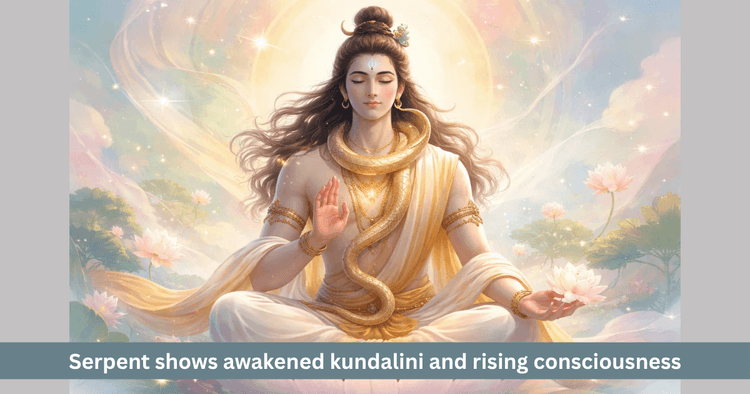
Table of Contents
In Indian sacred iconography, nothing is shown without meaning. Every ornament, every gesture, every direction, every emblem and every form carries philosophical and spiritual depth. The form of Bhagavan Dakshinamurti is one of the finest examples of this profound symbolism. He is not only a guru, not only the silent teacher of wisdom but also a supreme acharya in whose entire form knowledge, yoga, consciousness and self realization are beautifully integrated. The serpent seen around his neck is one such deeply significant symbol and it should not be dismissed merely as a common Shaiva mark.
Drawing upon the indicative understanding found in the tradition associated with Hatha Yoga Pradipika, the serpent at Dakshinamurti’s neck is often understood as a symbol of awakened Kundalini Shakti. It is not merely a mark of danger or power in an outer sense. It represents that ascending energy of consciousness which rises from dormancy toward awakening, expansion and finally direct realization. When the serpent is shown resting at the neck of Dakshinamurti, it declares that he is not only the guru of Vedantic wisdom but also the supreme master of yoga. He is the lord of that inner force which lifts awareness from inertia toward illumination.
Why Is the Serpent at Dakshinamurti’s Neck So Important
The form of Dakshinamurti may be understood on many levels. He is the guru, the silent revealer of truth, the lord of self realization and the one who points the way toward the unity of the individual and the Absolute. In such a form, the serpent at the neck cannot be ornamental alone. It indicates that the guru’s wisdom is not limited to scripture. It is also experiential, energetic and verified through yogic realization.
The importance of the serpent is deep for another reason as well. In Indian tradition, the serpent has long been understood as a symbol of:
- Power
- Awakening
- Guarded consciousness
- Ascending energy
- Controlled force
Thus, the serpent at Dakshinamurti’s neck shows that the energy within him is not wild or destructive but fully awakened and perfectly mastered.
Why Is the Serpent Taken as a Symbol of Kundalini Shakti
In yogic tradition, Kundalini is often described through the image of a coiled serpent. This does not mean that Kundalini is literally a physical serpent. Rather, the serpent serves as a fitting symbol because it embodies two essential characteristics. First, it remains coiled and condensed while still containing immense power. Second, when awakened, it can rise with remarkable directness and intensity. These two qualities make it a natural symbol for Kundalini Shakti.
Kundalini is understood as a dormant divine force within the seeker. As long as it remains latent, human life tends to remain bound within ordinary consciousness, limited identity and external existence. But when this same force awakens, the path of practice begins to transform from within. This is why the serpent symbol is treated as so meaningful.
Symbolic parallels between the serpent and Kundalini
| Symbol | Deeper Meaning |
|---|---|
| Coiled serpent | Dormant spiritual force |
| Rising serpent | Awakening of consciousness |
| Controlled movement | Disciplined progress in practice |
| Power to hold poison or nectar | Energy depends on the level of the seeker |
This table makes it clear that the serpent symbolizes not merely power but directed and disciplined power.
What Is the Special Meaning of the Serpent Being at the Neck
If the serpent were shown anywhere on the body, it would still carry symbolic significance. But its presence specifically at the neck adds a special dimension. In Indian yogic understanding, the neck is not merely a bodily region. It is also associated with speech, expression, energetic regulation and the passage of force. The serpent at the neck indicates that the awakened power is not only present but also fully governed.
Dakshinamurti is the silent guru. The serpent at the throat and the silence at the mouth together reveal something subtle and beautiful. His inner energy is so awakened that it does not require noisy expression. His silence is not passive. It is the balanced and luminous form of awakened force. Therefore the serpent at the neck becomes a symbol of controlled spiritual awakening.
Is This Only a Yogic Symbol or Also a Philosophical One
It is not only yogic. It is deeply philosophical as well. The awakening of Kundalini is not merely an experience of energy. Its final aim is the expansion of consciousness and the realization of the Self. Therefore the serpent at Dakshinamurti’s neck becomes a beautiful meeting point of yoga and Vedanta. It shows that the final truth is related not only to thought but also to transformed consciousness.
Its philosophical meaning may be understood in the following ways:
- Divine power already exists within the individual
- Spiritual practice does not import power from outside but awakens what is already present
- The true result of awakening is not pride but stable wisdom
- When power comes under the guidance of the guru principle, it begins to lead toward liberation
Why May Dakshinamurti Be Called the Supreme Acharya of Yoga
Dakshinamurti is often associated with knowledge and Vedanta but his form is not that of an intellectual teacher alone. He is the guru of consciousness itself. His silence holds samadhi. His gesture expresses self realization. His serpent signals awakened Kundalini. The sages seated before him represent inquiry. His full form reflects the complete balance of yoga.
He may be called the supreme acharya of yoga because:
- He knows energy, yet is never bound by it
- He gives knowledge, yet does not fall into dry intellectualism
- He abides in silence, yet is full of realization
- He represents the upward movement of consciousness toward its highest fulfillment
Thus the serpent is not a display of force. It is evidence of fully perfected yoga.
Does Kundalini Awakening Mean Only Extraordinary Experience
No and this is a very important correction. Kundalini awakening is often spoken of only in terms of unusual experiences, rare powers or sensational phenomena. Traditional understanding is much more serious. The first true signs of awakening are not display but clarity, stability, concentration, detachment and the right direction of energy. If energy appears to awaken while the person becomes more unstable, more egoic or more confused, then the process is not complete or properly integrated.
The serpent at Dakshinamurti’s neck teaches the right model of awakening. The highest form of awakened power is not noisy display but noble silence, mastery and illumined understanding.
What Does This Symbol Teach the Seeker of Yoga
The serpent at Dakshinamurti’s neck offers a profound lesson to the spiritual practitioner. This lesson is not limited to posture or meditation technique. It concerns the entire discipline of practice. Energy must awaken but it must also receive direction. Practice must deepen but it must remain balanced. Power may manifest but its purpose must be self illumination, not display.
Lessons for the seeker from this symbol
- Before awakening force, the mind must be purified
- Along with awakening, restraint and discernment are essential
- Silence and energy are not opposites but mature complements
- Without the guru principle, the path of force may become confusing
- The final goal is not accumulation of experiences but self realization
Does the Serpent at the Throat Also Show the Relation Between Speech and Knowledge
Yes, in a very beautiful way. The throat is the seat of speech and Dakshinamurti is the silent guru. This means that where ordinary human beings express knowledge through words, the perfected guru may radiate knowledge through presence itself. The serpent rests at the throat, yet speech does not arise outwardly. The meaning is that the highest use of awakened energy is not excessive speech but living transmission.
It may also be understood that when speech is backed by power and power is illumined by realization, knowledge becomes living truth. But when power settles into silence, then presence itself becomes the teaching. Dakshinamurti is the embodiment of that state.
What Is the Relevance of This Symbol in Modern Life
Today people desire power, impact, expression and rapid results. Yet far fewer value restraint, steadiness and maturity. The serpent at Dakshinamurti’s neck teaches the modern mind that the true beauty of power lies in mastery. The real sign of higher energy is balance. Inner awakening becomes meaningful only when it makes life clearer, quieter and more truthful.
For modern life, this symbol offers several important directions:
| Modern condition | Teaching from Dakshinamurti’s serpent |
|---|---|
| Excessive mental noise | Settle inner energy into silence |
| Restless ambition | Give direction to power |
| Outer display | Turn awakening into humility |
| Intellectual fatigue | Recognize the balance of consciousness and energy |
| Spiritual curiosity | Value maturity more than unusual experience |
What Is the Deepest Spiritual Message of This Symbol
The deepest message of the serpent at the neck is that within the human being there already lies a divine force but its awakening becomes meaningful only when it moves under the guidance of the guru principle, discernment and self realization. It is not enough that power awakens. Power must unite with wisdom. This is exactly what shines through the form of Dakshinamurti.
The serpent silently declares:
- The power is already within you
- It can be awakened
- But it requires discipline, guidance and right understanding
- Its final purpose is self illumination
Final Reflection
The serpent at the neck of Dakshinamurti should be understood as one of the most subtle and profound symbols in the Indian traditions of yoga and Vedanta. According to the indicative understanding preserved in the tradition of Hatha Yoga Pradipika, it represents awakened Kundalini Shakti and in that light it becomes clear that Dakshinamurti is not only the guru of wisdom but also the supreme acharya of yoga. Within him, power is awakened yet restrained. Silence is present yet full of force. Depth is present without agitation. This is the teaching of the serpent.
therefore it may be said that the serpent around Dakshinamurti’s neck is not merely a Shaiva symbol. It is a living map of spiritual practice. One who understands it begins to see that awakening does not mean noise. It means quiet radiance. That is the most beautiful and deepest truth of this sacred symbol.
Frequently Asked Questions
What does the serpent around Dakshinamurti’s neck represent
It is regarded as a symbol of awakened Kundalini Shakti and controlled yogic energy.
Why is the serpent linked with Kundalini
Because it symbolizes dormant force, awakening and the upward movement of consciousness.
What is the special meaning of the serpent being at the neck
It indicates that awakened power is also mastered, restrained and inwardly regulated.
Is this symbol only connected with yoga
No, it is connected both with yoga and with the deeper philosophical meaning of self realization.
What can a seeker learn from this symbol
The seeker learns that power must move toward silence, balance, discernment and self illumination.
Get your accurate Kundali
Generate KundaliDid you like it?
Author

Pt. Nilesh Sharma (63)
Experience: 20
Consults About: Family Planning, Career
Clients In: Punjab, Haryana, Delhi
Share this article with friends and family
About ZODIAQ
ZODIAQ is an online Vedic Astrology platform. It connects clients seeking astrological advice to experienced astrologers with deep knowledge. Our users also generate kundali and perform kundali milan for free. ZODIAQ also offers services to the Astrologers. Astrologers utilize various offerings by ZODIAQ to serve their clients effectively.
If you are a User
Consult with experienced astrologers and seek their guidance. You can also order handwritten Janm Patrika report with life prediction prepared by experienced astrologers. Generate accurate Kundali, perform Kundali Matching and check horoscope and muhurat. Utilize our online library for all the necessary astrological and spiritual information.
If you are an Astrologer
Create accurate kundali for your clients and perform Kundali Matching for up to 5 people at a time. Write comprehensive Janm Patrika report for your clients with ZODIAQ. Check client details anytime by saving it in client directory. Become more productive by tracking how many clients you guide every day.
WELCOME TO
ZODIAQ
Right Decisions at the right time with ZODIAQ
