Saturday Worship of Dakshinamurti and the Grace of Shani
By Pt. Nilesh Sharma
Understanding how guru grace helps endure the discipline of Shani
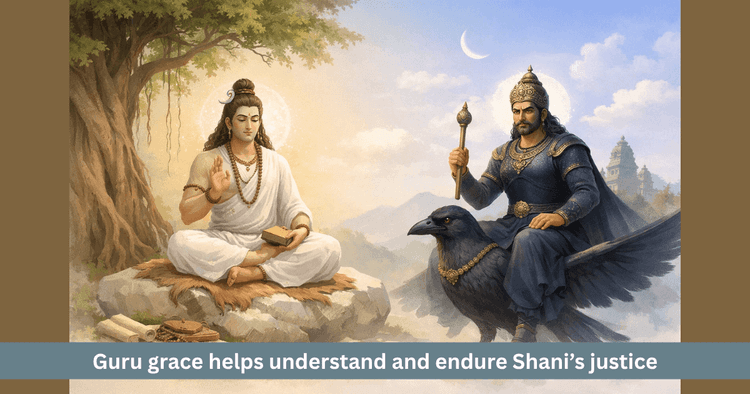
Table of Contents
In Indian spiritual tradition, every form of Lord Shiva carries a distinct metaphysical meaning. In one form he appears as the lord of dissolution, in another as the ocean of compassion, in another as the great ascetic and in yet another as Dakshinamurti, the primordial guru of the universe. The form of Dakshinamurti is especially associated with wisdom, silence, discernment, self knowledge and the grace of the guru. On the other hand, Shani is regarded as the lord of karma, justice, time, discipline, responsibility and the hard tests of life. At first glance, these may appear to belong to different streams of spiritual symbolism. Yet in the living temple traditions of South India, a very deep connection is seen between them. That is why in many places in Tamil Nadu and across South India, Dakshinamurti receives special worship on Saturday.
This tradition is not merely a popular custom. It expresses a profound spiritual understanding. The justice of Shani is considered stern but not unjust. He gives the fruits of karma, confronts human beings with their limitations, breaks ego and forces them to face reality. Yet not every seeker is able to endure this justice with steadiness. When the influence of Shani becomes heavy in life, a person may become exhausted, emotionally broken, inwardly confused or even hardened. In such a condition, Dakshinamurti appears as a compassionate refuge. The idea here is that the grace of the guru does not necessarily remove the results of karma but grants the strength to endure, understand and rise through them.
In local temple traditions, Saturday worship of Dakshinamurti is performed so that the seeker does not remain trapped only in fear of Shani but can go to the feet of the guru and understand the lesson hidden within the hardship. This is the deepest and most practical meaning of the episode.
Why are Dakshinamurti and Shani seen together
At first glance, the relationship between Dakshinamurti and Shani may not appear obvious. Yet when their principles are understood, the connection becomes deeply natural. Dakshinamurti is the guru of knowledge. He awakens self realization, sharpens discernment and teaches the distinction between the lasting and the transient. Shani too does something similar in his own way. He shakes the unstable supports of worldly life so that a human being may search for what is real. He disturbs outer comfort so that inner stability may awaken.
Their relationship may be understood in the following way
| Principle | Dakshinamurti | Shani |
|---|---|---|
| Essential role | Guru and giver of wisdom | Giver of karmic result and justice |
| Main work | Awakening insight | Breaking illusion |
| What they offer the seeker | Discernment and self knowledge | Discipline and confrontation with reality |
| Final purpose | Direction toward liberation | Purification of karma and maturity |
This table makes clear that their modes differ but their deeper purpose converges. One teaches through grace, the other through experience. One awakens inner light, the other exposes outer darkness. Together they open a more balanced spiritual path for the seeker.
Why is Saturday considered especially significant
Saturday is traditionally associated with Shani. On this day people often pray for relief from karmic burdens, stability amidst difficulty and a gentler experience of justice. Yet in many South Indian traditions, Saturday becomes not only a day to pacify Shani but also a day to understand Shani through the guru.
The significance of Saturday may be understood in several ways
- it encourages reflection on one’s karma
- it turns attention away from outer achievement toward inner condition
- it brings a mood of seriousness, slowness and honest observation
- it helps cultivate discipline, humility and patience
When Dakshinamurti is worshipped on Saturday, it is as though the energy of the day is given a higher direction. The day of Shani is placed at the feet of the guru with the prayer that justice may come but also understanding. Hardship may come but also patience. Karma may unfold but also insight.
Does the grace of the guru change the justice of Shani
A very subtle point must be understood here. The tradition does not say that worshipping Dakshinamurti magically removes all karmic consequence associated with Shani. To think so would reduce the spiritual depth of the practice. The deeper understanding is that the grace of the guru does not erase Shani’s justice but gives the strength to endure it and learn from it. This is the most mature insight in the tradition.
The grace of the guru may be seen to work in the following ways
- it awakens discernment within the seeker
- it makes the seeker more honest about one’s own karma
- it helps one see suffering not merely as punishment but as a process of purification
- it gives inner steadiness instead of mental collapse
Thus the grace of the guru is not a magical reversal of fate. It is the power that matures consciousness.
What does the stern justice of Shani actually teach
The name of Shani often evokes fear. People associate him with delay, obstacles, suffering, loss and struggle. This association is not entirely false but it is incomplete. The justice of Shani is not merely punitive. It also makes a person serious, responsible, patient, realistic and honest before oneself. What Shani seems to take away often includes those supports to which the person had become excessively attached.
The deep teachings carried within Shani’s justice include
- ego is not enduring
- outer success is not the final truth of life
- nothing is greater than time
- the fruit of karma inevitably comes
- no lasting attainment is possible without patience and effort
When these lessons come without the guidance of the guru, the seeker may see only pain. When they come with the grace of Dakshinamurti, the hidden meaning also becomes visible.
How does Saturday worship of Dakshinamurti create a different spiritual mood
Worship of Dakshinamurti on Saturday is not merely an additional ritual. It creates a special inner orientation. Worship related to Shani is often driven by fear or the hope of relief. But the worship of Dakshinamurti takes the seeker toward insight rather than fear alone. One begins to ask
- what is this difficult period trying to teach me
- where was I living in illusion
- which attachments made me inwardly weak
- can this time make me more truthful, simple and steady
In this way, Saturday worship of Dakshinamurti elevates Shani related devotion to a deeper spiritual level.
How do South Indian local temple traditions keep this connection alive
In many Shiva temples of Tamil Nadu and South India, Dakshinamurti is not treated as a secondary deity. He is worshipped as a living presence of the guru principle. In many places, devotees make a special effort to visit him on Saturdays, offer lamps, pray and seek the light of the guru amidst difficult periods associated with Shani.
Some common devotional moods seen in these traditions include
- special silent contemplation before Dakshinamurti on Saturday
- sitting beneath the banyan or peepal associated with the guru form and praying quietly
- asking for wisdom and patience during phases of karmic hardship
- seeking understanding of karma instead of only escape from it
In this way, devotion does not turn into blind fear. It becomes a means of transforming life’s difficulties into spiritual learning. This is the strength of living temple tradition.
What does this relationship between the guru and Shani reveal psychologically
If the entire episode is read psychologically, it becomes deeply meaningful. Life often brings phases where everything slows down. Progress halts, relationships are tested, confidence breaks and one feels limited. Such a period may resemble the influence of Shani. In that time, what the seeker needs is not merely remedy but inner guidance. The guru form of Dakshinamurti offers exactly that.
Psychologically, this tradition teaches that
- difficult times require discernment, not blind reaction
- what is needed is not self pity but self understanding
- one should not run away but learn to look deeply and patiently
- what feels like punishment may also be a process of becoming inwardly mature
For this reason, the worship of Dakshinamurti on Saturday can also be seen as a subtle means of inner healing.
What can a seeker learn from this tradition
This tradition offers lessons that are both deeply practical and spiritually elevated. It teaches that when difficulty arises, it is not enough only to ask for relief. One must also ask what the meaning of the difficulty is, what lesson it carries and how one may be transformed through it.
Main teachings of this tradition
- the justice of Shani may be purification more than punishment
- the grace of the guru can transform hardship into learning
- Saturday need not be only a day of fear but also a day of discernment
- taking refuge in Dakshinamurti can give steadiness, patience and insight
- greater than removing karma is learning to pass through it with awakened understanding
These teachings elevate the tradition from simple popular belief into a high spiritual discipline.
Is this tradition still relevant today
Yes and perhaps more than ever. Modern life is full of Shani like experiences. Delay, career pressure, financial uncertainty, mental exhaustion, broken relationships, heavy responsibility and instability are all common forms of Shani in contemporary life. In such a time, if a person does not have the guiding vision of Dakshinamurti, one may feel only stress and pain. But if this guru vision is embraced, the same difficult period can become a doorway to profound inner transformation.
The final radiance of this episode
The South Indian tradition of special Saturday worship of Dakshinamurti conveys a very mature and beautiful spiritual insight. The local temple traditions, especially in Tamil Nadu, teach that the stern justice of Shani should not be seen only as a source of fear. If the seeker connects with the grace of the guru, that same justice can make life more truthful, more humble, more patient and more awake.
Dakshinamurti here is not merely a deity. He is the guru who gives the seeker strength not to escape the time of Shani but to pass through it with maturity. This is the deepest secret of the tradition. Let justice come but let the light of the guru remain. Let karma unfold but let self understanding also awaken within it. This is the most beautiful meaning of the connection between Saturday and Dakshinamurti.
Frequently Asked Questions
Why is Dakshinamurti specially worshipped on Saturday
Because it is believed that the grace of the guru helps the seeker understand and endure the stern karmic results associated with Shani.
Does worship of Dakshinamurti completely remove the influence of Shani
According to traditional understanding, it does not magically erase karma but grants patience, insight and inner strength.
What is the relationship between Dakshinamurti and Shani
Dakshinamurti represents wisdom and the grace of the guru, while Shani represents karma, discipline and justice. Together they help mature the seeker.
Where is this tradition especially seen
It is especially alive in many local temple traditions of South India, particularly in Tamil Nadu.
What is the main lesson a seeker can take from this tradition
The seeker may learn that difficult periods are not only punishment but can also become deep spiritual teaching when approached through the grace of the guru.
Get your accurate Kundali
Generate KundaliDid you like it?
Author

Pt. Nilesh Sharma (63)
Experience: 20
Consults About: Family Planning, Career
Clients In: Punjab, Haryana, Delhi
Share this article with friends and family
About ZODIAQ
ZODIAQ is an online Vedic Astrology platform. It connects clients seeking astrological advice to experienced astrologers with deep knowledge. Our users also generate kundali and perform kundali milan for free. ZODIAQ also offers services to the Astrologers. Astrologers utilize various offerings by ZODIAQ to serve their clients effectively.
If you are a User
Consult with experienced astrologers and seek their guidance. You can also order handwritten Janm Patrika report with life prediction prepared by experienced astrologers. Generate accurate Kundali, perform Kundali Matching and check horoscope and muhurat. Utilize our online library for all the necessary astrological and spiritual information.
If you are an Astrologer
Create accurate kundali for your clients and perform Kundali Matching for up to 5 people at a time. Write comprehensive Janm Patrika report for your clients with ZODIAQ. Check client details anytime by saving it in client directory. Become more productive by tracking how many clients you guide every day.
WELCOME TO
ZODIAQ
Right Decisions at the right time with ZODIAQ
