The Secret of Silent Teaching: When Dakshinamurti Resolved Cosmic Doubts Without Words
By Pt. Amitabh Sharma
How Dakshinamurti’s silent teaching reveals the highest form of Advaita truth, Guru principle and inner illumination
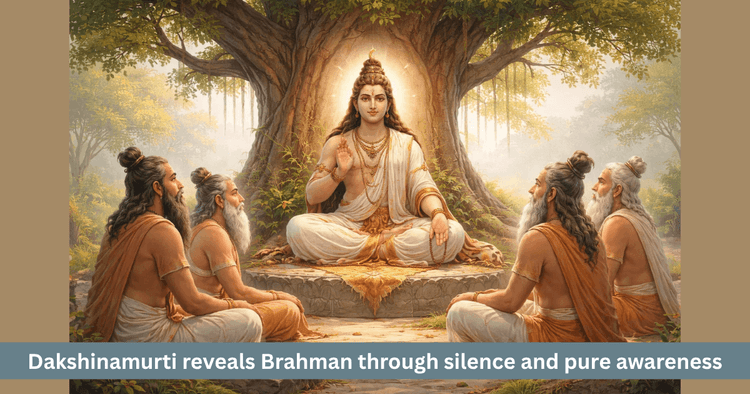
Table of Contents
In the Indian spiritual tradition, the guru is not regarded merely as one who gives information. The guru is understood as the medium through which inner darkness is removed by the light of truth. Ordinarily, we believe that learning comes through words, arguments, explanations and discussion. Yet one of the deepest teachings of Indian philosophy says that the highest truth is at times revealed not through speech but through silence. This is why Bhagavan Dakshinamurti is revered as the primal guru who taught without speaking, who resolved without debating and who removed the profound cosmic doubts of Brahma’s four mind born sons, Sanaka, Sanandana, Sanatana and Sanatkumara, simply through the power of silent presence.
This sacred vision is beautifully expressed in Shri Dakshinamurti Ashtakam, composed by Adi Shankaracharya. There the guru appears outwardly serene, still and silent but inwardly he is full of consciousness, illumination and non dual truth. This is not merely a story of sages sitting in assembly. It addresses one of the deepest human questions. What happens when words reach their limit, when logic begins to circle and when scripture itself seems only to point rather than fully reveal. Then silence begins to speak. And that silence becomes the highest teaching of Dakshinamurti.
Why Is Dakshinamurti Called the First Guru
Dakshinamurti is a sacred form of Shiva as the guru of wisdom. Here he is not primarily the destroyer, not merely the ascetic yogi but the embodiment of liberating knowledge. He is called the first guru because he represents that original awakening from which all inner knowledge flows. He is not a teacher of books alone. He is the direct presence of that truth toward which the Vedas, Upanishads and great mahavakyas all point.
The greatness of Dakshinamurti as guru may be understood in these ways:
- He is regarded as the lord of self knowledge
- He gives not outer information but inner awakening
- His teaching is based not upon speech but upon presence
- He reveals that truth is not merely learned but awakened
For this reason his guruhood stands far above ordinary intellectual instruction.
Why Were the Doubts of the Sanakadi Rishis So Deep
The four sons of Brahma, known collectively as the Sanakadi sages, were not ordinary seekers. They are revered as beings of innate renunciation, purity, austerity and deep spiritual inquiry. They had turned away from worldly attraction, yet even within them a final question remained. If they were so exalted, why did doubt still remain. The answer is that in spiritual life, outer learning and final realization are not the same.
Their questions were not ordinary questions. They were of the deepest order:
- What is the true relation between the individual self and Brahman
- If the world is experienced, what is its real nature
- Who is the knower, what is known and what is the ultimate truth
- How may that truth toward which the scriptures point be directly realized
These are not merely intellectual questions. They are existential questions. And existential questions cannot always be resolved by logic alone.
How Can Silence Be Called Teaching
This is the central wonder and illumination of the whole episode. In ordinary life, silence is often mistaken for absence. People think that where there are no words, there can be no teaching. But the episode of Dakshinamurti shows that in the realm of truth, words may themselves become limited. This is because words function within duality. They depend upon speaker and listener, subject and object. But Brahman is non dual. Therefore it is inherently difficult to express fully through language.
Silent teaching does not mean that nothing was communicated. It means that what needed to be revealed was transmitted not at the level of language but at the level of consciousness. The guru’s presence, his complete stillness, his established identity in truth and the contact of the disciple’s inner awareness with that presence, this itself is silent teaching.
The deeper dimensions of silent teaching
| Dimension | Meaning |
|---|---|
| Outer silence | Absence of spoken words |
| Inner communication | Contact of consciousness with consciousness |
| Presence of the guru | Direct embodiment of truth |
| Realization of the disciple | Dissolution of doubt from within |
This makes it clear that silence is not emptiness. It is a higher mode of communication.
Are Words Truly Limited
Indian philosophy repeatedly says that words may indicate truth but they do not become the final truth itself. They can show the direction but they do not replace arrival. In the Upanishads too there are many places where it is said that Brahman is that from which speech returns, unable to fully grasp it. In this light, Dakshinamurti’s silence becomes profoundly meaningful. He does not show that words are useless. He reveals that they have a boundary and beyond that begins the field of direct realization.
Adi Shankaracharya presents this beautifully. The guru is silent, the disciples are present, the questions remain within them and yet the answer arises from within as well. This shows that the highest teaching is not always that which enters through the ear but that which reveals itself in the innermost awareness.
Why Is the Silence of Dakshinamurti Not Frightening but Peace Giving
Many people feel uneasy in silence because they are accustomed to inner noise. But the silence of Dakshinamurti is not of that kind. It is a compassionate silence, a reassuring silence, a silence in which the disciple does not become lost but instead discovers oneself. It is not empty. It is full. The answer is already present within it. There is no anxiety in it, only stillness.
Some qualities of Dakshinamurti’s silence may be understood as follows:
- It is free from the noise of ego
- It contains the peace of complete knowledge
- It does not violently cut down doubt but gently dissolves it
- It does not merely provide answers but reveals the source of all answer
That is why his silence itself becomes teaching.
Is This Only a Spiritual Symbol or Also a Path of Practice
It is not only a story. It is also a very deep path of practice. Dakshinamurti’s silence does not teach that one should always remain externally quiet. It teaches that without inner stillness, outer knowledge may remain incomplete. If the mind is full of noise, the hint of truth may be missed. Therefore silence is not merely the stopping of speech. Silence means the quieting of unnecessary inner movement.
This teaching may be brought into spiritual practice in several ways:
- Giving some time daily to inner silence
- Sitting quietly with a question rather than rushing toward verbal answers
- Letting scriptural reflection sink inward instead of turning at once into argument
- Learning to remain a silent witness before guru, deity or one’s own inner awareness
This kind of silence prepares the ground for real knowledge.
How Were the Doubts of the Sanakadi Rishis Resolved
This is a deep question because tradition does not describe a long discourse by Dakshinamurti. How then were the doubts resolved. The answer lies in the nature of spiritual realization. Doubt does not arise only from lack of information. Often it arises from inward division. The moment that division dissolves, doubt also dissolves. In the presence of the guru, when the disciple comes closer to one’s own true nature, the root of the question itself is transformed.
The resolution of their doubts may therefore be understood in this way:
- They did not merely hear an answer, they saw it within themselves
- They received not theory but directness of realization
- They found that the guru outwardly present was linked with the very consciousness within
- Their doubts were not defeated by argument but melted by insight
How Deep Is the Relation Between Dakshinamurti and Advaita
The Dakshinamurti Ashtakam of Adi Shankaracharya is regarded as one of the most beautiful devotional expressions of Advaita Vedanta. Here Advaita does not remain a dry doctrine. It becomes alive in the form of the guru. Dakshinamurti symbolizes that truth in which the ultimate difference between knower, knowing and known disappears. His silence itself becomes the practical form of non dual realization.
In relation to Advaita, the teaching of Dakshinamurti shows the following:
| Advaitic principle | Expression in Dakshinamurti |
|---|---|
| Brahman is one | The guru abides in that one truth |
| The world is experienced | Doubt arises in relation to this experience |
| The self is Brahman | The disciple is brought to recognition of the true self |
| Words are limited | Silence becomes the nearest expression of the highest truth |
Thus, to understand Dakshinamurti is to understand something very essential in Advaita itself.
Does Silence Mean Inaction
No and this is one of the greatest misunderstandings. Silence is not inaction. Many who speak constantly are inwardly restless, while one who appears outwardly quiet may be deeply awake. The silence of Dakshinamurti is not inactive. It is the silence of living consciousness. It contains light, compassion, direction and knowledge. It does not oppose action. It connects action to its deepest source.
In an age where everyone is eager to speak, react, write and establish presence, Dakshinamurti teaches that the deepest truth does not always arrive with the greatest noise.
What Does This Episode Teach Modern Life
Today the human mind is full of information but not always full of clarity. There is much communication, yet little inward listening. There is an abundance of speech, yet a lack of real assimilation. In such a time, the silence of Dakshinamurti offers a profound lesson. It teaches that not every problem is solved through more words. Sometimes the right answer emerges through stillness, presence and inward descent.
For the modern world, this episode gives several powerful teachings:
- Not every question demands an immediate verbal answer
- Without inner peace, outer information remains incomplete
- A true guru does not only speak but may also transform through presence
- Real knowledge is that which turns doubt into inner peace
The Final Illumination
The episode of silent teaching described in Shri Dakshinamurti Ashtakam, composed by Adi Shankaracharya, is one of the greatest teachings in the Indian guru tradition. Even sages as exalted as the four mind born sons of Brahma came to a point where the highest truth could not be grasped by discussion alone. Dakshinamurti then showed that the final touch of truth comes not through speech but through being. His silence is not empty. It is full of answer. It is a silence in which questions do not merely disappear but are transformed. The disciple then realizes that what was being sought outside was always shining within.
For this reason, it may be said that the silence of Dakshinamurti is one of the first and deepest spiritual dialogues of all time. No statement was spoken, yet everything became clear. No debate took place, yet doubt was removed. This is the most beautiful and profound truth of the whole episode.
Frequently Asked Questions
Why is Dakshinamurti called the first guru
Because he is regarded as the primordial guru of self knowledge, who reveals truth beyond words.
Who were the Sanakadi Rishis
They are regarded as the four mind born sons of Brahma and symbols of high wisdom and renunciation.
What does silent teaching mean
Silent teaching means the transmission of truth at the level of consciousness without spoken explanation.
Where is this episode expressed
This sacred vision is beautifully expressed in Shri Dakshinamurti Ashtakam composed by Adi Shankaracharya.
What does this story teach us
It teaches that to know the highest truth, words alone are not enough. Inner stillness and awakened presence are also necessary.
Get your accurate Kundali
Generate KundaliDid you like it?
Author
Pt. Amitabh Sharma (56 Years)
Experience: 20
Consults About: Family Planning, Career
Clients In: Punjab, Haryana, Delhi
Share this article with friends and family
About ZODIAQ
ZODIAQ is an online Vedic Astrology platform. It connects clients seeking astrological advice to experienced astrologers with deep knowledge. Our users also generate kundali and perform kundali milan for free. ZODIAQ also offers services to the Astrologers. Astrologers utilize various offerings by ZODIAQ to serve their clients effectively.
If you are a User
Consult with experienced astrologers and seek their guidance. You can also order handwritten Janm Patrika report with life prediction prepared by experienced astrologers. Generate accurate Kundali, perform Kundali Matching and check horoscope and muhurat. Utilize our online library for all the necessary astrological and spiritual information.
If you are an Astrologer
Create accurate kundali for your clients and perform Kundali Matching for up to 5 people at a time. Write comprehensive Janm Patrika report for your clients with ZODIAQ. Check client details anytime by saving it in client directory. Become more productive by tracking how many clients you guide every day.
WELCOME TO
ZODIAQ
Right Decisions at the right time with ZODIAQ
