Why the South Direction: The Deep Spiritual Secret of Dakshinamurti Facing South
By Pt. Narendra Sharma
How Dakshinamurti facing south reveals profound philosophical truths about death, time and liberation
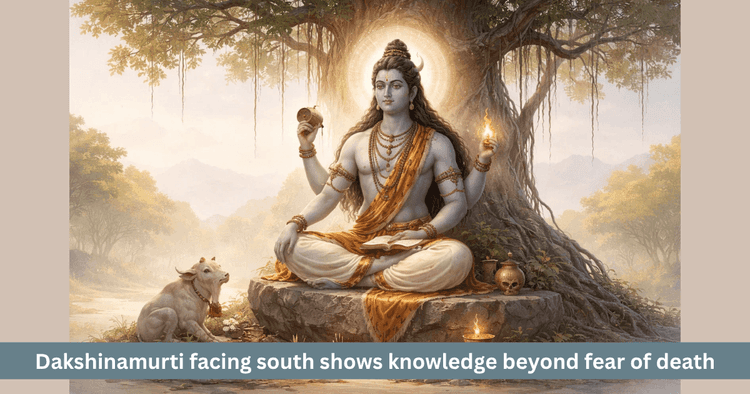
Table of Contents
In the spiritual traditions of India, Lord Shiva appears in many forms and each form carries a distinct philosophical meaning. Among these forms, one of the most profound, silent and luminous is Dakshinamurti. This form does not merely present Shiva in beauty or majesty. It reveals him as the primordial guru, the teacher of truth through silence, the giver of essential wisdom and the guide who can take the seeker beyond death and the cycle of time. When one looks carefully at the form of Dakshinamurti, a natural question arises. Why does his face turn specifically toward the south. Is this only a matter of sacred iconography or is there a deeper scriptural and spiritual meaning hidden within it.
The tradition associated with the Suta Samhita, connected with the Skanda Purana, gives a very deep insight into this mystery. In the Indian understanding of direction, the south is not regarded as an ordinary orientation. It is associated with Yama, the lord of death. For this reason, the south also becomes linked with time, the limits of embodied life, the law of karmic result and the awareness of mortality. In that context, Dakshinamurti facing south signifies that he is not merely a guru who imparts knowledge but one who leads the seeker beyond the fear of death, the darkness of ignorance and the binding force of time.
Here the south is no longer just a geographical direction. It becomes a symbol of the truth that human beings fear most. Dakshinamurti, as the guru principle, turns toward that very direction and shows that the place where the world sees fear may also become the doorway to liberation. This is the deepest secret of the episode.
Who is Dakshinamurti and why is his form as guru so unique
The form of Dakshinamurti is especially associated in Indian philosophy with knowledge, silence, non dual realization and self awareness. In this form Shiva does not appear merely as a deity granting boons. He appears as a guru, still, grave and inwardly radiant. He teaches the disciples not so much through speech as through presence. This is extraordinary, because it shows that the highest truth is often revealed not through argument but through silent awakening.
Some key qualities of Dakshinamurti as guru may be understood in this way
- He is regarded as the primordial guru
- He represents silent instruction
- He is centered not in outer learning but in self knowledge
- He leads the seeker not only in religion but toward liberation
- He is the guru who makes one face time, death and fear
For this reason, his southward orientation does not appear accidental. It reveals the depth of his guru form.
Why is the south regarded as the direction of Yama
In Indian tradition, directions are often seen as carrying subtle meaning. The east is linked with the rising sun and beginnings. The north is associated with wisdom, tapas and the divine path. The west can suggest inwardness and decline into contemplation. The south is especially associated with Yama, death, time, karma and the limits of embodied existence. This does not mean that the south is inherently inauspicious. Rather, it reminds one of the truth that human beings most often try to avoid.
The symbolic meanings associated with the south may be understood as follows
| Direction | Symbolic association | Deeper meaning |
|---|---|---|
| South | Yama | Reminder of mortality |
| South | Kala | The inevitability of time |
| South | Karmic result | The direction of existential accountability |
| South | Guru facing it | The path beyond fear |
This table makes it clear that the south is not merely the direction of ending. It is the direction in which one must confront the deepest truth of finite existence.
What does Dakshinamurti facing south truly signify
This is the heart of the entire episode. If the south is the direction of Yama and death, then Dakshinamurti seated facing that very direction shows that he does not turn away from the ultimate human fear. He looks directly toward it. This image itself becomes a teaching. Where the ordinary person trembles at the thought of death, the guru sits utterly still facing it. This means that liberation does not arise by escaping truth but by facing it.
Dakshinamurti teaches that
- Death cannot be avoided but freedom from its fear is possible
- Time cannot be stopped but one may awaken to that which is beyond it
- The body is mortal but the essence of the Self is not bound by mortality
- The guru is the one who helps the seeker realize this distinction directly
Thus Dakshinamurti facing south reveals that the guru is not merely one who comforts. He is the one who can make the disciple stand still before the hardest truth.
What does victory over time truly mean
When it is said that Dakshinamurti grants victory over time, this does not mean he makes someone physically immortal. The deeper meaning is victory over the fear born of time bound consciousness. Much of human suffering is tied to time. One regrets the past, fears the future and loses the present. In the same way, the fear of death arises from the mind’s identification with what is temporal.
The knowledge of Dakshinamurti leads the seeker to understand that
- what is born is perishable
- what changes cannot be the final reality
- what witnesses all change stands nearer to truth
- when the Self is realized, the grip of time begins to weaken
Thus victory over time does not mean destroying time. It means becoming established in a consciousness where time is no longer the final master.
Is the south only a sign of death
No. This is where the subtlety of the teaching appears. Indian philosophy does not regard death merely as an ending. It may also indicate transition, dissolution of limitation and entry into another state of consciousness. The south is indeed linked with Yama but Yama is not merely a deity of punishment. He is also the lord of order, consequence and boundary. therefore the south teaches that life is not endless in form and should thus be lived with awareness.
Our fear of the south is often not only the fear of death but the fear of instability, ignorance and inner insecurity. Dakshinamurti sits facing that direction to reveal that with the guidance of the guru, the same direction can turn from fear into awakening.
How does Suta Samhita give meaning to this episode
In the tradition connected with the Suta Samhita, Dakshinamurti facing south is not treated as incidental. It carries the deep sense that he is the guru who lifts the seeker beyond the bondage of death and time. This is a very profound statement. It means his wisdom is not meant merely for scriptural learning but for existential transformation.
If stated simply, the teaching suggests that
- the mind that fears death remains in ignorance
- the mind that knows the Self can become steady
- the guru’s function is not only to provide information but to dissolve fear
- only one established beyond time can face the south with utter peace
This is why the form of Dakshinamurti is considered so unique in Indian spirituality.
The connection between silent teaching and the south
Another extraordinary aspect of Dakshinamurti is his silence. He teaches not through verbal discourse but through silent presence. If this silence is placed in relation to the south, its meaning becomes even deeper. Before death, words often become small. Before time, argument reaches its limits. The guru’s silence indicates that ultimate truth is realized not through verbal conclusion but through direct inner experience.
Where the south symbolizes mortality, Dakshinamurti’s silence suggests that
- the final answer to fear does not lie in mental noise
- realization of the Self is born in inner stillness
- victory over death is not gained through debate but through direct awakening
Thus the south and silent instruction together create an extraordinarily deep expression of the guru principle.
What does this mean in the life of a seeker
Dakshinamurti facing south is not merely a matter of iconography or scriptural symbolism. It can apply directly to the inner life of every seeker. Every human being carries some fear. For one it is death, for another failure, for another the passing of time and for another loneliness or uncertainty. In one way or another, these are all forms of the south within.
In such a situation, Dakshinamurti teaches the seeker
- do not turn away from the direction of your fear
- learn to look at it through the eyes of the guru
- understand the truth hidden within it
- stand in self awareness and cross beyond it
This is why the teaching remains alive even today. It belongs not only to scripture but also to the modern spiritual journey.
Dakshinamurti and inner spiritual practice
If this entire tradition is understood not only as outer worship but also as inward practice, then the south may symbolize that region within us where our deepest fears, karmic impressions and hidden limitations reside. Dakshinamurti is the guru seated facing that inward south. He seems to say that liberation comes not merely by looking upward but by looking inward with truth.
In this light, the practice of Dakshinamurti teaches three inner stages
| Stage of practice | Inner meaning |
|---|---|
| Recognition of fear | Seeing the inner south clearly |
| Steadiness in the guru | Becoming a witness instead of running away |
| Self realization | Rising above the fear of time and death |
This table shows that Dakshinamurti is not only a deity to be worshipped but also a guide to deep inner transformation.
Why is this interpretation relevant in the modern age
Modern people are surrounded by speed, technology and outward activity, yet remain as uneasy before the question of death as ever. The pressure of time, uncertainty of life and anxiety about the future still haunt the human mind. In such a world, Dakshinamurti facing south becomes deeply relevant. He teaches that peace does not come by escaping the final questions of life but by understanding them.
This interpretation offers several important lessons to the modern seeker
- one must learn to pause in order to rise above the tyranny of time
- remembrance of mortality can deepen the meaning of life
- a guru is not merely an inspirer but one who changes the direction of existence
- fear comes to an end when knowledge of the Self begins
The final light of this episode
Dakshinamurti facing south is one of the most profound symbols in Indian spirituality. The tradition of the Suta Samhita and the Skanda Purana does not see it merely as a directional detail but as one of the highest expressions of the guru principle. The south, associated with Yama, mortality and time, is the very direction toward which Dakshinamurti sits in stillness. This declares that the true guru is the one who can take the disciple beyond the deepest fear.
This episode teaches that the guru’s role is not merely to make life pleasant but also to make one face the final truths of existence. That is why Dakshinamurti is unique. He transforms the direction of fear into the direction of liberation. He sits facing death and teaches the knowledge of immortality. This is the deepest, most beautiful and most enduring meaning of the episode.
Frequently Asked Questions
Who is Dakshinamurti
Dakshinamurti is the guru form of Lord Shiva, regarded as the primordial teacher and the revealer of wisdom through silence.
Why is the south called the direction of Yama
In Indian tradition the south is associated with death, karmic result and the force of time and is therefore linked with Yama.
What does Dakshinamurti facing south signify
It signifies that he is the guru who grants the knowledge by which the seeker can rise above the fear of death and time.
What does victory over time mean
It does not mean bodily immortality. It means freedom from the fear created by time and mortality through knowledge of the Self.
What is regarded as the main source of this interpretation
The principal source associated with this explanation is the Suta Samhita, connected with the tradition of the Skanda Purana.
Get your accurate Kundali
Generate KundaliDid you like it?
Author

Pt. Narendra Sharma (63)
Experience: 20
Consults About: Family Planning, Career
Clients In: Punjab, Haryana, Delhi
Share this article with friends and family
About ZODIAQ
ZODIAQ is an online Vedic Astrology platform. It connects clients seeking astrological advice to experienced astrologers with deep knowledge. Our users also generate kundali and perform kundali milan for free. ZODIAQ also offers services to the Astrologers. Astrologers utilize various offerings by ZODIAQ to serve their clients effectively.
If you are a User
Consult with experienced astrologers and seek their guidance. You can also order handwritten Janm Patrika report with life prediction prepared by experienced astrologers. Generate accurate Kundali, perform Kundali Matching and check horoscope and muhurat. Utilize our online library for all the necessary astrological and spiritual information.
If you are an Astrologer
Create accurate kundali for your clients and perform Kundali Matching for up to 5 people at a time. Write comprehensive Janm Patrika report for your clients with ZODIAQ. Check client details anytime by saving it in client directory. Become more productive by tracking how many clients you guide every day.
WELCOME TO
ZODIAQ
Right Decisions at the right time with ZODIAQ
