Dakshinamurti Stotram: From Guru Dosha to Inner Purification
By Pt. Narendra Sharma
Understanding the transformative power of Dakshinamurti Stotram
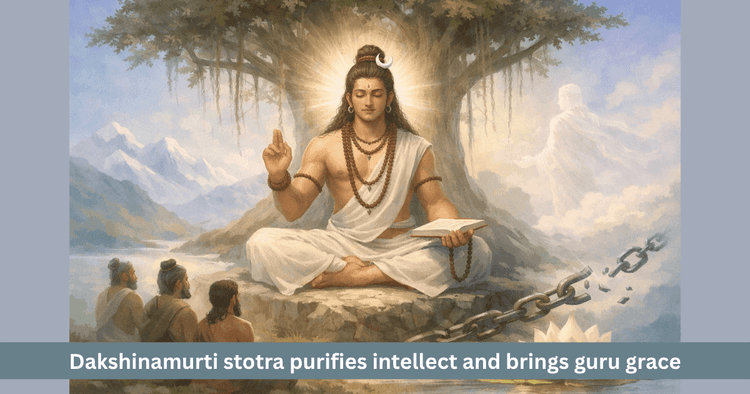
Table of Contents
In the Indian guru tradition, certain hymns are regarded not merely as praises offered to the Divine but as living instruments of inner transformation. Dakshinamurti Stotram is counted among those rare and profound compositions. It is not just a sequence of sacred words. It is a subtle means of invoking the guru principle, self knowledge, silent wisdom and purification of the inner being. Tradition holds that when Adi Shankaracharya composed this stotram, he was not merely glorifying Bhagavan Dakshinamurti. He was giving form to that divine guru force which can lift the individual out of ignorance, confusion and deep karmic patterns carried across time.
Among the works attributed to Adi Shankaracharya, Dakshinamurti Stotram occupies a highly distinctive place because here the guru is not praised merely as an external teacher but as the very embodiment of Brahman in silent awareness. This is why its recitation is not regarded as a simple religious act. It is seen as a means of clearing inner confusion, refining thought and restoring alignment with right guidance. In many traditions there is also the belief that regular recitation of this stotram helps remove the effects of guru dosha carried even from previous births. This belief should not be read only as a ritual claim. It also contains a very deep spiritual meaning.
Why Is Dakshinamurti Stotram Considered So Special
Dakshinamurti Stotram is not regarded merely as a devotional hymn meant to please a deity. It places before the seeker the subtle relationship between guru, disciple, knowledge, maya, self, world and Brahman. It does not lead the seeker only into devotion. It also leads toward reflection, inward inquiry and self recognition. Therefore one who recites it is not merely repeating words. One gradually begins to confront the knots hidden within one’s own consciousness.
Some of the main reasons this stotram is considered special are:
- It connects the guru principle with the truth of Brahman
- It transforms self knowledge from a concept into something inwardly lived
- Its recitation is believed to steady the mind and turn it inward
- It takes the seeker from outer learning toward inner awakening
For this reason, Dakshinamurti Stotram is seen not only as praise but as a spiritual discipline in poetic form.
Does Guru Dosha Mean Only an Astrological Defect
A very important distinction must be understood here. Many people look at guru dosha only through the lens of astrology but tradition allows a broader meaning as well. At the astrological level, guru dosha may be associated with obstacles in wisdom, guidance, right judgment, scriptural understanding, blessings of the teacher or the ability to move in the right direction. But at the spiritual level, guru dosha may also signify a condition in which the individual becomes cut off from proper guidance, fails to honor true knowledge, turns wisdom into ego or repeatedly loses direction even after receiving guidance.
When traditions say that guru dosha from previous births may be reduced, the deeper meaning may be that those subtle tendencies carried within consciousness, because of which one repeatedly misses right guidance, slowly begin to dissolve. Thus guru dosha may be understood not only as a planetary issue but also as a defect of direction, defect of understanding and separation from guiding wisdom.
How Should the Relationship Between Dakshinamurti Stotram and Guru Dosha Be Understood
Dakshinamurti Stotram is connected with the removal of guru dosha because Dakshinamurti himself is revered as the Adi Guru, the primordial teacher. He is not merely a guru who instructs through words. He is the guru of that fundamental consciousness which can teach even through silence. therefore when life is marked by confusion, impure judgment, difficulty in learning, disconnection from teacherly grace, disrespect toward knowledge, spiritual instability or repeated loss of inner direction, the remembrance of Dakshinamurti is understood to work at the subtle level from which real guru grace flows.
This relationship may be understood in the following way:
| Element | Influence of Dakshinamurti Stotram |
|---|---|
| Disconnection from the guru principle | Awakens inner reverence and receptivity |
| Intellectual confusion | Brings clarity into thought |
| Spiritual crisis of direction | Opens inward guidance |
| Obstacles in study | Helps make the mind stable and receptive |
| Deep rooted ignorance | Purifies consciousness gradually |
In this way, the removal of guru dosha may be understood not only as outer relief but as an inner restoration of sacred alignment.
How Can Recitation Affect Patterns From Previous Births
Indian philosophy holds that a human being is not shaped only by the events of one lifetime. Deep tendencies, attractions, fears, reactions and impressions remain layered within consciousness. These shape present life in subtle ways. When a stotram is not merely poetic language but a sacred composition born of higher realization, it is believed to reach these deeper layers.
Dakshinamurti Stotram is regarded as such a text because:
- It arises from the current of silent wisdom
- It invokes the grace of the guru principle
- It clarifies the relation between maya and the Self
- It turns the seeker from the outer to the inner
For this reason, it is believed that its recitation can work not only upon present thoughts but also upon long standing impressions carried through time.
Is Its Effect Only a Religious Belief or Also Psychological
This is a profound question and the answer may be understood on both levels. Religiously, Dakshinamurti Stotram is regarded as a means of receiving guru grace and reducing subtle doshas. Psychologically, its regular recitation gives the mind a certain rhythm. That rhythm can reduce mental agitation, awaken reverence, strengthen contemplation and make the mind more receptive to genuine guidance.
When a person repeatedly recites a stotram connected with wisdom, silence and self knowledge, certain shifts may gradually occur within:
- Ego may soften
- Receptivity may grow
- Mental disorderliness may lessen
- The mind may begin to dwell on meaning rather than surface sound
- Inner discipline may develop
Therefore its power may be understood in both religious and psychological terms.
Why Does Its Importance Increase Because It Was Composed by Adi Shankaracharya
Adi Shankaracharya was not only a philosopher. He was an experiential teacher, a spiritual reformer, a master of stotram literature and one of the great unifying acharyas of India. In his compositions, there is not only poetic skill but also the force of realization. When he composes Dakshinamurti Stotram, it does not remain mere literature. It becomes a concise transmission of living guru experience.
Its importance deepens for several reasons:
- It carries the depth of Vedanta
- It holds the tenderness of devotion
- It is rooted in the authority of the guru tradition
- It transmits the subtle energy of silent wisdom
For this reason, the tradition does not treat it as an ordinary hymn but as a powerful means of inner transformation.
What May Regular Recitation Give to a Seeker
Regular recitation does not mean simply repeating words each day. It means placing oneself again and again before that guru force which can bring clarity, direction and refinement into life. Gradually, the stotram begins to work within. A new meaning may open each time. An old confusion may weaken. The mind may become quieter and more inwardly ordered.
Some inward benefits associated with regular recitation
- Purification of intellect
- Order in thought
- Reverence for the guru principle
- Humility toward knowledge
- Maturity in decision making
- Inner steadiness
These should not be treated as magical results but as the gradual ripening of disciplined spiritual contact.
Is It Also Connected With Study, Memory and Decision Making
Yes, very deeply. One expression of guru dosha may be that a person has knowledge but cannot use it properly, studies much but understands little, knows much but decides poorly or keeps losing direction. Dakshinamurti Stotram is considered especially meaningful for such conditions because it does not only quiet the mind. It gives the intellect gravity. This gravity means seriousness, stability and the ability to perceive what is essential.
Thus this stotram is seen as beneficial not only for spiritual seekers but also for students, scriptural learners, teachers, researchers and those who must make significant decisions. Here the reduction of guru dosha can also be understood as the restoration of right intellectual direction.
Is Recitation Alone Enough or Is Inner Feeling Also Necessary
The full effect of any stotram unfolds when sound is joined with feeling. If recitation becomes mechanical, its transformative potential may remain limited. Dakshinamurti Stotram especially invites reverence, silence, humility and inwardness. To quiet the mind a little before recitation, to hold respect for the guru principle and to acknowledge one’s own confusion can make the seeker much more receptive.
Helpful attitudes for recitation may include:
- I am ready to learn
- I do not wish to cling to my confusion
- I seek not only sound but meaning
- I wish to create inner space for guru grace
What Is the Importance of This Stotram in Modern Life
Modern life is full of information but not always of direction. People hear much, yet understand little. They read much, yet assimilate less. There is much talk of teachers but little recognition of the true guru principle. In such a time, Dakshinamurti Stotram becomes deeply relevant. It brings one back to the guru who teaches not through outer display but through silent wisdom. It compels one to ask whether the intellect is truly pure, whether right guidance can still be recognized and whether one remains humble before knowledge.
Some of the major directions this stotram offers to modern life are:
| Modern problem | Guidance from Dakshinamurti Stotram |
|---|---|
| Intellectual confusion | Clarity in reflection |
| Misleading guidance | Recognition of true guru principle |
| Instability in study | Steadiness of intellect |
| Faulty decision making | Awakening of discernment |
| Spiritual shallowness | Return to depth and silence |
What Is the Deepest Spiritual Message of This Stotram
The deepest message of Dakshinamurti Stotram is that the true guru does not come to give something entirely new from outside. The guru removes ignorance and reveals the truth already shining within. Guru dosha is also a kind of forgetfulness in which one becomes cut off from right direction, pure understanding and luminous guidance. Dakshinamurti Stotram becomes a means of restoring that inner connection.
It seems to say:
- Knowledge is not outside alone. It waits to awaken within
- Guru grace descends where receptivity is present
- Dosha is not merely punishment but also disconnection from right direction
- Recitation is not only sound but a means of purifying consciousness
Final Reflection
The Dakshinamurti Stotram, attributed to Adi Shankaracharya, is one of those rare compositions in Indian spiritual literature where the streams of guru principle, wisdom, silence and self realization meet together. The traditional belief that its recitation can reduce guru dosha from previous births should not be understood only in terms of karmic relief. It may also be understood as the restoration of a broken inner connection with the principle of true guidance. This stotram gradually brings the seeker into a condition where knowledge is no longer treated as information alone but as living direction.
therefore it may be said that Dakshinamurti Stotram is not merely a recited hymn. It is a serious means of reconnecting life with the center of true guidance. One who recites it with reverence, patience and inwardness receives not only the hope of dosha reduction but also a new illumination of intellect, humility and discernment. That is the deepest and most beautiful truth of this sacred stotram.
Frequently Asked Questions
Who composed Dakshinamurti Stotram
Tradition attributes this stotram to Adi Shankaracharya.
What does guru dosha mean
It may indicate not only an astrological condition but also disconnection from knowledge, guidance and the grace of the true guru principle.
Can this stotram help reduce impressions from previous births
Traditional belief says yes and the deeper meaning may be linked to purification of long standing confusion and loss of direction.
Is this stream useful for students and learners too
Yes, it is regarded as beneficial for purification of intellect, steadiness, memory and right understanding.
What is the main message of this stotram
It teaches that through guru grace, ignorance may be removed and the seeker may regain clarity, discernment and inner direction.
Get your accurate Kundali
Generate KundaliDid you like it?
Author

Pt. Narendra Sharma (63)
Experience: 20
Consults About: Family Planning, Career
Clients In: Punjab, Haryana, Delhi
Share this article with friends and family
About ZODIAQ
ZODIAQ is an online Vedic Astrology platform. It connects clients seeking astrological advice to experienced astrologers with deep knowledge. Our users also generate kundali and perform kundali milan for free. ZODIAQ also offers services to the Astrologers. Astrologers utilize various offerings by ZODIAQ to serve their clients effectively.
If you are a User
Consult with experienced astrologers and seek their guidance. You can also order handwritten Janm Patrika report with life prediction prepared by experienced astrologers. Generate accurate Kundali, perform Kundali Matching and check horoscope and muhurat. Utilize our online library for all the necessary astrological and spiritual information.
If you are an Astrologer
Create accurate kundali for your clients and perform Kundali Matching for up to 5 people at a time. Write comprehensive Janm Patrika report for your clients with ZODIAQ. Check client details anytime by saving it in client directory. Become more productive by tracking how many clients you guide every day.
WELCOME TO
ZODIAQ
Right Decisions at the right time with ZODIAQ
