Third Eye of Dakshinamurti: Divine Vision Beyond Appearance
By Pt. Abhishek Sharma
Understanding insight, wisdom, and awakened perception in Shiva’s form
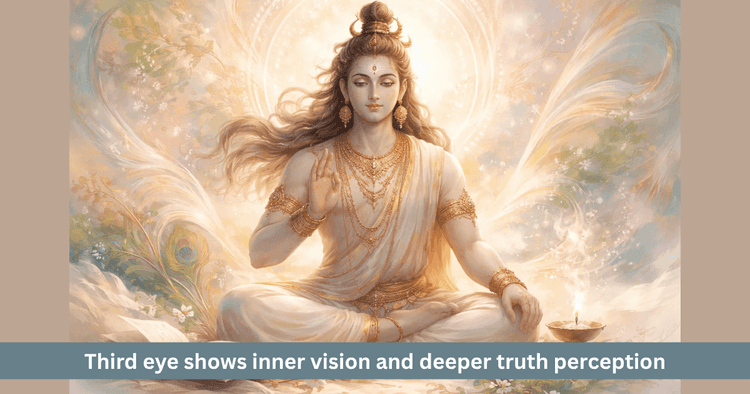
Table of Contents
In Indian spiritual tradition, every aspect of the form of Lord Shiva as Dakshinamurti carries deep symbolic meaning. Nothing in this form is merely decorative. Every gesture, every posture and every mark on the divine body reveals a subtle philosophical truth. Dakshinamurti is usually understood as the supreme guru of silence, wisdom and inner realization. Yet when attention turns toward his third eye, it becomes clear that this form is not only that of a teacher of knowledge but of the primordial guru who awakens inner insight. A profound traditional understanding holds that the third eye of Dakshinamurti is always open. This does not simply mean that he possesses supernatural power to see everything. It points instead to the deeper truth that he sees beyond the limits where ordinary human perception comes to an end.
The ordinary eyes see the world in terms of form, color, movement and outward behavior. They perceive objects but not always the hidden causes, karmic flow, subtle truths or the inner structure of consciousness behind them. The third eye of Dakshinamurti, however symbolizes insight. It points to a mode of seeing that perceives the subtle meaning hidden behind visible forms. It does not merely see the outer world. It discerns the consciousness, illusion, ignorance and truth working behind it. For this reason, the ever open third eye of Dakshinamurti becomes not only a sign of divine force but a symbol of awakened vision.
The tradition of Tirumantiram, associated with the wisdom of Tirumular, offers a deeply spiritual way to understand this symbol. Here the third eye is not only an ornament of Shiva but the inner awakening that takes the seeker beyond the vision of the flesh. This vision does not reject the world. It teaches the seeker how to see the world rightly. That is the deepest and most lasting meaning of this episode.
Why has the third eye always inspired such deep curiosity
The third eye of Lord Shiva has inspired wonder, reverence and intense curiosity for centuries. It is often connected in popular imagination with power, transformation and even destruction, because many sacred narratives describe the opening of Shiva’s third eye in such contexts. Yet in the form of Dakshinamurti, the same third eye receives a different emphasis. Here it is not primarily the sign of fiery wrath but of quiet insight.
The third eye becomes especially significant in Dakshinamurti for several reasons
- it points beyond surface perception toward inner seeing
- it reveals the guru’s ability to know the truth hidden within the disciple
- it symbolizes the discernment that sees the difference between illusion and the Self
- it teaches that final wisdom comes not only through study but through a transformed way of seeing
For this reason, the third eye of Dakshinamurti is not merely a Shaiva symbol. It is one of the highest emblems of inner realization in Indian spirituality.
What is the difference between ordinary sight and inner insight
This is where the central meaning of the episode becomes clearer. The ordinary physical eyes see the external world. They perceive appearance, shape, movement, behavior and event. Yet they often fail to reach the underlying truth of what they behold. Human life becomes confused, attached, fearful and misguided precisely because of this limitation. One sees a face but not the inner state behind it. One sees an event but not the karmic movement behind it. One sees attraction but not the instability concealed within it.
Inner insight breaks this limitation. It does not see merely through the eyes. It sees through consciousness. This may be understood more clearly in the following way
| Level of seeing | What it sees | What remains limited |
|---|---|---|
| Physical eyes | Form, shape, outer event | Only a partial truth |
| Intellect | Logic, cause, analysis | Still incomplete without realization |
| Inner insight | Subtle cause, consciousness, essence | It must be awakened through practice |
This table shows that inner insight is not imagination. It is a higher mode of perception. The third eye of Dakshinamurti is the divine symbol of that awakened mode.
What does it mean that Dakshinamurti’s third eye is always open
This statement is extremely profound. It does not mean that Dakshinamurti is always in some explosive or outwardly intense state of force. Here “always open” means that his consciousness is never covered by ignorance. He is forever awake, witnessing and seeing inwardly. Where an ordinary human being alternates between clarity and confusion, awareness and attachment, Dakshinamurti’s insight remains perpetually awakened.
This suggests three important meanings
- the guru’s vision never stops at outer events
- he sees the inner obstruction of the disciple even before the question is fully spoken
- for him truth is not something to be discovered later but an ever present reality
That is why the third eye of Dakshinamurti is regarded as a sign of the highest maturity of the guru principle.
Is the third eye only a symbol of power
No. If it is reduced merely to power, miracle or supernatural force, then only half its meaning is understood. In the case of Dakshinamurti, the primary meaning of the third eye is insight. Power may be a consequence but the essence is luminous understanding. It is the wisdom that sees directly through illusion.
In this context, the third eye may be read at several levels
- discernment that separates the lasting from the temporary
- witness consciousness that remains beyond passing events
- inner vision that recognizes subtle truth
- spiritual awakening that knows the Self beyond body and mind
Thus the symbol belongs not only to divine might but to the maturity of knowledge.
How does the perspective of Tirumantiram deepen this episode
The tradition of Tirumantiram presents the Shiva principle not merely through mythic narration but through deep yogic and spiritual realization. In the thought of Tirumular, Shiva is linked to what unfolds within consciousness itself. For this reason, the third eye of Dakshinamurti is better understood there not merely as an outer mark but as the sign of awakened inner vision.
Within this line of understanding, the third eye may imply
- rising above perception limited by the senses
- awakening of a subtle center within consciousness
- transformation of knowledge from concept into experience
- the guru’s power to awaken that inner light in the disciple
This is why Tirumantiram lifts the symbol beyond outer iconography and makes it a sign of yogic consciousness.
What does inner insight truly see
This question is especially important for the seeker. If inner insight differs from ordinary sight, what does it actually perceive. According to Indian spirituality, inner insight begins to recognize
- where the mind is trapped in attachment
- where ego has begun to imagine itself as final truth
- where outer pleasure is hiding inner emptiness
- where confusion persists between the eternal and the temporary
- where the light of the Self is covered by the noise of mind and senses
The third eye of Dakshinamurti is the ideal symbol of this capacity. He does not reject the world. He sees it in its true nature. That is insight.
Why is the relation between the guru and the third eye so deep
The work of a guru is not merely to inform. A true guru sees the inner state of the disciple. He does not hear only the question that has been spoken. He also recognizes the question that remains unspoken. The third eye of Dakshinamurti symbolizes exactly this dimension of the guru. He sees the confusion before the disciple can describe it and beyond the confusion he also sees the hidden light that has not yet fully awakened within the seeker.
Because of this, the third eye takes on a new meaning when connected with the guru principle
| Work of the guru | Symbolic support of the third eye |
|---|---|
| Seeing the disciple | Seeing inwardly, not merely outwardly |
| Removing ignorance | Recognizing truth beyond illusion |
| Giving direction | Knowing the actual condition of the seeker |
| Awakening realization | Stirring inner insight |
Here the third eye becomes not a symbol of fear but of compassionate awakening.
Does the third eye also have meaning within the seeker
Yes and this is perhaps its most important inward dimension. Within the seeker, the third eye does not mean a physical alteration. It means the refinement of consciousness. When the mind becomes steady, the intellect becomes subtle, the ego begins to soften and the seeker learns to abide in witness consciousness, then insight begins to awaken. That awakening is the inner meaning of the third eye.
Some signs of such awakening may include
- reacting less and understanding more
- seeing beyond the outer attraction of things into their consequences
- understanding events not merely in terms of pleasure and pain but in terms of deeper movement
- allowing the search for the Self to become the true center of life
The form of Dakshinamurti inspires the seeker toward precisely this inner opening.
What is the relation between the third eye and ignorance
In Indian philosophy, ignorance does not merely mean lack of information. It means mistaking the temporary for the eternal, identifying the body as the Self and taking the world to be the final reality. The third eye is often understood as the force that burns this ignorance. In the case of Dakshinamurti, however this burning is not outer destruction. It is the dissolution of inner confusion.
In this sense, the third eye works on three levels
- recognizing illusion
- discerning reality from appearance
- becoming established in the truth of the Self
That is why it is called inner insight. It is not merely the power to see but the power to abide in truth.
Why is this symbol relevant in modern life
Modern human beings are more visually stimulated than ever before. They live among screens, images, reactions, information and external appearances. They see much but often understand very little. In this sense, modern life is deeply dependent on the physical eyes and outward perception. That is precisely why the symbol of Dakshinamurti’s third eye remains urgently relevant today.
It teaches the modern seeker that
- what appears outwardly is not the whole truth
- not everything that shines carries lasting value
- right seeing does not arise only from information but from inner purification
- without insight, even knowledge can become another form of confusion
Thus the third eye of Dakshinamurti remains both a spiritual warning and a compassionate guide for the present age.
The final radiance of this episode
The third eye of Dakshinamurti is regarded as ever open and this understanding places his guru form at a very high spiritual level. The tradition of Tirumantiram helps reveal beautifully that this eye symbolizes the power of inner insight beyond ordinary physical perception. It sees truths that ordinary vision cannot perceive. It recognizes the illusion in which the world remains caught. It also sees the light of the Self that has not yet fully awakened in the seeker.
That is why Dakshinamurti is not merely a giver of knowledge. He is the guru who opens the inner eye. He teaches that as long as perception remains fixed outwardly, knowledge remains incomplete. When insight awakens, the true meaning of life begins to unfold. That is the deepest secret of the third eye.
Frequently Asked Questions
What is the main meaning of Dakshinamurti’s third eye
It symbolizes inner insight, subtle discernment and the capacity to perceive truth beyond ordinary external vision.
Is the third eye only a symbol of power
No. In the case of Dakshinamurti it primarily symbolizes wisdom, discernment, witness consciousness and inner awakening.
What is the difference between physical sight and inner insight
Physical sight perceives outer form, while inner insight recognizes subtle cause, consciousness and essential truth.
What is regarded as the main source of this interpretation
The principal source associated with this understanding is the Tirumantiram tradition connected with Tirumular.
What can a seeker learn from this symbol
A seeker may learn that the truth of life does not open through outward seeing alone but through the awakening of inward vision.
Get your accurate Kundali
Generate KundaliDid you like it?
Author

Pt. Abhishek Sharma (63)
Experience: 20
Consults About: Family Planning, Career
Clients In: Punjab, Haryana, Delhi
Share this article with friends and family
About ZODIAQ
ZODIAQ is an online Vedic Astrology platform. It connects clients seeking astrological advice to experienced astrologers with deep knowledge. Our users also generate kundali and perform kundali milan for free. ZODIAQ also offers services to the Astrologers. Astrologers utilize various offerings by ZODIAQ to serve their clients effectively.
If you are a User
Consult with experienced astrologers and seek their guidance. You can also order handwritten Janm Patrika report with life prediction prepared by experienced astrologers. Generate accurate Kundali, perform Kundali Matching and check horoscope and muhurat. Utilize our online library for all the necessary astrological and spiritual information.
If you are an Astrologer
Create accurate kundali for your clients and perform Kundali Matching for up to 5 people at a time. Write comprehensive Janm Patrika report for your clients with ZODIAQ. Check client details anytime by saving it in client directory. Become more productive by tracking how many clients you guide every day.
WELCOME TO
ZODIAQ
Right Decisions at the right time with ZODIAQ
