Medha Dakshinamurti: Lord of Intelligence and Memory
By Pt. Abhishek Sharma
Understanding divine intelligence, memory and discernment through Medha Dakshinamurti
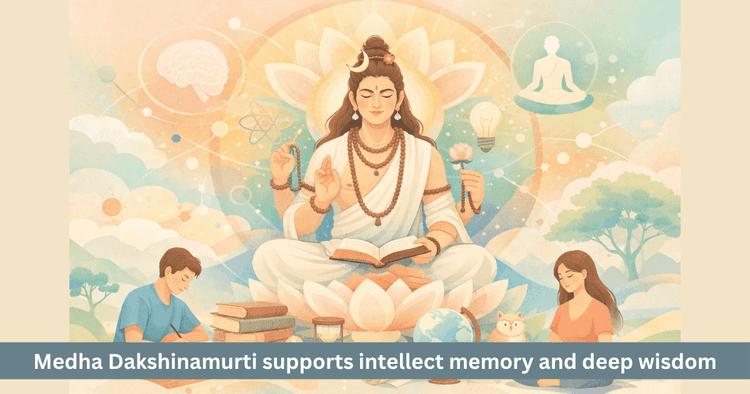
Table of Contents
In the Indian spiritual tradition, knowledge is never understood merely as information or book learning. It includes memory, discernment, concentration, reasoning, inner clarity and finally the awakening of that truth which illumines consciousness beyond intellect. It is in this deeper sense that a very special form of Bhagavan Dakshinamurti is revered, known as Medha Dakshinamurti. This form is especially honored by students, serious learners, thinkers and those engaged in deep inquiry who seek not merely success in examinations but also clear understanding, right judgment and stable intelligence.
In the traditional stream associated with Mantra Mahodadhi, the worship of Medha Dakshinamurti is considered particularly powerful. It is believed that through his grace, one does not merely develop the ability to memorize but awakens that deeper faculty by which what is heard settles within, what is studied becomes understandable and what is understood returns at the right time through living memory. This is why students, scriptural learners, researchers, seekers of logic and those devoted to deep contemplation have regarded this form as especially beneficial. Here intelligence does not merely become sharp. It becomes mature. Memory does not merely become accumulated. It becomes meaningful.
What Does Medha Dakshinamurti Mean
The word Medha is often translated simply as intellect or brilliance but in the Indian tradition it means much more. Medha is the power that does not merely know but integrates. It joins what is heard to understanding, understanding to experience and experience to right judgment. For this reason, Medha Dakshinamurti should not be described merely as the deity of intelligence. He is the lord of that inner intellectual illumination which gives order and meaning to otherwise scattered knowledge.
This form of Dakshinamurti also teaches that real intelligence is not mere quick response. It includes patient observation, quiet reflection and the ability to make decisions aligned with truth. Therefore the worship of Medha Dakshinamurti is connected not only with brilliance but also with deep and balanced thinking.
Why Is This Form Considered So Important for Students and Learners
The problem of a student is not always only failure of memory. Sometimes what is studied is not understood. Sometimes it is understood but not organized. Sometimes knowledge is present, yet cannot be recalled at the right moment. Sometimes there is recall but no depth. All these are related not merely to ordinary intelligence but to the deeper faculty of medha. That is why Medha Dakshinamurti is considered especially sacred for those engaged in study.
This form is traditionally seen as supportive on four levels:
- In strengthening memory
- In deepening and balancing reasoning power
- In increasing concentration
- In nurturing discerning judgment
Thus this worship is not only useful for study in a narrow sense but for the entire life of the intellect.
Is Medha Only Memory or Something More
Many people mistake medha for fast memory alone but the traditional understanding is much deeper. Memory is important but if memory lacks comprehension, knowledge remains incomplete. In the same way, comprehension without reasoning may become unstable. Reasoning without discernment may turn into ego. Medha harmonizes all these.
Major dimensions of Medha
| Dimension | Deeper Meaning |
|---|---|
| Memory | The ability for what is heard and studied to arise at the right time |
| Grasping power | Understanding a subject in its true spirit |
| Reasoning | Connecting thoughts with order and validity |
| Discernment | Distinguishing what is right from what is misleading |
| Stable intelligence | Remaining clear even under pressure |
This table shows that medha is not merely mental sharpness. It is well integrated intellectual maturity.
How Is the Silence of Dakshinamurti Connected With Medha
Dakshinamurti is known primarily as the silent guru. At first it may seem that silence has little connection with intelligence. Yet on deeper reflection, one sees that the greatest obstacle to intelligence is inner noise. When the mind is crowded with anxiety, comparison, fear, reaction and restlessness, both memory and reasoning become weakened. The silence of Dakshinamurti symbolizes the quieting of this inner turbulence. When inner stillness arises, the faculty of medha begins to function in a more integrated way.
That is why the worship of Medha Dakshinamurti is not merely a request for blessing. It is also a path of cultivating an inner condition in which unnecessary disturbance loses its hold over the mind. From silence comes concentration and from concentration comes deeper understanding.
Why Is This Form Especially Significant for Researchers and Deep Thinkers
A person engaged in serious study, research, analysis, scriptural reflection or intellectual inquiry faces more than the question of collecting information. One must also ask what is essential, what is secondary, which argument is sound, which is misleading and which conclusion truly deserves acceptance. At such a level ordinary intelligence alone is not enough. What is needed is medha, patience, objectivity and subtle discernment.
This is why the tradition associated with Mantra Mahodadhi gives special importance to Medha Dakshinamurti. He does not merely make the mind faster. He makes it deeper and steadier. True research depends upon the ability to observe without haste, to think without agitation and to remain inwardly clear while holding complexity. This capacity is linked to the guru principle embodied in Dakshinamurti.
Major qualities associated with Medha Dakshinamurti in research and deep study
- The ability to identify essence within vast material
- The power to keep reasoning close to truth rather than emotional bias
- The patience to reflect over long periods
- The preservation of intellectual humility
- The transformation of knowledge into illumination rather than ego
Is This Form Only for Students
No, this form is not limited to students. Anyone who needs clarity of mind, memory, understanding, judgment and discernment may turn toward Medha Dakshinamurti. Teachers, philosophers, writers, scriptural readers, decision makers, spiritual seekers and all those who wish to move from confusion to clarity may benefit from this sacred form.
A subtle point must be understood here. The need for intelligence does not arise only in schools or universities. It is equally needed in relationships, work, spiritual life and crucial moments of decision. Therefore Medha Dakshinamurti is not only the deity of learners but also of mindful living.
What Should Be the Inner Attitude in the Worship of Medha Dakshinamurti
The fruit of any sacred worship depends not only upon outer method but upon inner attitude. One should not approach Medha Dakshinamurti merely to surpass others. If intelligence is pursued only for competition, pride or display, then it remains cleverness and does not become medha. The right attitude in this worship is one of clarity, truth seeking, quiet discernment and inner illumination.
Helpful inner attitudes for this worship include:
- Humility to admit what is not yet understood
- Honest desire to know truth
- Readiness to connect learning with life
- The intention to make intelligence a means of service, insight and light
What Is the Spiritual Relationship Between Memory and Reasoning
Ordinarily people connect memory with examinations and reasoning with debate. But in the Indian tradition, both also have a deeper role in self development. Memory can mean remembering one’s higher orientation and reasoning can mean cutting through confusion to reach truth. When both are purified, a person becomes not merely skillful but inwardly awakened.
The grace of Medha Dakshinamurti may be understood in this light. His presence is believed to shape the mind so that it rises above forgetfulness and no longer becomes trapped in false patterns of thought. That is why memory and reasoning, in his worship, take on a spiritual meaning as well.
Is This Teaching Only Religious or Also Practical
This teaching is deeply practical. The modern world is marked by an excess of information and a shortage of clarity. People read much but assimilate little. They speak much but reflect less. In such a time, the teaching of Medha Dakshinamurti reminds us that knowledge does not mean information alone. It also means right reception, timely recall and wise application.
Some practical directions from this teaching for modern life are these:
| Area of life | Direction offered by Medha Dakshinamurti |
|---|---|
| Study | Preparation rooted in understanding |
| Research | Patient and balanced analysis |
| Decision making | Harmony of logic and discernment |
| Spirituality | Purity and steadiness of mind |
| Daily life | Reflection instead of mere reaction |
What Special Message Does This Form Offer to Today’s Students
The modern student often struggles with pressure, comparison, fear of results and mental exhaustion. In such a situation, Medha Dakshinamurti teaches that study is not only outer competition. It is also the building of inner order. If the mind is fragmented, memory becomes weak. If intelligence is unstable, reasoning becomes scattered. If ego grows, knowledge cannot be properly assimilated. Therefore inner balance is as necessary as effort.
This form gives five very important messages to students:
- Calm the mind before trying to absorb knowledge
- Treat learning not as burden alone but as self refinement
- True memory requires understanding, not mere repetition
- Use reasoning to seek truth, not merely to argue
- Knowledge learned with humility remains more deeply rooted
What Is the Deepest Secret of This Form
The deepest secret of Medha Dakshinamurti is that he does not allow intelligence to remain merely a tool of outer achievement. He redirects it toward inner awakening. Through his grace, memory becomes not only retention of content but remembrance of higher purpose. Reasoning becomes not merely the raising of questions but the cutting away of confusion. Intelligence becomes not only an instrument of success but a vessel of illumination.
This is why Medha Dakshinamurti should not be reduced to the idea of a deity who grants marks in examinations. He is the divine source of mature intelligence, stable memory, luminous discernment and inner awakening.
Final Reflection
The tradition of Medha Dakshinamurti described in Mantra Mahodadhi is a beautiful and deeply relevant expression of the Indian guru principle. It teaches that the highest use of intelligence lies not in cleverness but in the capacity to hold truth properly. For students, learners, researchers, teachers and thoughtful seekers, this reminder is especially valuable, that the flower of knowledge opens fully only when memory, reasoning, discernment, humility and inner stillness come into harmony.
therefore it may be said that Medha Dakshinamurti is not merely the deity of intelligence. He is the lord of awakened intelligence, stable memory and luminous discernment. One who does not only worship this form but also understands it, can gradually raise knowledge from mere information into the path of self refinement and inner vision. That is the deepest and most beautiful truth of this sacred form.
Frequently Asked Questions
Who is Medha Dakshinamurti
This is a special form of Bhagavan Dakshinamurti associated with intelligence, memory, discernment and deep understanding.
For whom is this worship considered especially beneficial
It is especially valued for students, learners, researchers, teachers and those engaged in serious contemplation.
Does medha mean only memory power
No, medha includes memory, reasoning, grasping power, discernment and stable intelligence.
Is this worship useful only for study
No, it is considered helpful in every area of life where clear thought and balanced judgment are needed.
What is the central message of this form
It teaches that true intelligence is that which transforms knowledge into light, humility and right judgment.
Get your accurate Kundali
Generate KundaliDid you like it?
Author

Pt. Abhishek Sharma (63)
Experience: 20
Consults About: Family Planning, Career
Clients In: Punjab, Haryana, Delhi
Share this article with friends and family
About ZODIAQ
ZODIAQ is an online Vedic Astrology platform. It connects clients seeking astrological advice to experienced astrologers with deep knowledge. Our users also generate kundali and perform kundali milan for free. ZODIAQ also offers services to the Astrologers. Astrologers utilize various offerings by ZODIAQ to serve their clients effectively.
If you are a User
Consult with experienced astrologers and seek their guidance. You can also order handwritten Janm Patrika report with life prediction prepared by experienced astrologers. Generate accurate Kundali, perform Kundali Matching and check horoscope and muhurat. Utilize our online library for all the necessary astrological and spiritual information.
If you are an Astrologer
Create accurate kundali for your clients and perform Kundali Matching for up to 5 people at a time. Write comprehensive Janm Patrika report for your clients with ZODIAQ. Check client details anytime by saving it in client directory. Become more productive by tracking how many clients you guide every day.
WELCOME TO
ZODIAQ
Right Decisions at the right time with ZODIAQ
