Veena Dakshinamurti: Source of Music and Divine Knowledge
By Pt. Amitabh Sharma
Exploring Shiva as the primordial guru of music and sacred sound
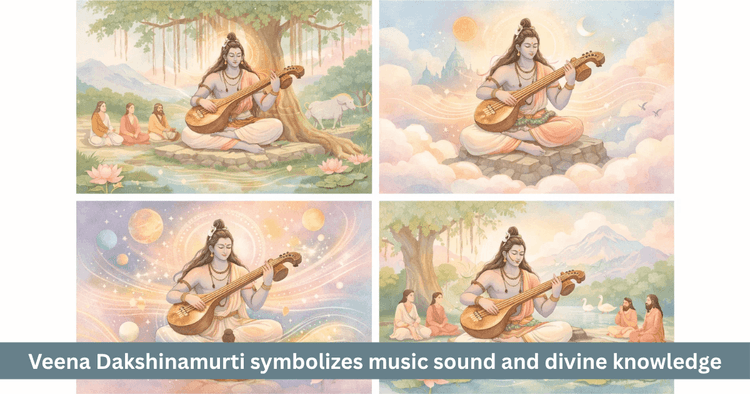
Table of Contents
The form of Dakshinamurti in Indian spiritual tradition is regarded as the supreme symbol of knowledge, silence, truth and the grace of the guru. Usually Dakshinamurti is seen seated beneath the banyan tree, bestowing self knowledge upon the disciples through silent presence. Yet there are certain forms of this same Dakshinamurti in which he appears holding or playing the veena. This form is known as Veena Dakshinamurti. It is not merely an aesthetically beautiful image. It reveals a very deep philosophical and cultural truth, namely that Lord Shiva is not only the primordial guru of scripture but also the original source of art, music, rhythm, sacred sound and creative consciousness.
When the veena appears in the hands of Dakshinamurti, it suggests that knowledge does not arise through words alone. Truth is not confined to statements, logic or metaphysical explanation. At times that same truth manifests as tone, inner vibration, rhythm, resonance and melodic experience. For this reason, the form of Veena Dakshinamurti is considered extremely profound in Indian tradition. It tells us that the foundation of the cosmos is not only thought but also vibration. Not only meaning but also sound. Not only scripture but also musical realization.
The tradition associated with the Karana Agama indicates that this form of Dakshinamurti shows that he is not only the original teacher of scripture but also the primal guru of music and the arts. Building on this understanding, some traditions further say that before Saraswati, the root of music emerged from Shiva. This does not diminish the greatness of any deity. Rather, it means that Shiva is seen here as the source of the primal vibration from which later artistic expression unfolds. This is a very deep idea and gives Indian aesthetics a remarkable spiritual height.
What does the form of Veena Dakshinamurti reveal
The usual guru form of Dakshinamurti is associated with silent instruction but Veena Dakshinamurti gives that silence an audible expression. Here the guru does not speak. He awakens sound. He does not argue. He stirs inner experience. That is why this form helps the seeker understand that the guru’s role is not only to provide knowledge but also to attune the inner being to a subtle harmony in which the mind gradually becomes pure, steady and inwardly joyful.
The form of Veena Dakshinamurti suggests several important truths
- knowledge and music are not opposed but complementary
- truth is not only studied but also heard and experienced
- at the root of creation lies sound and vibration
- the guru’s teaching often descends beyond language into rhythmic consciousness
In this way the form reveals that music is not mere entertainment. It can become a profound path of spiritual practice.
Why is the symbolism of the veena so deep
In Indian tradition, the veena is not merely a musical instrument. It symbolizes balance, subtlety, discipline, purity of tone and inner harmony. The strings of the veena can neither remain too loose nor too tight. If balance is absent, no sweet music can emerge. Human life is the same. If the mind becomes too dull, spiritual practice does not deepen. If it becomes too tense, peace is lost. True practice resembles the veena whose strings remain in perfect balance.
This is why the veena is also a spiritual symbol. It teaches that
| Aspect of the veena | Inner meaning |
|---|---|
| Sound | Pure expression of consciousness |
| Strings | The different levels of life |
| Balance | The proper state of spiritual practice |
| Music | Harmony between the soul and the cosmos |
Although the table helps make the teaching clearer, the inner significance remains highly subtle. When Dakshinamurti plays the veena, he is not merely presenting art. He is also revealing the secret of balance in life.
Can music also become a path of knowledge
In Indian thought, the answer is clearly yes. If words give direction to the mind, sound opens the heart. If philosophy refines the intellect, music purifies feeling. If silence steadies the soul, sacred sound leads it toward subtle awakening. That is why music was never treated only as an artistic field. It was also connected with nada upasana, devotion, meditation and inner discipline.
The form of Veena Dakshinamurti embodies this deeper idea. It shows that
- music can gently turn the mind from the outer world toward the inner
- rhythm can gather a scattered consciousness back to its center
- sound can gradually purify inner disorder
- art, when joined with spiritual discipline, can assist the path of liberation
For this reason, this form is deeply significant not only for artists but for seekers as well.
What does it mean to say that the root of music emerged from Shiva before Saraswati
At first hearing, this statement may seem puzzling, because in the wider Indian tradition Goddess Saraswati holds the exalted place of the deity of music, speech, wisdom and the arts. Then how can it be said that the root of music emerged from Shiva. The deeper meaning here is not one of rivalry between deities. Rather, it points to the idea that the primordial vibration, the first resonance and the cosmic sound principle are seen as arising from the Shiva tattva. From that primordial sound then unfold speech, melody, rhythm, expression and learning in their developed forms.
In this way the idea may be understood as follows
- the Shiva principle is seen by some traditions as the source of primordial vibration
- Dakshinamurti manifests that vibration in the form of the guru
- the veena gives that vibration an experiential musical expression
- Saraswati presides over the refined flow of knowledge, speech and art that unfolds from that sacred source
Thus there is no contradiction. Rather, there is a spiritual sequence of emergence. The primal sound from Shiva and its refined expressive unfolding in Saraswati can both be honored together.
What is the importance of this form from the perspective of the Karana Agama
The Agamic traditions preserve temple symbolism, deity forms, meditative methods and subtle principles of worship with great care. In the Karana Agama, the form of Veena Dakshinamurti should not be seen merely as a visual variation of the deity. It indicates that the guru principle is not limited to scripture, philosophy or silence alone. It can also express itself through sound, art and aesthetic realization.
From this perspective, Veena Dakshinamurti helps us understand that
- Shiva’s wisdom is existential before it becomes intellectual
- his teaching descends into experience before it becomes verbal doctrine
- he is not only the teacher of Brahmavidya but also the primordial source of aesthetic consciousness
- there is a deep bridge between spirituality and the arts
This is why the form is not merely religious imagery. It is a complete philosophical revelation.
The relation between Veena Dakshinamurti and Nada Brahma
Indian music and philosophy hold a very profound idea known as Nada Brahma, which means that the ultimate reality can also be experienced as sacred sound. Here sound does not mean only audible vibration. It means the primal resonance through which the order of creation begins to move. That is why music has often been regarded not merely as an auditory art but as an echo of the cosmic order itself.
The form of Veena Dakshinamurti is deeply connected with this idea of Nada Brahma. When the guru plays the veena, it signifies that
- the universe is not only a structure of matter but also an expansion of vibration
- spiritual practice may unfold not only through silence but also through subtle listening
- music that enters deeply within can lead the mind toward self realization
For this reason, meditating on Veena Dakshinamurti is not merely deity worship. It is also an invitation to refine the soul through sacred sound.
How does this form reveal the relationship between art and scripture
Many people assume that scripture and art belong to entirely different domains. Scripture seems serious and art appears emotional. But Indian tradition often does not separate them so sharply. Here scripture without rasa may become dry and art without inner principle may lose direction. The form of Veena Dakshinamurti brings these two together in a striking way.
He teaches that
- scripture gives direction
- art opens sensitivity
- music can wash inner impurity
- the guru can transform all of these into spiritual practice
Thus this form expresses a high tradition in which knowledge and beauty are not opposites but allies.
What does Veena Dakshinamurti mean in the life of a seeker
If this form is seen only as a variation in iconography, then its practical value remains limited. In truth, it also gives a subtle way of understanding life itself. Every seeker carries inner strings. The mind, intellect, memory, feeling, desire and speech together form the inner veena. If these are unbalanced, life becomes noise. If they become properly tuned, life itself can become music.
Veena Dakshinamurti silently teaches the seeker
- recognize the strings within
- refine and tune them
- bring life into right rhythm
- do not merely listen to music, let it enter your being
- do not merely study knowledge, let it become the sound of your life
These teachings are deeply practical and yet profoundly subtle.
Why is this form relevant in the modern age
Modern people are surrounded by noise. There are many sounds but little sacred resonance. There is much information but little wisdom. There is much entertainment but little true refinement of perception. At such a time, the form of Veena Dakshinamurti becomes even more important. It reminds us that sound becomes sacred only when it carries balance, meaning born of silence and the touch of consciousness.
This form offers the modern world several important teachings
- do not reduce art to consumption alone
- allow music also to become a means of inner purification and inwardness
- when life loses rhythm, even knowledge begins to feel dry
- the guru does not merely give information but tunes existence itself
For this reason, Veena Dakshinamurti is not merely an ancient image. It remains a living spiritual teaching for the present age.
The final light of this episode
The form of Veena Dakshinamurti reveals that Lord Shiva is not only the silent guru, the knower of truth and the bestower of self realization but also the primal source of music, art and the vibrational order of the cosmos. The tradition of the Karana Agama brings this secret forth in a beautiful way. When Dakshinamurti is seen playing the veena, it becomes clear that knowledge does not remain locked within texts alone. It also flows through tone, abides in rhythm and can touch the soul through music.
That is why the darshan of Veena Dakshinamurti offers more than artistic delight. It reminds us that human life itself is a veena. If its strings are properly tuned, then from that very life can arise the music of wisdom, devotion, peace and beauty. That is the deepest, sweetest and most enduring meaning of this form.
Frequently Asked Questions
Who is Veena Dakshinamurti
He is the form of Lord Shiva as Dakshinamurti in which he is shown holding or playing the veena.
What is the main meaning of this form
It shows that Lord Shiva is the primordial guru not only of scripture but also of art, music, sacred sound and rhythm.
What is the spiritual meaning of the veena
The veena symbolizes balance, subtlety, harmony and consciousness brought into disciplined refinement.
Can music also become a path of spiritual practice
Yes. In Indian tradition, music is also regarded as a means of sacred sound worship, purification of the mind and inner realization.
What is considered the main source of this episode
The principal source associated with this form is the tradition of the Karana Agama.
Get your accurate Kundali
Generate KundaliDid you like it?
Author
Pt. Amitabh Sharma (56 Years)
Experience: 20
Consults About: Family Planning, Career
Clients In: Punjab, Haryana, Delhi
Share this article with friends and family
About ZODIAQ
ZODIAQ is an online Vedic Astrology platform. It connects clients seeking astrological advice to experienced astrologers with deep knowledge. Our users also generate kundali and perform kundali milan for free. ZODIAQ also offers services to the Astrologers. Astrologers utilize various offerings by ZODIAQ to serve their clients effectively.
If you are a User
Consult with experienced astrologers and seek their guidance. You can also order handwritten Janm Patrika report with life prediction prepared by experienced astrologers. Generate accurate Kundali, perform Kundali Matching and check horoscope and muhurat. Utilize our online library for all the necessary astrological and spiritual information.
If you are an Astrologer
Create accurate kundali for your clients and perform Kundali Matching for up to 5 people at a time. Write comprehensive Janm Patrika report for your clients with ZODIAQ. Check client details anytime by saving it in client directory. Become more productive by tracking how many clients you guide every day.
WELCOME TO
ZODIAQ
Right Decisions at the right time with ZODIAQ
