Yoga Dakshinamurti: Path of Discipline and Self Realization
By Aparna Patni
Understanding Shiva as the embodiment of yogic discipline and inner stability
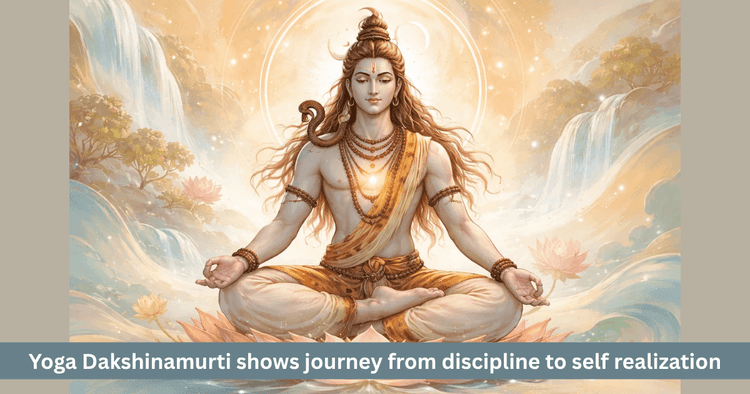
Table of Contents
In the Indian spiritual tradition, many forms of Bhagavan Shiva are described and each form carries within it a distinct path of realization. Dakshinamurti is generally understood as the silent guru, the lord of self knowledge and the one who reveals the non dual truth. Yet there is also a deeply significant and practice centered form known as Yoga Dakshinamurti. In this form, he is not only the teacher who imparts truth but the supreme acharya who embodies discipline through body, breath, mind and consciousness. Here he appears established in profound yogic states and his very form teaches that realization of the Self is not merely a matter of thought. It is the fruit of a total inner discipline.
In the tradition of the Shaiva Agamas, Yoga Dakshinamurti is regarded with particular reverence. In this form, he is not merely giving philosophical instruction. He is established in that state where the body is stable, the breath is balanced, the senses are restrained, the mind is inward turned and consciousness is directed toward the Self. This is why the form carries such a powerful message. It teaches that the body should not be treated as something irrelevant or opposed to spiritual awakening. The body is a vessel of practice, a medium of transformation and when properly disciplined, it becomes the doorway to the upward journey within.
What Does Yoga Dakshinamurti Mean
Yoga Dakshinamurti does not simply mean that Dakshinamurti is seated in a yogic posture. The meaning is much deeper. Here yoga does not refer merely to physical exercise or bodily flexibility. It means discipline, concentration, balance of energy, inner steadiness and preparation for self realization. This form teaches that knowledge and yoga are not two unrelated paths. When practice matures, yoga becomes the foundation of knowledge and knowledge becomes the flowering of yoga.
In this form, the guru is not merely giving concepts. Through his own posture, steadiness, silence and established presence, he reveals that truth requires not only intelligence but the discipline of the whole being. That is why Yoga Dakshinamurti may be understood as the guru of embodied realization.
Why Does the Body Become So Important in This Form
Many people think of spirituality only as a matter of mind or soul and therefore treat the body as secondary. But the Indian traditions of practice repeatedly teach that if the body is unstable, the breath is disordered, the senses are restless and the energetic system is scattered, then the mind too cannot remain steady. And if the mind is not steady, self realization remains only theoretical. The form of Yoga Dakshinamurti symbolizes this very truth.
The body becomes important here for three reasons:
1. It is the base of practice
Without bodily steadiness, deeper meditation becomes difficult.
2. It is the vessel of prana
The balancing of the body influences the flow of breath and energy.
3. It prepares the mind
When the body is disciplined, the mind gradually learns discipline as well.
Thus the message of Yoga Dakshinamurti is very clear. The body should not be treated merely as an instrument of enjoyment but as an instrument of realization.
Does Disciplining the Body Itself Mean Realizing the Self
A subtle distinction must be understood here. Disciplining the body is not itself identical with realizing the Self, yet it is a very important preparation for that realization. If one remains only at the level of body, then one grasps only the outer aspect of yoga. But if one disciplines the body and then moves toward breath, mind, contemplation and inner inquiry, then the path becomes complete. The form of Yoga Dakshinamurti teaches precisely this balance.
He does not say that the body is everything. He also does not say that the body has no place. He teaches that by disciplining the body, balancing the breath, restraining the senses and quieting the mind, one prepares the ground for the realization of the Self. This form therefore symbolizes the progressive unfolding of spiritual life.
What Do the Difficult Yogic Postures of Dakshinamurti Teach
When a divine form is shown established in intense yogic conditions, the purpose is not merely to create wonder. It is to reveal that spiritual discipline is not fulfilled by comfort and passivity alone. It requires steadiness, regularity, patience and continuous effort. The form of Yoga Dakshinamurti points directly toward this tapas. His stillness teaches that the body must be mastered. His concentration teaches that the mind must be gathered. His guruhood teaches that the final goal is not bodily accomplishment but inner illumination.
Major teachings received from the form of Yoga Dakshinamurti
- Without stabilizing the body, depth in meditation remains difficult
- Without balancing the breath, the mind continues to scatter
- Without restraining the senses, the inward journey cannot deepen
- Without regular practice, no real transformation is sustained
- Knowledge becomes living only when it enters the whole of life
How Deep Is the Connection Between Yoga Dakshinamurti and the Shaiva Agamas
The Shaiva Agamas do not present Shiva only as a deity to be worshipped from a distance. They reveal him as the living center of practice. These texts deal with temple, mantra, gesture, meditation, yoga, principle, energy and liberation in an integrated way. Yoga Dakshinamurti is understood within this broader Agamic vision. Here Shiva is simultaneously guru, yogi, knower of truth and source of liberation.
In this context, Yoga Dakshinamurti may be understood through the following:
| Agamic principle | Expression in Yoga Dakshinamurti |
|---|---|
| Guru principle | Guidance through silent presence |
| Yoga principle | Discipline of body and prana |
| Knowledge principle | Directing consciousness toward the Self |
| Practice principle | Gradual inward movement |
This shows that Yoga Dakshinamurti is not only a sacred image but a complete spiritual philosophy of practice.
Is He Only the Deity of Yogic Postures
No, to describe him only as the deity of postures would limit the depth of this form. He teaches steadiness through posture but his aim is far beyond posture. He shows that the body must be prepared in such a way that it does not become an obstacle to the ascent of consciousness. He teaches that the purpose of yoga is not merely flexibility, control or physical mastery but ultimately recognition of the Self.
If one stops at the outer posture, one receives only the beginning of the teaching. But if one reads this form as a map of inward transformation, one realizes that posture, breath, meditation and self knowledge are progressive stages of the same journey.
How Does Bodily Discipline Change the Mind
This is a highly practical question. Body and mind are deeply interconnected. When the body is disordered, exhausted, lazy or unstable, the mind also becomes more restless. When the body is disciplined, when it learns to sit, when the breath deepens and when the nervous system comes into balance, the mind is also transformed. The form of Yoga Dakshinamurti symbolically reveals this inner relationship.
Through bodily discipline, the following changes become possible in the mind:
- Concentration increases
- Restlessness decreases
- Patience develops
- Sensory agitation is reduced
- The mind becomes more suitable for meditation
This is why the yogic path often begins with the body and then moves toward mind and Self.
Is This Form Also Connected With Kundalini and Prana
Yes, it may be understood in that way as well. When Yoga Dakshinamurti is seen as fully established in perfected yogic stillness, it becomes clear that his inner energy is not dispersed. Prana is ordered, awareness is upward oriented and power is controlled. This state resonates with the mature yogic understanding of Kundalini where energy is not merely awakened but becomes harmonized under knowledge.
For this reason, the form of Yoga Dakshinamurti may be taken as a sign of the balance of prana, nadi, shakti and consciousness. He teaches that the culmination of yoga is not merely energetic experience but quiet, steady, luminous awareness.
What Does Yoga Dakshinamurti Teach Modern Life
Modern human life stands in a strange condition. The body is tired, the mind is racing, sleep is irregular, attention is weak and inner clarity is fading. In such a time, the form of Yoga Dakshinamurti becomes profoundly relevant. He teaches that spiritual clarity does not arise suddenly. It requires attention to one’s bodily condition, breathing rhythm, mental direction and inner order.
For modern life, this form offers important guidance:
| Modern problem | Direction offered by Yoga Dakshinamurti |
|---|---|
| Mental scattering | Stabilize body and breath |
| Lack of concentration | Develop regular seated discipline |
| Stress and fatigue | Give priority to balance of prana |
| Spiritual confusion | Understand the relation between body mind and Self |
| Desire for quick results | Accept the law of gradual practice |
Is This Form Relevant Only for Advanced Practitioners or Also for Ordinary Life
This form is certainly inspiring for serious practitioners but it is not limited to them. Anyone who seeks steadiness, discipline, clarity and depth in life can learn from Yoga Dakshinamurti. He teaches that to elevate life, it is not enough merely to change ideas. One must also transform the way one sits, breathes, lives and inwardly directs oneself.
Thus this form is also relevant to ordinary life because it teaches:
- Do not neglect the body
- Make daily rhythm part of spiritual discipline
- Do not mistake silence and discipline for weakness
- Join spirituality to the concrete structure of life
What Is the Deepest Spiritual Message of This Form
The deepest message of Yoga Dakshinamurti is that realization of the Self does not happen in some distant realm outside life. Through this very body, this very breath, this very mind and this very life, the seeker can move toward the higher truth within. This form does not reject the body, yet it does not absolutize it either. It gives the body the dignity of a sacred instrument.
Its message is subtle and powerful:
- Discipline the body but do not become trapped in the body
- Practice yoga but do not turn yoga into performance
- Become steady, so that inner illumination may appear clearly
- The realization of the Self requires that life itself become practice
Final Reflection
The form of Yoga Dakshinamurti described in the Shaiva Agamas is one of the most balanced and powerful ideals in the Indian spiritual tradition. In it, guru and yogi, silence and power, body and Self, discipline and knowledge, all meet in one sacred point. In this form, Dakshinamurti does not teach that the body is everything. Nor does he teach that the body is insignificant. He teaches that by disciplining the body, balancing the breath, quieting the mind and turning consciousness inward, the ground is prepared for realization of the Self.
therefore it may be said that Yoga Dakshinamurti is not merely a divine icon. He is a living principle of practice. One who understands his form begins to know that the path to self realization does not lie in the sky or somewhere outside but through one’s own being. And on that inward path, the body is not an enemy but an initial doorway. That is the most beautiful and deepest truth of this sacred form.
Frequently Asked Questions
Who is Yoga Dakshinamurti
This is a special form of Dakshinamurti in which he reveals the path of self realization through yogic stillness and discipline.
Is this form related only to postures
No, it is connected with the integrated discipline of posture, breath, mind, restraint and self knowledge.
Why is bodily discipline considered important here
Because without a stable body, it becomes difficult to cultivate a steady mind and deeper meditation.
Is this form useful only for advanced seekers
No, anyone seeking steadiness, concentration, discipline and clarity can learn from this form.
What is the main message of this form
It teaches that by disciplining the body, balancing the breath and calming the mind, one may move toward realization of the Self.
Get your accurate Kundali
Generate KundaliDid you like it?
Author

Aparna Patni (63)
Experience: 20
Consults About: Family Planning, Career
Clients In: Punjab, Haryana, Delhi
Share this article with friends and family
About ZODIAQ
ZODIAQ is an online Vedic Astrology platform. It connects clients seeking astrological advice to experienced astrologers with deep knowledge. Our users also generate kundali and perform kundali milan for free. ZODIAQ also offers services to the Astrologers. Astrologers utilize various offerings by ZODIAQ to serve their clients effectively.
If you are a User
Consult with experienced astrologers and seek their guidance. You can also order handwritten Janm Patrika report with life prediction prepared by experienced astrologers. Generate accurate Kundali, perform Kundali Matching and check horoscope and muhurat. Utilize our online library for all the necessary astrological and spiritual information.
If you are an Astrologer
Create accurate kundali for your clients and perform Kundali Matching for up to 5 people at a time. Write comprehensive Janm Patrika report for your clients with ZODIAQ. Check client details anytime by saving it in client directory. Become more productive by tracking how many clients you guide every day.
WELCOME TO
ZODIAQ
Right Decisions at the right time with ZODIAQ
