The Divine Origin of Ganga: From Vishnu’s Feet to the Cosmos and Beyond
By Pt. Sanjeev Sharma
The deeper spiritual origin and divine flow of Mother Ganga
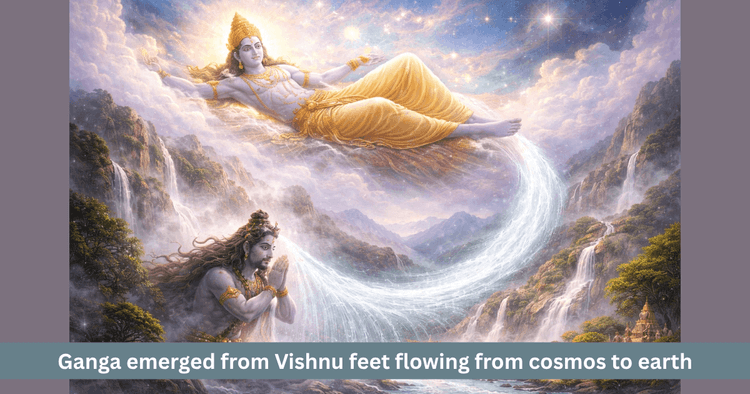
Table of Contents
In Indian spiritual tradition, Mother Ganga is not regarded merely as a river. She is seen as a flow of divine consciousness, purification, grace and liberation. Usually, when the story of Ganga is told, greater attention is given to her descent upon Earth through the matted locks of Bhagavan Shiva. This remembrance is entirely appropriate, because it was Shiva who held her unbearable force and made her descent beneficial for the world. Yet the true origin of Ganga belongs to an even earlier and more cosmic event. Without understanding that deeper beginning, the spiritual meaning of Ganga cannot be fully understood.
The account of Ganga’s divine origin in the Vamana Purana and the Bhagavata Purana is not merely a mythic story. It is also a profound expression of creation, balance, dharma and the descent of sacred consciousness. This narrative tells us that Ganga did not first emerge within the limits of Earth. She arose at the moment when Bhagavan Vishnu in his Vamana Avatara, meaning the dwarf incarnation, extended his cosmic form and touched the highest reaches of existence. For this reason, Ganga is called Vishnupadi, meaning the one who emerged from the feet of Vishnu.
Why is the connection between Vamana Avatara and Ganga so important
To understand the origin of Ganga, one must first understand the meaning of the Vamana Avatara. This avatara is not merely the story of Bhagavan Vamana asking King Bali for three steps of land. It is the moment when dharma, cosmic order and balance were re established through divine play. Vamana’s small form symbolizes humility, while his vast form symbolizes the boundless nature of divinity. This contrast makes the story extraordinary. On one side there is humility and on the other side there is infinite expansion.
When Bhagavan Vamana took his cosmic form to measure the worlds in three steps, one of his feet rose beyond Earth and the heavens and reached the highest level of the cosmos. This was not merely a display of power. It was the revelation that divinity cannot be contained by boundaries. At that very moment, the nail of his toe pierced the cosmic covering. From that opening there emerged a divine stream of water. That very stream later became known as Ganga.
Main spiritual indications of this episode
● The smallness of Vamana symbolizes humility
● The cosmic form symbolizes the limitless nature of divinity
● The piercing of the cosmic covering suggests the breaking of the line between the finite and the infinite
● The emergence of a sacred stream from that opening signifies grace and purification
What does it mean that Ganga emerged from Vishnu’s feet
The title Vishnupadi carries a profound spiritual meaning. The feet of Vishnu are not merely a physical image. They symbolize preservation, balance, dharma and divine support. In Indian tradition, the feet are revered because they represent the foundation upon which the order of existence stands. When Ganga is said to have arisen from Vishnu’s feet, it does not mean only that a divine event took place. It means that the essential nature of Ganga is connected with divine preservation and cosmic harmony.
That is why Ganga is considered not only a destroyer of sin but also mokshadayini, meaning the giver of liberation. Her touch is believed to cleanse not only the outer body but also the impurities of the inner being. The meaning of her emergence from Vishnu’s feet is that Ganga carries within her the reminder of that higher consciousness in which life is not meant merely for survival but also for spiritual elevation.
What does the piercing of the cosmic covering symbolize
One of the deepest philosophical layers of the story is that Bhagavan Vamana’s nail pierced the cosmic covering. If this is seen only as a miracle, much of its meaning remains hidden. The cosmic covering here symbolizes the boundary between the material and the divine, the gross and the subtle, the limited and the infinite. When that covering is pierced, a sacred stream appears. This indicates that when divinity itself opens the limit, the flow of grace becomes possible.
This truth also applies to human life. So long as a person remains bound only by ego, desire, fear and limited vision, the inner flow remains restricted. But when some inner covering breaks, then compassion, purity and light begin to move within. Thus the story of Ganga is not only a sacred narrative. It is also a symbol of inner awakening.
Why is Ganga considered the holiest river
The holiness of Ganga is not connected only with the physical properties of her water. Her sanctity is rooted in her origin, divine associations, spiritual function and unceasing flow. She arose from Vishnu, was held by Shiva and became on Earth a path of liberation for countless beings. Through this entire journey, Ganga ceased to be only a river and became a divine bridge between gods, sages and the human world.
The sanctity of Ganga may be understood through several dimensions:
| Dimension | Meaning |
|---|---|
| Divine origin | Emergence from the feet of Vishnu |
| Holding force | Being received in Shiva’s matted locks |
| Welfare of the world | Becoming available for all beings on Earth |
| Liberating quality | Connected not only with bodily but also with inner purification |
This is why Ganga water is not treated as ordinary water. It is regarded as charanamrita svarupa, meaning water of divine feet, a stream of grace and a means of liberation.
Why were Shiva’s locks necessary
When this divine stream moved from the cosmos toward Earth, its force was so intense that the Earth could not have endured it directly. This is where Bhagavan Shiva’s role becomes central. Shiva held Ganga within his matted locks and gave her immense force direction, restraint and a form that the world could receive. This relationship between Ganga and Shiva is not merely a divine event but a universal principle of energy and balance.
If the feet of Vishnu symbolize flow, then Shiva’s locks symbolize containment, patience and the discipline of descent. This teaches that divine energy becomes auspicious only when there is also the steadiness required to hold it. Power alone is never enough. There must also be the capacity to guide and contain that power.
Life lessons from this balance
● Flow is necessary but discipline is equally necessary
● Energy is sacred but without holding capacity it may become destructive
● The united role of Shiva and Vishnu is an ideal of balanced life
● Real transformation happens when grace and steadiness work together
Ganga’s descent to Earth was not merely the arrival of water
When Ganga came to Earth, it was not simply heavenly water descending upon the world. It was the descent of divinity from higher realms into earthly existence. It symbolized grace flowing from above to below so that limited life too may receive the touch of the infinite. This is why Ganga is not only a geographical river. She is the stream that calls the human being beyond the merely material toward subtle meaning.
In Indian sacred practice, whether in bathing, sipping, oblation, vow taking, ancestral offerings or final rites, the presence of Ganga is meaningful for this very reason. Her use is not merely ritual. It is joined with the belief that Ganga carries purification, sacred memory, forgiveness and the path toward transcendence. This is why the banks of Ganga are not only riverbanks but fields of austerity, remembrance and release.
What is the philosophical meaning of Ganga
Seen philosophically, Ganga carries many meanings at once. She is grace descending from above. She is the process of purification. She is continuity. She is movement despite obstacles. She teaches that life is not meant to remain stagnant but to keep flowing in the right direction. She also teaches that true purification is not merely outward but a joined process of inner and outer cleansing.
This philosophical form of Ganga also applies directly to human life. When a person lives with the desire to wash away inner impurity, ego, sorrow, confusion and affliction, then a kind of Ganga begins to flow within. In this sense, Ganga is not only the river that flows outside. She is also a path of inner sadhana.
What is the message of Ganga’s unceasing flow
Ganga does not stop, does not remain blocked forever and continues to move even through difficult terrain. This is one of her greatest teachings. She tells us that in life, flow must continue. Where stillness turns into dead stagnation, the music of life begins to fade. Ganga’s movement teaches that change should not be feared. One must flow but with direction. One must move forward but with purity.
That is why remembering Ganga does not awaken only religious feeling. It also offers a deep inner consolation. She seems to say that impurity is not the final truth. It can be washed away. Sorrow is not the final truth. It can be released. Stagnation is not the final truth. It can be turned into flow.
Life lessons received from Ganga
● Continuity is a natural principle of life
● Purification is not one moment but an ongoing process
● Light that comes from above finds meaning only when it reaches the world
● Balance between flow and steadiness makes life complete
Why is bathing in Ganga still considered so significant
Even today, when a person bathes in Ganga, it is not merely a physical act of touching water. It is an attempt to connect with that sacred memory whose origin lies in Vishnu’s feet and whose descent was held by Shiva. In this way, bathing in Ganga is an outer act carrying deep inner meaning. If accompanied by reverence, it inspires release from burden, guilt, affliction and inner unrest.
Bathing in Ganga, worshipping her waters, practicing on her banks and remembering her name all arise from the same deeper understanding that life repeatedly needs purification. And wherever purification appears, a new beginning becomes possible.
What is the real secret of Ganga
The real secret of Ganga is that she is not merely a river. She is the result of the united working of divinity and balance. Vishnu’s feet give her birth. Shiva’s locks hold her. Earth receives her as welfare for the world. Human beings receive her as a path of purification and liberation. Throughout this journey, Ganga teaches that where grace, holding capacity, flow and purification come together, transformation inevitably takes place.
For this reason, Ganga’s origin is not merely a mythic episode. It is an eternal spiritual truth. That truth is this: when divinity breaks through limitation and balance receives it, the stream of grace enters the world. And that stream becomes a path of liberation for living beings.
Frequently Asked Questions
Why is Ganga called Vishnupadi
Because according to the Puranic account, she arose from the feet of Bhagavan Vishnu and therefore she is called Vishnupadi.
Did Ganga originate from Shiva’s locks
No. Her original emergence is from Vishnu’s feet. Shiva received and held her in his matted locks during her descent to Earth.
What is the connection between Vamana Avatara and Ganga
In the cosmic form of Vamana, Vishnu’s toenail pierced the cosmic covering and from that opening Ganga’s divine flow emerged.
Why is Ganga considered mokshadayini
Because her origin is divine, her flow symbolizes purification and she is connected with both outer and inner sanctity.
What does the story of Ganga teach in life today
It teaches that purification, flow, patience and balance are essential for life and real transformation comes through both grace and discipline.
Get your accurate Kundali
Generate KundaliDid you like it?
Author

Pt. Sanjeev Sharma (63)
Experience: 20
Consults About: Family Planning, Career
Clients In: Punjab, Haryana, Delhi
Share this article with friends and family
About ZODIAQ
ZODIAQ is an online Vedic Astrology platform. It connects clients seeking astrological advice to experienced astrologers with deep knowledge. Our users also generate kundali and perform kundali milan for free. ZODIAQ also offers services to the Astrologers. Astrologers utilize various offerings by ZODIAQ to serve their clients effectively.
If you are a User
Consult with experienced astrologers and seek their guidance. You can also order handwritten Janm Patrika report with life prediction prepared by experienced astrologers. Generate accurate Kundali, perform Kundali Matching and check horoscope and muhurat. Utilize our online library for all the necessary astrological and spiritual information.
If you are an Astrologer
Create accurate kundali for your clients and perform Kundali Matching for up to 5 people at a time. Write comprehensive Janm Patrika report for your clients with ZODIAQ. Check client details anytime by saving it in client directory. Become more productive by tracking how many clients you guide every day.
WELCOME TO
ZODIAQ
Right Decisions at the right time with ZODIAQ
