The Secret of Ganga Dussehra: The Deeper Meaning of the Destruction of Ten Sins
By Pt. Nilesh Sharma
A sacred festival conveying spiritual purification of body, speech, and mind
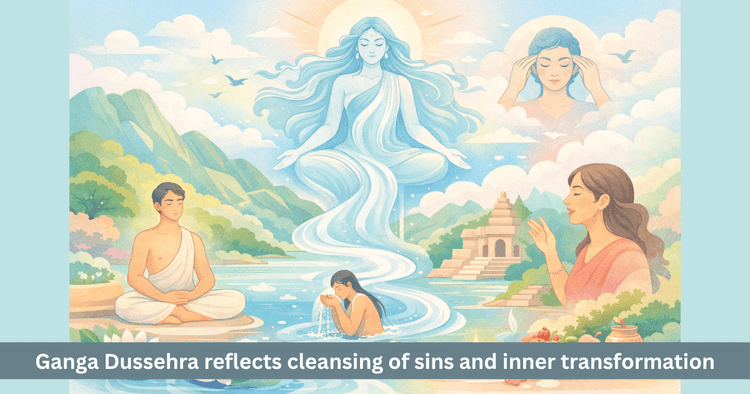
Table of Contents
In the sacred festivals of India, each observance is more than a date or a ritual. It becomes a means of balancing the hidden defects and virtues within the human being. Ganga Dussehra is one such deeply revered occasion, associated with the descent of Mother Ganga to Earth. On the surface, it appears to be a sacred bathing festival, yet in its deeper essence it is a call toward purification of the entire self. It reminds the individual that outer cleansing has little value unless it is accompanied by inner transformation.
According to the Narada Purana, bathing in Ganga on this day destroys ten kinds of sins. This is why the day is called Dussehra, meaning that which removes ten faults. This is not merely a numerical label. It points toward the complete human personality, because these ten faults arise through the body, speech and the mind. In this way, Ganga Dussehra teaches that purification is not limited to action alone. Words too must be purified and beyond words, thought itself must be made pure.
Why is Ganga Dussehra more than a festival
Many people know Ganga Dussehra simply as a bathing festival. This understanding is not wrong but it is incomplete. The significance of bathing on this day does not lie in the idea that one dip in water automatically erases every imperfection in life. The deeper indication is that just as a person enters the sacred river outwardly, one must also enter inwardly into the stream of self reflection. Water touches the body but reverence, repentance, resolve and self awareness are what truly touch the inner being.
In this sense, Ganga’s water is not merely a natural substance. It becomes the symbol of spiritual purification. When one bathes with humility, one silently accepts that there are impurities within that must be recognized and released. This acceptance is what transforms a physical act into a sacred act.
Why is the idea of ten sins so important
In Indian thought, sin does not always mean only a great visible wrongdoing. Often it also refers to subtle distortions that slowly become part of a person’s nature. What one thinks repeatedly begins to appear in speech. What appears in speech begins to take the form of action. For this reason, Ganga Dussehra does not limit impurity to physical deeds alone. It includes body, speech and mind.
This understanding is very important because it makes it clear that imbalance in life does not arise only from visible acts. The thoughts that one nourishes also shape destiny. If the mind is impure, speech becomes harsh. If speech becomes impure, action follows the same direction. Thus Ganga Dussehra is fundamentally a festival of total purification.
How are the ten sins traditionally understood
The Narada Purana explains these ten faults in three broad categories. This division is deeply meaningful because human life itself functions through these three levels. One acts, one speaks and one thinks. Therefore the disturbances of life also arise through these same channels.
| Type of fault | Number | Related sphere | Deeper indication |
|---|---|---|---|
| Physical faults | 3 | Body and actions | Purification of outward conduct |
| Verbal faults | 4 | Speech and words | Protection of truth and relationships |
| Mental faults | 3 | Mind and thoughts | Balance of inner consciousness |
This table is not only a classification. It helps a person observe where one’s weakness may be more active. Someone may appear calm outwardly, yet remain inwardly disturbed. Someone may avoid visible wrongdoing, yet speak harshly. Someone may speak sweetly, yet carry jealousy within. Ganga Dussehra invites awareness on all these levels.
What do physical sins indicate
Physical sins are those faults connected with the body and action. These are the forms of conduct whose effects directly touch the world. An improper action committed through the body is never merely a passing event. It leaves an imprint upon society, family and the person’s own inner being. That is why physical purification is not considered complete through bathing alone. It is completed through purity of conduct.
When one bathes in Ganga on Ganga Dussehra, it becomes important to remember that the body is not only a tool of comfort or pleasure. It is also an instrument of dharma, service, labor and righteous action. If bodily actions are impure, then outer worship alone remains incomplete. This is why reflection upon physical conduct forms an essential part of the day.
Inner indications for physical purification
- Awareness in action
- Commitment to non harm and rightful conduct
- Seeing the body not only as an instrument of enjoyment but as an instrument of dharma
Why are verbal sins considered so serious
Four faults are associated with speech. This number itself suggests the wide and powerful domain of words. A single wrong word can wound another person for years. A bodily wound may heal, yet a wound caused by speech may remain much longer. This is why Ganga Dussehra also emphasizes purification of speech.
The idea of verbal sins reminds us that speaking is not merely expression. It is responsibility. If speech contains falsehood, cruelty, slander, insult or division, then it spreads unrest. By contrast, if speech contains truth, sweetness, restraint and the intention of welfare, then it can also become healing.
Inner practices for purification of speech
- Thinking before speaking
- Speaking truth without needless harshness
- Choosing words that heal rather than divide
- Honoring silence, because not every situation requires speech
Why are mental sins the most subtle
The three faults of the mind are regarded as the most subtle. They are difficult to observe because they are not always visible outwardly. A person may appear peaceful and balanced, yet inwardly carry jealousy, greed, resentment or distorted desire. This is why purification of mind is considered the most difficult discipline.
Ganga Dussehra calls attention to this inward layer as well. If the inner being remains disturbed, then outward observances remain limited. For this reason, the real essence of this festival lies in self examination. One must ask inwardly what kind of thoughts are being repeatedly nourished. Is there more compassion within or more comparison. Is there gratitude or constant dissatisfaction. Does one wish well for others or secretly hold negative feeling.
Means for mental purification
- Continuous self reflection
- Replacing jealousy with goodwill
- Replacing dissatisfaction with gratitude
- Replacing restless thought with japa, prayer and remembrance
What is the true meaning of bathing in Ganga
If bathing in Ganga is reduced only to immersion in water, then only half its meaning is understood. Its deeper significance lies in recognizing the inner burden and resolving to release it. When one stands before Ganga, one does not stand only before a river. One stands before a divine flow, primordial purity and the possibility of liberation.
For this reason, three inner attitudes become especially important.
1. Acceptance
Acceptance that faults are present and must be seen.
2. Prayer
Prayer that inner impurities may gradually be washed away.
3. Resolve
Resolve that after the bath, one will use body, speech and mind with greater purity.
Together these make Ganga snana, meaning sacred bathing, truly spiritual.
Is one day of bathing enough
This is a necessary question. If a person imagines that one may live carelessly throughout the year and then balance everything through a single day of bathing, then the meaning of the festival becomes limited. Ganga Dussehra is a beginning, not the final completion. It is the day that turns the person inward. The further discipline must be lived by the individual.
The bath of this day should become the beginning of an inner discipline. Faults that become visible should gradually be reduced. Harsh speech should be softened. The unstable mind should be guided toward steadiness. Unrestrained action should be brought into right conduct. Only then does the festival truly open its deeper fruit.
How does Ganga’s water symbolize inner purification
Mother Ganga flows continuously. She does not stop, grow tired or remain stagnant. This uninterrupted current carries a spiritual message. Purification too is not a one time event. It is an ongoing process. Just as Ganga continues to flow, a human being too must continue the cleansing of the inner self.
Ganga’s water becomes symbolic on many levels.
| Aspect of Ganga | Spiritual indication |
|---|---|
| Flow | Continuing forward even amidst obstacles |
| Purification | Recognizing and releasing faults |
| Coolness | Calming anger and inner disturbance |
| Sacredness | Bringing balance to both inner and outer life |
This is why Ganga Dussehra is not only a religious observance. It is also an experience of life philosophy.
Why is Ganga Dussehra so relevant today
Modern life is extremely fast. Human beings possess many conveniences, yet little peace. There is much communication, yet little restraint in speech. There are many connections, yet little steadiness of mind. In such a time, Ganga Dussehra becomes especially relevant. It gives a person one sacred pause to turn inward and ask how one is truly living.
Three kinds of imbalance are especially visible today.
1. Physical imbalance
Lifestyle excess, greed and lack of restraint
2. Verbal imbalance
Harsh language, rushed speech and false or hurtful communication even through digital means
3. Mental imbalance
Comparison, stress, jealousy and chronic unrest
Ganga Dussehra invites us to examine all three. In this sense, it is not only a religious festival but also an opportunity for modern inner cleansing.
What could be the inner practice of Ganga Dussehra
To make this festival more meaningful, certain inward practices may be adopted.
- Silent contemplation before bathing
- Writing down three major faults within oneself
- Offering a prayer for forgiveness and purification before Ganga
- Taking a resolve to work upon one verbal fault, one mental fault and one physical fault
- Expressing purification through charity, service or humble conduct
In this way, Ganga Dussehra does not remain only a festival. It becomes a true means of self transformation.
What is the final light of Ganga Dussehra
Ganga Dussehra reminds us that impurity does not live only in action. It also lives in speech and in thought. Therefore purification must also happen on all three levels. The idea of ten sins is not meant to frighten but to awaken. It is meant to remind the human being that however busy outer life may be, one must return inward.
The message of Mother Ganga is that when flow, purification and surrender come together, true balance begins to arise in life. Ganga Dussehra is the festival of that balance. Here bathing is not merely a physical action but a preparation of consciousness. When a person sincerely strives to purify body, speech and mind, then peace, clarity and the path toward liberation begin to open.
Frequently Asked Questions
Why is Ganga Dussehra called Dussehra
Because there is a traditional belief that bathing in Ganga on this day destroys ten kinds of sins and therefore it is called Dussehra.
To which levels do these ten sins belong
These ten faults are traditionally connected with body, speech and mind.
Is bathing in Ganga alone enough to destroy these faults
Bathing is important but its deeper fruit comes only when it is joined with reverence, self reflection and a resolve for purified conduct.
What is the deeper spiritual meaning of Ganga bathing
It is not only cleansing of the body but also the resolve to recognize and release inner impurity.
What does Ganga Dussehra teach in today’s life
It teaches that without purification of body, speech and mind, lasting peace and true balance in life are not possible.
Get your accurate Kundali
Generate KundaliDid you like it?
Author

Pt. Nilesh Sharma (63)
Experience: 20
Consults About: Family Planning, Career
Clients In: Punjab, Haryana, Delhi
Share this article with friends and family
About ZODIAQ
ZODIAQ is an online Vedic Astrology platform. It connects clients seeking astrological advice to experienced astrologers with deep knowledge. Our users also generate kundali and perform kundali milan for free. ZODIAQ also offers services to the Astrologers. Astrologers utilize various offerings by ZODIAQ to serve their clients effectively.
If you are a User
Consult with experienced astrologers and seek their guidance. You can also order handwritten Janm Patrika report with life prediction prepared by experienced astrologers. Generate accurate Kundali, perform Kundali Matching and check horoscope and muhurat. Utilize our online library for all the necessary astrological and spiritual information.
If you are an Astrologer
Create accurate kundali for your clients and perform Kundali Matching for up to 5 people at a time. Write comprehensive Janm Patrika report for your clients with ZODIAQ. Check client details anytime by saving it in client directory. Become more productive by tracking how many clients you guide every day.
WELCOME TO
ZODIAQ
Right Decisions at the right time with ZODIAQ
