Ganga and the Eight Vasus: Why Seven Sons Were Released into the River
By Aparna Patni
The spiritual mystery behind the liberation of the Vasus in the Mahabharata
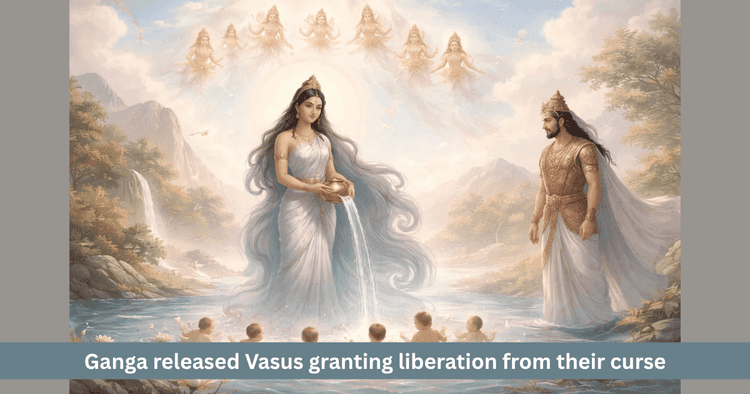
Table of Contents
In the Indian epics, some events appear harsh and deeply unsettling at first glance. They seem difficult to accept and sometimes even unjust. Yet when the spiritual context, the law of karma, the journey of the soul and the divine purpose behind them are understood, the same episodes begin to reveal a profound truth. The act of Maa Ganga releasing her first seven sons into the river immediately after birth is one such deeply serious and subtle event. If it is seen only outwardly, it appears unnatural and severe. But when understood in the context of the Mahabharata, curse, liberation, compassion and the movement of the soul, the episode reveals a very high spiritual mystery.
In the Adi Parva of the Mahabharata, this story is not merely the narrative of Ganga and Shantanu’s marriage. It is also the story of the eight Vasus, divine beings who, through a single act of transgression, became bound to birth in the human realm. From that point, the story no longer remains limited to birth and death. It becomes a profound account of karma, atonement, compassion, liberation and divine design. This is why the episode must not be judged through emotion alone but understood through spiritual insight.
Who Were the Eight Vasus and Why Were They Important
The eight Vasus mentioned in the Mahabharata were not ordinary beings. They were a group of divine powers representing subtle principles and forces of nature. In the Indian tradition, the Vasus are not merely gods but symbols of those energies through which the balance of creation is sustained. This is why their birth in human form was not considered an ordinary event. For them, it was a kind of fall, because coming from divine existence into human limitation meant entering the field of sorrow, attachment, finitude and karmic bondage.
A very important truth appears here. Even a higher being, when moving away from dharma, must face the result of karma. This is the first spiritual lesson of the story, that the law of karma is universal. It does not change because of power, divinity or high status.
The episode of the eight Vasus gives us the following indications:
- Even divinity does not stand outside the law of dharma
- High status does not cancel karmic consequence
- Creation is sustained by law, not by favoritism
- What appears like a small wrong action may lead to deep consequences
What Did the Vasus Do That Brought the Curse
According to the story, at one time the eight Vasus entered the hermitage of a sage. There they saw the sage’s divine cow and desired to take it away. On the surface, this may appear to be a theft but the epics understand this act as a violation of sacred order. The sage’s cow was not merely an animal. It was bound to tapas, dharma, the order of the hermitage and divine right. Taking it away was not simply the taking of a possession but a violation of sacred restraint and rightful order.
For this reason, the sage in anger cursed the Vasus to be born in the human realm. For divine beings, human birth here was not regarded as a blessing in the ordinary sense, because it meant experiencing maya, pain, limitation and bondage through karma. therefore this curse was extremely heavy for them.
Another deep sign emerges here, that adharma does not produce only punishment but can also result in a lowering of consciousness. For the Vasus, divine beings becoming human symbolized that very descent.
What Prayer Did the Vasus Make to Maa Ganga
When the Vasus understood the weight of the curse, they turned to Maa Ganga and prayed that she might free them quickly from the long suffering of human life. This is the point where the emotional and spiritual depth of the story becomes especially moving. Ganga is not only a river. She is the living symbol of purification, flow, liberation and compassion. She who washes away sin, who is revered as the stream of outer and inner cleansing, could not refuse this plea.
From this point onward, Ganga’s role becomes greater than that of a mother in the ordinary sense. She becomes the giver of liberation. She is not only the one who gives birth but also the one who releases the soul from the bondage of birth and returns it toward its original nature. This is why her act of releasing the seven sons into the river must be understood as a sacred vow of liberation rather than an act of cruelty.
Why Did Ganga Release the Seven Sons Immediately After Birth
When Maa Ganga descended to earth as the wife of King Shantanu, she released her first seven sons into the river immediately after their birth. Seen outwardly, this appears deeply severe. For a mother to cast her child into water is difficult for the heart to bear. But the center of this story lies precisely here, that beneath outer severity there may also be the deepest form of compassion.
Ganga knew that these seven children were in truth the same Vasus who had prayed for quick release. If she had allowed them to live out ordinary human lives, they would have remained bound for long in the suffering, attachment, limitation and karmic burden of human existence. By releasing them into the water at birth, she was in fact freeing them at once from the bondage of human birth. Thus, her decision was not an act of hardness but a divine and difficult form of compassion.
This symbolism may be understood in the following way:
- Birth here was the beginning of bondage
- Release into the waters became the path of liberation
- Ganga’s action was not punishment but the removal of the curse
- Compassion does not always appear in a soft outward form
Why Did Compassion Take Such a Harsh Form
Indian philosophy repeatedly teaches that compassion does not always look like outward tenderness. At times it appears in the form of a difficult decision, because its purpose is not temporary emotional comfort but the deeper welfare of the soul. This is exactly what appears in Ganga’s act. She could have held those children back through maternal feeling, yet that would have meant binding those souls to prolonged suffering. Instead, she chose the path that looked harsh outwardly but inwardly carried mercy.
This story also teaches that not every event should be judged immediately through surface emotion. At times, what appears severe outwardly may, from a higher vision, be the deepest act of grace. That is why to see Ganga’s act only as a denial of motherhood would be an incomplete reading of the story.
Why Was the Eighth Vasu Not Freed Immediately
The eighth Vasu was different from the other seven because he had received a heavier form of the curse. He was not meant only to take birth and be released. He had to live out a full human life. This eighth Vasu was later born as Bhishma Pitamaha. His life became the great symbol of how some karmic consequences cannot end symbolically but must be experienced through a full human journey.
The life of Bhishma is a story of vow, austerity, sacrifice, duty, suffering, patience and spiritual endurance. That is why his birth becomes the deepest dimension of this episode. While seven Vasus were released quickly, the eighth had to undergo the full experience of life. That difference itself reveals the subtle justice of karma.
The following table clarifies this distinction:
| Episode | Seven Vasus | Eighth Vasu |
|---|---|---|
| Result of curse | Short human birth | Full human life |
| Ganga’s role | Immediate liberation | Birth without immediate release |
| Spiritual meaning | Quick removal from bondage | Full experience of karma |
| Final form | Freed from the curse | Born as Bhishma Pitamaha |
How Does the Life of Bhishma Deepen the Story Further
Bhishma is not merely a character. He is the living answer to the deeper meaning of the curse. His life shows that some souls must fully live through karma, vows, dharmic conflict, burden and duty. That is why his birth connects both compassion and justice. Ganga released seven but not the eighth, because divine justice required him to pass through the fire of human experience.
As Bhishma, the eighth Vasu teaches that:
- Some karmic results do not end immediately
- Some souls must travel a longer path
- Greatness is often shaped through pain, vow and endurance
- Liberation does not come by one method alone for every soul
What Is the Philosophical Meaning of This Story
This episode offers a very deep vision of life and death. Ordinary perception sees birth as joy and death as loss. But here birth is bondage and death becomes the medium of liberation. This makes clear that in Indian thought, the journey of the soul is the highest truth, greater than the temporary condition of the body. The flowing nature of Ganga deepens this even further, because the river itself symbolizes coming, moving, changing and going onward.
The story teaches that:
- Life and death are not final opposites but phases in a journey
- The truth of the soul is greater than bodily birth
- No event can be fully understood only at the outer level
- Compassion may sometimes appear as liberation, even when it seems severe
Was Ganga’s Decision Truly Unjust
Many readers naturally ask whether this decision was not unjust. The question is understandable, because the story touches deep emotion. But the answer lies within the logic of the episode itself. Ganga was not destroying her children. She was releasing them from the very bondage from which they themselves had wished to be freed. Thus, her action becomes not injustice but grace hidden within the curse.
It is also important to understand that the higher vision of dharma does not always look identical to ordinary emotional judgment. Ganga was not seeing only the body. She was seeing the soul. That is what makes this story so profound.
What Does This Story Compel Us to Reflect Upon Today
Modern people often judge very quickly. They see only the outer event and form conclusions. But this story slows us down. It invites us to ask whether every harsh event is truly injustice or whether behind it there may be a deeper cause, an unseen history or a spiritual purpose. This perspective makes us more patient, more sensitive and more reflective.
For modern life, this story gives many teachings:
- No event can be understood only by its surface form
- At times difficult decisions may also contain higher compassion
- What appears as loss outwardly may conceal inner liberation
- Without understanding the soul’s journey, the meaning of life remains incomplete
- True compassion may be greater than temporary comfort
What Does This Union of Compassion, Curse and Liberation Teach Us
Ultimately, the story of Ganga and the eight Vasus teaches that compassion does not always look like wiping tears. Sometimes it appears as the difficult act of releasing the soul from bondage. A curse is not always only punishment. At times it also becomes direction. And liberation does not come only through austerity. It may also come through divine compassion.
therefore it may be said that Ganga’s act of releasing the seven sons into the river is not a symbol of cruelty but of higher compassion, release from the curse and liberation of the soul. And the birth of the eighth Vasu as Bhishma reveals that every soul has a distinct path. Some are freed quickly, while others must pass through the long road of experience. That is the real secret of the story and that is its profound spiritual depth.
Frequently Asked Questions
Who were the eight Vasus
The eight Vasus were a group of divine powers representing different natural and subtle energies of existence.
Why were they cursed to take human birth
They received the curse of human birth because of the theft of a sage’s divine cow.
Why did Maa Ganga release her seven sons into the river
She did so in order to free those seven Vasus immediately from human bondage and release them from the curse.
Who was the eighth Vasu
The eighth Vasu was later born as Bhishma Pitamaha, because he had to live out a full human life and experience karma.
What is the main teaching of this story
The main teaching is that even what appears harsh outwardly may conceal compassion, liberation and a higher purpose.
Get your accurate Kundali
Generate KundaliDid you like it?
Author

Aparna Patni (63)
Experience: 20
Consults About: Family Planning, Career
Clients In: Punjab, Haryana, Delhi
Share this article with friends and family
About ZODIAQ
ZODIAQ is an online Vedic Astrology platform. It connects clients seeking astrological advice to experienced astrologers with deep knowledge. Our users also generate kundali and perform kundali milan for free. ZODIAQ also offers services to the Astrologers. Astrologers utilize various offerings by ZODIAQ to serve their clients effectively.
If you are a User
Consult with experienced astrologers and seek their guidance. You can also order handwritten Janm Patrika report with life prediction prepared by experienced astrologers. Generate accurate Kundali, perform Kundali Matching and check horoscope and muhurat. Utilize our online library for all the necessary astrological and spiritual information.
If you are an Astrologer
Create accurate kundali for your clients and perform Kundali Matching for up to 5 people at a time. Write comprehensive Janm Patrika report for your clients with ZODIAQ. Check client details anytime by saving it in client directory. Become more productive by tracking how many clients you guide every day.
WELCOME TO
ZODIAQ
Right Decisions at the right time with ZODIAQ
