The Episode of Ganga and Saraswati: From Jealousy to Sacred Flow
By Pt. Suvrat Sharma
The transformation of emotions in the divine story of Ganga, Saraswati and Lakshmi
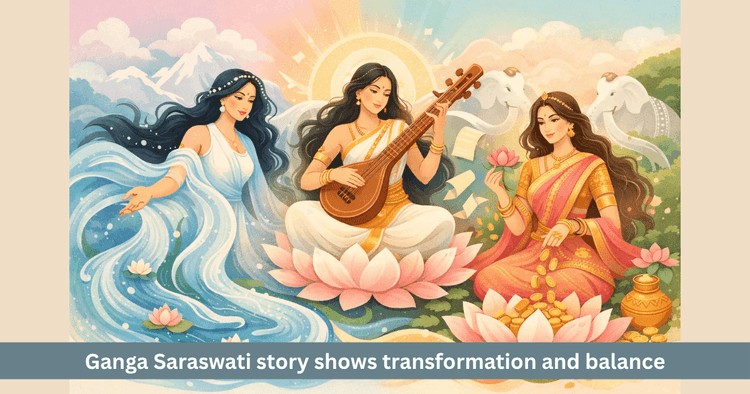
Table of Contents
In Indian Puranic wisdom, the episodes that occur among deities are never meant only as stories. They also reveal the emotions moving within human consciousness and the consequences that arise from them. The episode involving Maa Ganga, Maa Saraswati and Maa Lakshmi belongs to this profound spiritual tradition. At first glance, it appears to be a story of disagreement among divine beings but inwardly it is a journey through jealousy, comparison, imbalance, curse, flow, knowledge and finally transformative grace. That is why this episode is not merely the story of a quarrel. It reveals how even subtle emotions, when they lose balance, can have far reaching effects. Yet if those same emotions are transformed, they can become instruments of universal good.
According to the Devi Bhagavata Purana, these three divine powers dwelt in Vaikuntha with Bhagavan Vishnu. Maa Ganga embodied purification, flow and life giving grace. Maa Saraswati embodied knowledge, speech, subtle intelligence and inner illumination. Maa Lakshmi represented prosperity, auspicious balance, gentleness and graceful harmony. Each was complete in her own nature. Each had a unique greatness and each had a distinct role. This is the first and perhaps the deepest lesson of the episode, that divine diversity is meant to be complementary, not competitive.
Why Is This Vaikuntha Episode So Important
Vaikuntha is generally understood as a realm of peace, harmony and divine order. If even there a subtle imbalance begins, its meaning becomes even more profound. This story teaches that the world of emotion is extremely delicate. No matter how elevated consciousness may be, once comparison touches it, the inner currents begin to change. The same is true in human life. Outwardly, everything may appear fine but once comparison, hurt, competition or subtle insecurity enters within, balance begins to weaken.
The episode gives us the chance to understand that imbalance does not arise suddenly. First it appears in feeling, then in thought, then in speech and finally in outward action. This is the sequence that the story reveals. In this way, the divine episode becomes a teaching on the seriousness of the inner world.
This initial condition may be understood through a few simple points:
• All three goddesses were complete in their own nature
• Their fields were different and so was their significance
• Imbalance begins first at the emotional level before it becomes an event
• The story reveals that even a subtle feeling can produce large consequences
How Did the Feeling of Jealousy and Competition Arise
According to the story, there came a time when a subtle emotional imbalance arose among them. This imbalance did not come from some single dramatic cause. It was related to the inner tendency of comparison. When any being remains rooted in its own nature, peace remains. But when one begins to evaluate oneself only in relation to another, jealousy, competition, insecurity and anger may begin to emerge.
This is one of the most human layers of the story. Here the goddesses no longer remain only distant divine forms. They also become symbols of emotions moving within us. When a person forgets one’s own essential nature and begins to measure self worth against someone else’s position, imbalance begins to grow. This episode warns us that every comparison slowly diminishes peace.
What Does the Conflict Between Ganga and Saraswati Symbolize
When feelings lose balance, the next stage is conflict through speech. The intense exchange between Maa Ganga and Maa Saraswati reveals exactly this truth, that when inner feelings remain ungoverned, speech becomes sharp. Saraswati is the goddess of speech and Ganga is the goddess of flow. Their conflict symbolically suggests that when knowledge and emotion do not remain aligned, inner consciousness begins to experience division.
This is not only a story about anger. It is also a symbol of what happens when flow and speech, feeling and intellect, experience and expression begin to stand against each other. The same condition arises within human life. Many times the heart wants one thing, intellect says another, speech expresses something else and relationships begin to break under that tension. The psychological meaning of the story lies here, that inner imbalance eventually appears outwardly as conflict.
Why the Curse Was Not Merely Punishment
In anger and emotional intensity, both of them cursed one another to flow upon the earth as rivers. At first sight, this seems like punishment. But in Indian spiritual tradition, a curse is not always merely destructive. At times it becomes a process of transformation. The same happens here. Becoming a river was not a fall. It became the beginning of a new role, a new field of action and a wider blessing.
A very deep lesson is hidden in this. In life, certain events may seem painful, humiliating or harsh from the outer perspective, yet in time the same events become the cause of deeper transformation. The river form of Ganga and Saraswati symbolizes exactly this sacred change. The curse does not limit them. Rather, it expands their influence. What was once present only in Vaikuntha now begins to touch countless beings upon the earth.
The spiritual indications of this transformation may be understood as follows:
• Not every hard event is only punishment
• At times rupture becomes the beginning of a new function
• Even a curse, in a higher vision, may become a path of grace
• Divine descent often takes place through the doorway of pain
Why Is the Form of a River Such a Profound Symbol
In Indian thought, the river is an extremely deep symbol. A river is not merely flowing water. It is the symbol of continuity, change, purification, surrender and the energy that carries life forward. When Ganga and Saraswati descend upon the earth as rivers, this is not merely a change of form. It is the descent of divine principles capable of transforming human life both outwardly and inwardly.
The flow of Ganga represents purification at both the external and inner level. Saraswati, though remembered in many traditions as subtle or hidden, still remains the symbol of the flow of knowledge, refined speech and inner illumination of consciousness. Seen in this way, one river washes body, mind and karmic burden, while the other enlightens intellect, expression and subtle awareness.
The following table makes this distinction and unity easier to understand:
| Goddess | Primary Symbol | Meaning Upon Earth |
|---|---|---|
| Ganga | Purification and flow | Life, grace, inner cleansing, sacred washing |
| Saraswati | Knowledge and speech | Intellect, subtle awareness, inspiration, inner light |
| Lakshmi | Balance and prosperity | Harmony, softness, stable auspiciousness |
Why Did Their Descent to Earth Become a Blessing
This is perhaps the most beautiful aspect of the story. What begins as conflict and curse ultimately becomes blessing for the world. Through this, a great principle of Indian spirituality is revealed, that divine energy ultimately finds its way toward welfare. Ganga descends and becomes a source of purification, refuge, grace and inner washing for countless beings. Saraswati becomes the presiding force of knowledge, learning, music, art and refined thought, illuminating the course of human civilization.
It thus becomes clear that the emotions once entangled in jealousy were later transformed into blessings for the world. This is a profound lesson for human life as well. The tangled forces within us, if given right direction, can become the source of knowledge, compassion, creativity and spiritual growth.
What Does Lakshmi’s Quietness Teach in This Story
In this episode, the calm and balanced presence of Maa Lakshmi is deeply meaningful. She is not merely the third goddess in the story. She represents the force of balance. This teaches that whenever two energies become agitated through anger, comparison or emotional intensity, there must also be a principle within life that remains steady, soft and balanced. Lakshmi represents that very principle.
This is also psychologically important. When a person is trapped in comparison and competition, the inner Lakshmi principle weakens. That means inner ease, harmony and contentment begin to fade. Lakshmi here reminds us that prosperity is not merely a matter of wealth. True prosperity is the ability to preserve balance, grace and inner sweetness even amid tension.
What Is the Psychological Meaning of This Story
If understood inwardly, Ganga represents the emotional flow within us. Saraswati represents thought, knowledge and expression. Lakshmi represents balanced self worth, contentment and harmonious softness. When emotion and knowledge turn against each other, conflict begins within the person. When comparison increases, contentment decreases. When contentment decreases, jealousy grows. When jealousy grows, speech becomes harsh. This story shows exactly that inner sequence.
Yet the story does not stop there. It also teaches that when the same emotions are transformed, they become flow, wisdom and balance. This is why the episode is not only a warning. It is also a path of transformation.
Why Is This Story Even More Relevant Today
Modern life is deeply entangled in comparison, competition, display and the longing for recognition. Many people no longer measure themselves by their own nature but by the visible importance of others. This naturally increases insecurity, jealousy, restlessness and harsh speech. At such a time, the episode of Ganga and Saraswati becomes highly relevant. It teaches that every force has its own role. Every person has a unique nature, purpose and path. When this is understood, the fire of comparison begins to cool.
This episode offers many teachings for contemporary life:
• Comparison steals peace
• Imbalanced emotion may poison speech
• Unexamined jealousy can damage relationships
• The same energy, if transformed, can become knowledge and flow
• Real balance comes from recognizing one’s own nature
What Does This Journey From Jealousy to Flow Teach Us
The greatest message of this episode is that emotion itself is not the enemy but emotional imbalance becomes the cause of suffering. Feelings such as jealousy, comparison or insecurity, if left unrecognized, may become destructive. But if they are understood, purified and given a higher direction, the same forces can lead one toward self knowledge, cleansing and wisdom. The descent of Ganga and Saraswati upon the earth is the symbol of exactly this spiritual transformation.
therefore it may be said that this episode is not merely a tale of divine conflict. It symbolizes the deep truth that when emotion loses balance, there is descent but when the same emotion is transformed into flow, knowledge and spiritual maturity, it becomes a blessing for the world. That is the real meaning of the story and that is its enduring spiritual beauty.
Frequently Asked Questions
Why did conflict arise between Ganga and Saraswati
According to the story, a subtle feeling of jealousy and comparison increased between them, which created imbalance.
Was descending to earth as rivers only a curse
No, it was not only punishment. It became a divine transformation through which their beneficial forms appeared on earth.
What does the river form of Ganga and Saraswati symbolize
Ganga symbolizes purification and flow, while Saraswati symbolizes knowledge, speech and subtle consciousness.
What does Lakshmi’s role teach in this story
Maa Lakshmi’s calmness teaches that harmony and contentment are the powers that can calm conflict.
What lesson does this story offer for life today
It teaches that comparison and jealousy create unrest but when transformed, the same energy can become wisdom, purification and growth.
Get your accurate Kundali
Generate KundaliDid you like it?
Author

Pt. Suvrat Sharma (63)
Experience: 20
Consults About: Family Planning, Career
Clients In: Punjab, Haryana, Delhi
Share this article with friends and family
About ZODIAQ
ZODIAQ is an online Vedic Astrology platform. It connects clients seeking astrological advice to experienced astrologers with deep knowledge. Our users also generate kundali and perform kundali milan for free. ZODIAQ also offers services to the Astrologers. Astrologers utilize various offerings by ZODIAQ to serve their clients effectively.
If you are a User
Consult with experienced astrologers and seek their guidance. You can also order handwritten Janm Patrika report with life prediction prepared by experienced astrologers. Generate accurate Kundali, perform Kundali Matching and check horoscope and muhurat. Utilize our online library for all the necessary astrological and spiritual information.
If you are an Astrologer
Create accurate kundali for your clients and perform Kundali Matching for up to 5 people at a time. Write comprehensive Janm Patrika report for your clients with ZODIAQ. Check client details anytime by saving it in client directory. Become more productive by tracking how many clients you guide every day.
WELCOME TO
ZODIAQ
Right Decisions at the right time with ZODIAQ
