The Seven Streams of Ganga: Seven Dimensions of the Divine Flow
By Pt. Abhishek Sharma
The spiritual meaning of Ganga’s division and Shiva’s role in receiving her
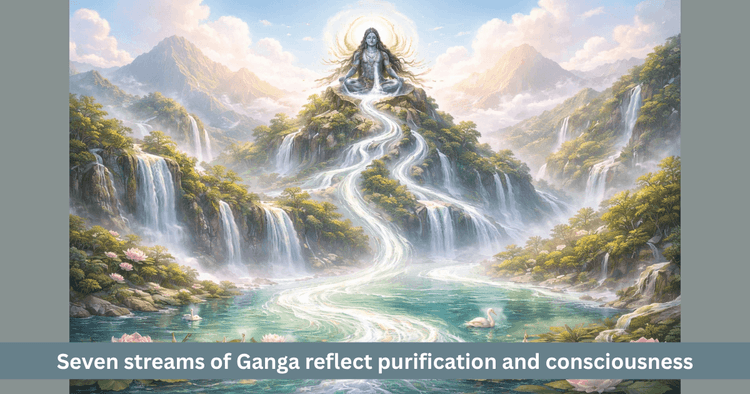
Table of Contents
The descent of Maa Ganga upon the earth is regarded as one of the most profound and luminous episodes in the Indian spiritual tradition. This is not merely the story of a river coming down to the earth. It is the story of a divine power that, if expressed without balance, could overwhelm everything and if guided with restraint, could sanctify all life. The force of Ganga was not only the force of water. It was the force of energy, purification, compassion and divine potency. For this reason, her descent was never understood as an ordinary event.
When Ganga was about to descend, it was clear that the earth would not be able to bear the full intensity of her flow directly. If she had fallen upon the earth without mediation, her force could have disturbed the balance of creation. It was at that moment that Bhagavan Shiva received Ganga into his matted locks. This image is not merely a beautiful mythic scene. It is the symbol of a great truth, that power requires restraint and even divine force must be harmonized before it becomes beneficial to the world.
What Does Ganga Resting in Shiva’s Locks Symbolize
Shiva holding Ganga in his locks is one of the deepest symbols in Indian thought. The locks here are not only hair. They symbolize tapas, self restraint, depth and the power to hold and regulate. Ganga’s force was immense, yet Shiva’s consciousness was more stable still. therefore he did not reject that power. He gave it direction. This is the central insight of the episode.
Many times in life, forces like Ganga arise within the human being as well. Emotions become intense, ideas become powerful, desires become overwhelming, spiritual experiences become great and opportunities become vast. If there are no inner locks of Shiva within, such power may throw the person into imbalance. But if the Shiva principle is present, the same power becomes life giving.
This episode offers several important teachings:
- Great energy always needs direction
- Without restraint, power may become destructive
- Tapas and the ability to hold are what create balance
- Even divine force needs a proper channel to serve the world
Why Did Ganga Divide Into Seven Streams
When Shiva received Ganga in his locks and then released her for the earth, she did not descend as one single current. She divided into seven streams. The Matsya Purana gives the names of these seven streams. This division is not understood merely in physical or geographical terms. It is given a deep spiritual significance. One source flowing in seven directions suggests that divine energy, though one in origin, may work through many forms and purposes.
The names of these seven streams are given as:
- Hladini
- Pavani
- Nalini
- Suchakshu
- Sita
- Sindhu
- Bhagirathi
Each of these names carries not only an identity but also a quality, direction and spiritual meaning. That is why they should not be seen merely as separate channels of a river. They also point toward seven dimensions of life itself.
What Is the Spiritual Meaning of the Seven Streams
In Indian thought, the number seven itself is considered deeply significant. Seven worlds, seven notes, seven seers, seven days, seven steps and seven levels of consciousness together make seven a symbol of deep completeness. therefore Ganga dividing into seven streams suggests that a single divine source is capable of touching many levels of life.
Each stream carries a distinct spiritual indication:
1. Hladini
Hladini represents joy, inward delight and cooling contentment. It is the current that awakens peace and satisfaction in the heart. Life cannot be lived only through duty and struggle. Without joy, the mind becomes hard. Hladini reminds us of that inner gladness which arises from balance within the soul.
2. Pavani
Pavani clearly points toward purity and sanctity. It symbolizes cleansing not only of body but also of thought, feeling, memory and action. When a person feels burdened by heaviness, guilt or negativity, the principle of Pavani offers inner purification.
3. Nalini
Nalini represents softness, grace and beauty. It points toward that tenderness which remains alive even in the midst of harshness. It is not enough to become pure. One must also remain gentle. Nalini teaches that beauty in life is not only outer form but also softness of feeling.
4. Suchakshu
Suchakshu signifies clear vision, discrimination and the ability to see rightly. A person may look at many things and yet fail to understand them correctly. Suchakshu is the current of inner sight that helps one discern right from wrong, enduring from temporary, essential from unnecessary.
5. Sita
Sita represents patience, dignity, restraint and endurance. It is the force that gives life stability. When circumstances shift, one needs an inner stream that prevents collapse. Sita teaches that purity must be joined with dignity and patient strength.
6. Sindhu
Sindhu signifies vastness, depth and expansiveness. It lifts a person beyond narrowness and inspires a wider perspective. Many sorrows deepen because one remains trapped in a limited outlook. Sindhu reminds us that the broader the consciousness, the more mature and balanced the experience of life becomes.
7. Bhagirathi
Bhagirathi represents resolve, austerity, purpose and dedication to a higher aim. This is the stream associated with the great tapas of King Bhagiratha, through which Ganga was brought to the earth. It is not merely a river but the memory of a spiritual effort through which divine grace was made accessible to the world.
How Do the Seven Streams Relate to Human Life
If these seven streams are understood in relation to human life, it becomes immediately clear that life does not move through a single quality alone. Different moments of life call for different inner strengths. At times joy is needed, at times purification. At times clear vision is needed and at others patience. Sometimes one needs expansiveness and sometimes unwavering resolve.
This is why the seven streams of Ganga appear like seven necessities of life. They teach that a balanced life is not created by the excess of one virtue alone but by the right presence of many virtues together.
This relationship may be understood as follows:
| Stream | Indication in Human Life |
|---|---|
| Hladini | Joy and contentment |
| Pavani | Purity and cleansing |
| Nalini | Softness and gentleness |
| Suchakshu | Discernment and clarity |
| Sita | Patience and dignity |
| Sindhu | Vastness and depth |
| Bhagirathi | Austerity, resolve and purpose |
What Does This Episode Teach About the Regulation of Energy
The division of Ganga into seven streams gives a very powerful philosophical message. When energy is extremely intense, it is not enough merely to stop it. It must be distributed, balanced and directed into proper channels. That is exactly what the story of Shiva and Ganga teaches.
If a person has knowledge but no humility, imbalance results. If there are emotions but no discernment, confusion arises. If there is resolve but no joy, harshness develops. If there is expansiveness without dignity, life scatters. The seven streams teach that true sadhana lies in transforming powerful energy into many virtues.
Are the Seven Streams Also Related to the Inner Journey of the Seeker
Yes and this is perhaps the most subtle aspect of the story. The journey of a seeker does not unfold in a single straight line. First purification may be needed, then joy, then clarity, then patience, then depth, then determination. At times several of these grow together. In this sense, the seven streams of Ganga may also be seen as seven inner stages that awaken within a spiritual life.
They remind us that spiritual growth is not completed through one single experience. It requires variation, sequence, maturity and balance. The flow of Ganga moves outwardly but it may also move inwardly through the seeker.
Why Is This Episode Important Today
The modern human being is often full of energy but lacking direction. There is information but little discernment. There is desire but little balance. There is speed but not enough patience. In such a time, the symbolism of the seven streams of Ganga becomes extremely relevant. It teaches that great energy does not automatically become beneficial. It must be balanced, regulated and expressed through different virtues.
For present life, the main teachings of this episode are:
- Every great force requires restraint
- A life based on only one quality remains incomplete
- True balance requires the growth of multiple virtues
- Without right direction, energy may exhaust rather than uplift
- Austerity, discernment, gentleness and joy must all coexist
What Is the Final Message of the Seven Streams of Ganga
The seven streams of Ganga are not merely a division of water. They show that one divine source may work in many forms and that each form has its own purpose. This story teaches that fullness in life does not arise from the dominance of one single quality but from balanced diversity. When joy, purity, vision, patience, depth and resolve all become present within, then life becomes beautiful and meaningful.
therefore it may be said that the seven streams of Ganga are like seven pathways of life. They teach that receiving divine flow requires not only devotion but also inner preparedness. And when great power is given the right direction, that very power becomes a means of welfare for the world. This is the deep and enduring meaning of the story.
Frequently Asked Questions
Why did Ganga divide into seven streams
Because her flow was immensely powerful and Shiva balanced that force by allowing it to move in multiple directions.
What are the names of the seven streams
Hladini, Pavani, Nalini, Suchakshu, Sita, Sindhu and Bhagirathi.
Do these seven streams have only a physical meaning
No, they also carry deep spiritual and psychological meanings, representing different qualities of life.
What is the special significance of Bhagirathi
It represents resolve, austerity and purpose, because Ganga came to earth through the tapas of Bhagiratha.
What is the greatest teaching of this episode
It teaches that great power becomes beneficial only when it is guided by balance, restraint and right direction.
Get your accurate Kundali
Generate KundaliDid you like it?
Author

Pt. Abhishek Sharma (63)
Experience: 20
Consults About: Family Planning, Career
Clients In: Punjab, Haryana, Delhi
Share this article with friends and family
About ZODIAQ
ZODIAQ is an online Vedic Astrology platform. It connects clients seeking astrological advice to experienced astrologers with deep knowledge. Our users also generate kundali and perform kundali milan for free. ZODIAQ also offers services to the Astrologers. Astrologers utilize various offerings by ZODIAQ to serve their clients effectively.
If you are a User
Consult with experienced astrologers and seek their guidance. You can also order handwritten Janm Patrika report with life prediction prepared by experienced astrologers. Generate accurate Kundali, perform Kundali Matching and check horoscope and muhurat. Utilize our online library for all the necessary astrological and spiritual information.
If you are an Astrologer
Create accurate kundali for your clients and perform Kundali Matching for up to 5 people at a time. Write comprehensive Janm Patrika report for your clients with ZODIAQ. Check client details anytime by saving it in client directory. Become more productive by tracking how many clients you guide every day.
WELCOME TO
ZODIAQ
Right Decisions at the right time with ZODIAQ
