Ganga and Uma: The Different Journeys of the Two Daughters of Himavan
By Pt. Nilesh Sharma
The philosophy of two different spiritual paths through Ganga and Parvati
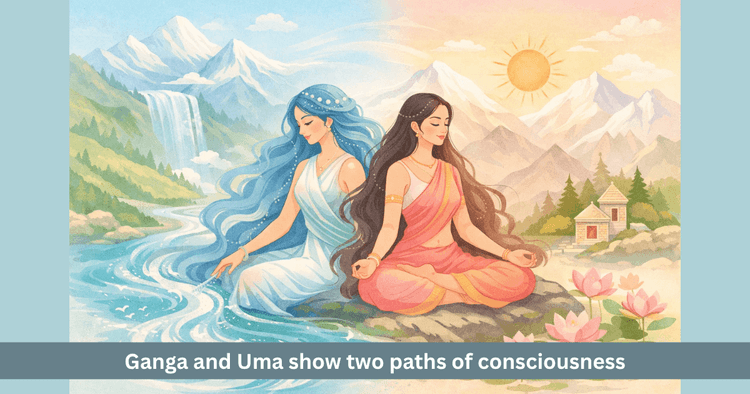
Table of Contents
In Indian tradition, family is never seen merely as a collection of relationships. It is also understood as a meeting point of different paths, temperaments and states of consciousness. The relationship between Maa Ganga and Maa Uma belongs to this deeper vision. Both arise from the same divine source, Himavan and yet both move in very different directions in order to fulfill their roles. One comes to symbolize flow, purification and compassion, while the other comes to symbolize austerity, steadiness and supreme surrender. For this reason, this story is not merely about two divine sisters. It also reveals two great spiritual pathways of life.
The Valmiki Ramayana gives an indication that Himavan had two divine daughters. The elder was Ganga and the younger was Uma, who later came to be known as Parvati. This very beginning makes the story special, because both arise from the same sacred house, yet their dharma, their field of action and their mode of spiritual expression are entirely different. The message becomes clear that even when two beings emerge from the same source, their purposes may still be completely distinct.
What Is the Deeper Meaning of Being Daughters of Himavan
Himavan is not regarded merely as a mountain. In Indian thought, he symbolizes height, purity, spiritual dignity and steadfastness. For Ganga and Uma to arise from such a source means that both have an origin that is elevated and sacred. Yet the way each one manifests is different. This is the first major teaching of the episode, that powers born from the same source may still serve through different forms.
As daughters of Himavan, both share some common indications:
- Both arise from a pure and exalted source
- Both are rooted in divinity
- Both guide life toward a higher meaning
- Both bring balance to the world through different paths
Why Is Ganga’s Path the Path of Flow
Maa Ganga does not remain fixed. She flows, touches, cleanses, purifies and moves forward. This flowing nature is what makes her unique. She does not remain confined to one place, one role or one condition. Her work is to bring purity where there is impurity, movement where there is stagnation and lightness where there is inner burden. This is why Ganga is not regarded merely as a river but as a symbol of life giving consciousness.
The decision of the gods to establish her in heaven points to the same truth. It was not merely an honor. It was an acknowledgment that the power of Ganga cannot remain limited to one realm. Her flow is expansive, dynamic and able to spread sanctity across the worlds.
The distinctive qualities of Ganga’s path may be understood in this way:
- Constant movement
- The work of purification
- The expansion of compassion
- The breaking of bondage through onward flow
- The power to bring sanctity wherever she reaches
Why Is Uma’s Path the Path of Stillness and Austerity
Maa Uma, later known as Parvati, represents a very different path from that of Ganga. Her life teaches that divinity does not express itself only through flow. It also reveals itself through stillness, discipline, austerity and endurance. The life of Parvati shows that the highest attainments in life are often reached not through easy grace alone but through long inner concentration and unwavering devotion.
She attained Lord Shiva through severe tapasya. This should not be understood only as a marriage story. It is a symbol of the inner journey in which the soul gathers itself completely around the supreme goal. Uma’s path teaches that love can become austerity, patience can become spiritual practice and silence can become a doorway to the highest truth.
Do Ganga and Uma Represent Opposite Paths
No, this is very important to understand. Ganga and Uma do not represent opposing paths. They represent complementary spiritual directions. One teaches how to flow, the other teaches how to remain centered. One spreads purity outwardly, the other stabilizes purity through inward tapasya. One washes from outside, the other transforms from within. This is the beauty of the relationship.
If there were only flow without center, life could lose direction. If there were only stillness without movement, life could become rigid. Therefore Ganga and Uma together teach that both flow and steadiness are needed. That is the real beauty of their bond.
The following table makes this distinction and unity clearer:
| Form | Ganga | Uma |
|---|---|---|
| Core quality | Flow, purity, compassion | Austerity, patience, surrender |
| Life direction | Movement | Stillness |
| Spiritual sign | Purifying through flow | Transforming through steadiness |
| Meaning in human life | Releasing inner heaviness | Concentrating upon the highest goal |
What Is the Deeper Psychological Meaning of Parvati’s Tapasya
Parvati’s tapasya is not merely an outer act of severity. It also carries a deep psychological meaning. It teaches that when a person becomes truly clear about a goal, scattered energy begins to gather. Desires begin to lose their grip. Outer distractions lose force. Slowly the person begins to stand before life with alignment.
The form of Uma teaches the following:
- Patience is the basis of deep practice
- No high attainment is possible without concentration
- Love, when pure, does not weaken a person but elevates one
- Tapasya is not only renunciation but fidelity to the goal
What Does Ganga’s Flow Teach Psychologically
Just as Uma teaches stillness, Ganga teaches the release of what has become stagnant within. A human being often carries sorrow, guilt, fear, memory and unspoken feelings inside. When these stop flowing, the mind becomes heavy. Ganga symbolizes the truth that whatever is blocked within must be allowed to move. Only then can purification become possible. That is why Ganga is not only the religious symbol of washing away sin. She is also the symbol of emotional and spiritual cleansing.
Does This Story Teach Us to Rise Above Comparison
Yes and in a very deep way. One of the great confusions of the present age is comparison. A person measures one’s own path by another’s path. One forgets that every soul has its own dharma, rhythm and direction. The episode of Ganga and Uma breaks this confusion. Both come from the same family, both are divine, both are worshipped, yet both move along different paths. The greatness of one does not lie in becoming like the other but in fulfilling its own truth.
This story clearly teaches:
- Every person’s journey is unique
- Difference does not mean incompleteness
- One person’s flow is not less than another’s austerity
- One person’s stillness is not less than another’s movement
- Real understanding comes from recognizing one’s own dharma
Why Is the Relationship Between Ganga and Uma Important for Life Balance
If this symbolism is brought into practical life, then every human being needs both Ganga and Uma. In some situations, one must flow, release, forgive and move ahead. There the teaching of Ganga becomes necessary. In other situations, one must stay, endure, concentrate and remain faithful to the goal. There the teaching of Uma becomes essential.
For this reason, the relationship is not only mythological but deeply useful for life. It teaches:
- Learn to flow, so that inner blockages may break
- Learn to be still, so that depth may arise
- Learn to purify, so that relationships may remain clear
- Learn to practice austerity, so that the goal may remain steady
How Does This Story Guide Us in the Present Time
Today many people are either constantly restless or inwardly frozen. Some are swept away by emotion. Others become so hard that they lose touch with love and compassion. Some move without direction, while others long for direction but do not gather the courage for discipline. In such a time, the relationship between Ganga and Uma becomes deeply relevant. It teaches that a complete life needs movement and depth, compassion and focus, flow and austerity together.
What Is the Final Message of This Story
The story of Ganga and Uma ultimately teaches that powers emerging from the same source may walk different paths and yet both remain complete in their own truth. One purifies life through flow. The other sanctifies life through tapasya. One brings purity from the outside. The other awakens strength from within. And when both these forces are present in life, true balance begins to emerge.
therefore it may be said that the relationship between Ganga and Uma is not merely a family story of the two daughters of Himavan. It is a symbol of the truth that when flow and stillness, compassion and austerity, movement and surrender come together in life, only then does a person attain true completeness and balance. That is the real meaning of the episode.
Frequently Asked Questions
Why are Ganga and Uma called the daughters of Himavan
Because tradition remembers both as the divine daughters of Himavan, symbolizing a sacred and elevated origin.
Why are the paths of Ganga and Uma regarded as different
Ganga represents the path of flow, purity and compassion, while Uma represents austerity, patience and surrender.
Is Parvati’s tapasya only a marriage story
No, it is also a symbol of the soul’s higher discipline in seeking the supreme goal.
What is the psychological meaning of this story
It teaches that at times feelings must be allowed to flow and at other times energy must be gathered and centered.
What lesson does this episode offer in present life
It teaches that maturity comes from leaving comparison behind and creating balance between flow and steadiness.
Get your accurate Kundali
Generate KundaliDid you like it?
Author

Pt. Nilesh Sharma (63)
Experience: 20
Consults About: Family Planning, Career
Clients In: Punjab, Haryana, Delhi
Share this article with friends and family
About ZODIAQ
ZODIAQ is an online Vedic Astrology platform. It connects clients seeking astrological advice to experienced astrologers with deep knowledge. Our users also generate kundali and perform kundali milan for free. ZODIAQ also offers services to the Astrologers. Astrologers utilize various offerings by ZODIAQ to serve their clients effectively.
If you are a User
Consult with experienced astrologers and seek their guidance. You can also order handwritten Janm Patrika report with life prediction prepared by experienced astrologers. Generate accurate Kundali, perform Kundali Matching and check horoscope and muhurat. Utilize our online library for all the necessary astrological and spiritual information.
If you are an Astrologer
Create accurate kundali for your clients and perform Kundali Matching for up to 5 people at a time. Write comprehensive Janm Patrika report for your clients with ZODIAQ. Check client details anytime by saving it in client directory. Become more productive by tracking how many clients you guide every day.
WELCOME TO
ZODIAQ
Right Decisions at the right time with ZODIAQ
