Why Ganga Water Does Not Easily Decay: Spiritual Insight Meets Science
By Pt. Suvrat Sharma
The spiritual and scientific reasons behind the purity of Ganga water
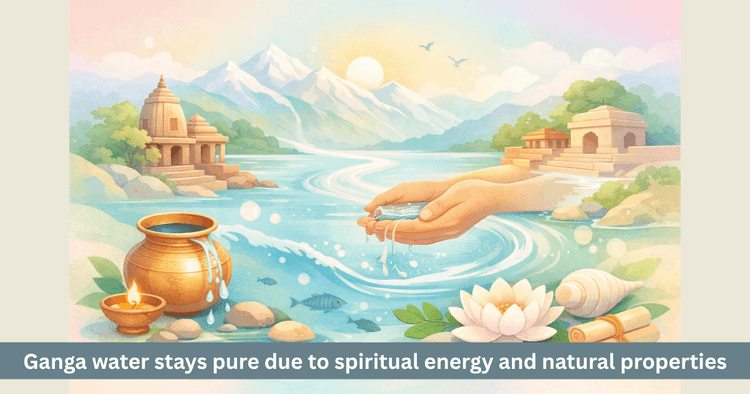
Table of Contents
In Indian tradition, Ganga water has never been regarded merely as natural water. It has been understood as a symbol of purity, life force, sacred संस्कार and divine touch. For centuries, a living belief has remained in the cultural mind that even if Ganga water is stored for a very long time, it does not deteriorate in the same way as ordinary water. This is why it has held a special place in homes, temples, rituals, sacred vows and even final rites. Yet this understanding does not belong only to faith. Behind it there also stand Puranic explanations, cultural memory and certain scientific observations that have tried to understand this remarkable quality.
To understand this unique nature of Ganga water, it is necessary not to approach it from a single angle. In Indian thought, no sacred substance is regarded as matter alone. It is also seen as a carrier of energy, memory and conscious presence. That is why when Ganga water is discussed, the language of laboratories alone does not seem complete and the language of scripture alone may also remain partial. When both are placed together, a fuller picture begins to emerge in which faith and observation each appear meaningful in their own way.
Why Is Ganga Water Regarded as So Sacred
The Puranas describe the origin of Ganga in a deeply divine way. She is called Vishnupadi, meaning the one who emerged from the feet of Bhagavan Vishnu. This title is not merely reverential. It indicates that the source of Ganga is not ordinary. Once a stream is linked to the touch of the supreme divine, Indian consciousness does not view it merely as a physical substance. This is why Ganga water has always been regarded as sacred, auspicious and worthy of use in the most refined rituals.
Several important beliefs arise from this sacred understanding:
- Because of her origin from the feet of Vishnu, the water is regarded as divine
- The blessing of the gods is believed to remain present in it
- It is seen not only as a means of outer cleansing but also of inner purification
- It is used in sacred rites because it is linked with spiritual balance and sanctity
How Do the Puranas Explain the Uniqueness of Ganga Water
In texts such as the Padma Purana and other traditional sources, the qualities of Ganga water are not described only in terms of ritual bathing. It is also suggested that there are subtle qualities present in this water which distinguish it from ordinary water. Some traditions mention that Ganga water carries a subtle influence of golden essence. Here gold may be understood not only in the literal sense but also as a symbol of radiance, purity and preservation.
The Puranic vision also says that Ganga flows through the three worlds. Because of this, her waters are not regarded as merely terrestrial. They are understood as the symbol of a wider sacred flow. This is why Ganga water came to be used in worship, mantra recitation, consecration, house rites, birth rituals, marriage and even death rites. Indian tradition thus regarded Ganga water not only as useful but as fit to carry sacred transformation.
Is the Special Nature of Ganga Water Limited Only to Faith
This is a natural question and here the modern perspective begins to enter. For a long time, people observed that Ganga water, even when stored for long periods, often did not develop foul odor or rapid decay in the same way as ordinary water. This led later observers and researchers to explore why this might be so.
Scientific observations have pointed out that certain types of bacteriophages have been found in Ganga water. These are subtle agents capable of acting against harmful bacteria. This means that when certain impurities or bacterial agents enter the water, these elements may help reduce or destroy them. Because of this, Ganga water has often been noted as retaining its qualities longer than ordinary water.
What Special Qualities Have Been Observed in Ganga Water Scientifically
Modern studies do not necessarily close the matter in a final way but they do offer certain useful indications. These should be understood carefully. Their purpose is not to prove or disprove faith but to examine the unique features of nature.
Some of the major observations associated with Ganga water are the following:
- It has been observed to contain bacteriophages, which can act against harmful bacteria
- It has been noted for having a relatively high level of dissolved oxygen, which may help preserve freshness
- It has shown a tendency toward a certain kind of self cleansing quality
- Even after prolonged storage, it has often been found to retain unusual stability compared to ordinary water
The following table helps place both perspectives together:
| Perspective | Explanation of Ganga Water | Main Indication |
|---|---|---|
| Puranic | Vishnupadi, filled with divine blessing | Divinity, sanctity, inner purification |
| Cultural | Used in every sacred rite | Tradition, faith, life rites |
| Scientific | Bacteriophages and special composition | Self cleansing, preservation, freshness |
| Spiritual | A current that purifies consciousness | Balance, energy, inward sanctity |
What Does the Term Bacteriophage Mean in Simple Language
This aspect is especially interesting to many people. In simple terms, bacteriophages are subtle entities that affect certain kinds of bacteria. If harmful bacteria begin to increase in water, such agents may play a role in limiting their spread. In relation to Ganga water, observations of this kind have drawn attention because they help explain why traditional experience may have noticed something unusual in its behavior.
One important thing must be understood here. If a natural cause is discovered, sacredness does not become smaller. And if reverence exists, observation does not become unnecessary. Both may stand together as two levels of one truth.
Why Is Dissolved Oxygen Also Considered Important
Yes, this is another significant aspect. A higher level of dissolved oxygen in water may help it remain fresh for a longer time. Where a body of water carries stronger life supporting balance, its behavior may differ from more ordinary stored water. Observations related to Ganga water have pointed in this direction as well.
Seen from the Indian perspective, it may also be said that what ancient people called life giving is now being approached through the language of living balance and structure. This is where tradition and scientific observation begin to appear in dialogue rather than conflict.
Why Has Such Deep Reverence for Ganga Water Continued in Indian Life
Long lasting reverence for any substance does not arise from imagination alone. It is supported by experience, use, ritual memory, generational transmission and collective trust. Ganga water was stored in homes, offered in worship, placed in the mouth of the dying, carried back from pilgrimage and used in the most sacred turning points of life. Such enduring use itself shows that Indian society treated it not merely as symbolic but as a living sacred presence.
This reverence survived also because people found in Ganga water not only a religious object but also an emotional refuge. In grief, vow, ritual, pilgrimage and transition, Ganga water became a reminder that purification is still possible.
What Does It Symbolize Spiritually That Ganga Water Does Not Easily Decay
At the spiritual level, this idea carries a beautiful meaning. If a substance retains its purity over time, then it also teaches us that purity can be greater than time. In that sense, Ganga water is not only water. It is a sign that when any element carries the right union of balance, energy and divine touch, it may behave differently from ordinary things.
This insight also applies to human life. If a person preserves inner balance, truth, purity and clarity of consciousness, then outer circumstances do not corrupt that person so easily. In this way, Ganga water becomes not only an outer substance but also an inner teaching.
Do Ancient Knowledge and Modern Science Seem to Stand Together Here
Yes and this is perhaps one of the most beautiful aspects of the subject. On one side, the Puranas say that Ganga is divine, Vishnupadi, flowing through the three worlds and that her water grants purification to the soul. On the other side, modern research attempts to understand what physical and biological qualities may make this water unusual. When seen properly, the two do not necessarily appear opposed. One speaks in the language of meaning, the other in the language of process. One speaks of spiritual experience, the other of natural mechanism.
This harmony gives us a more mature way of seeing. It suggests that reverence and observation can both contribute to understanding.
What Does This Secret of Ganga Water Teach Us Today
The modern mind often wishes to stand only with science or only with belief. The episode of Ganga water offers a third way, in which both may walk together. It teaches us that any truth may have several layers. What tradition knows through lived experience, science may later try to understand through another method.
For life today, this subject gives many teachings:
- Purity may be not only imagined but also experienced
- The value of a sacred element may lie in both its physical qualities and spiritual significance
- Purity is not limited to ritual but extends into the way one lives
- Nature still holds realities that invite humility
What Does This Unique Nature of Ganga Water Ultimately Tell Us
The long lasting freshness of Ganga water is not only a physical curiosity. It is a sign of a deeper relationship where divinity, nature, energy and human faith meet together. Ganga is not merely a river. In Indian consciousness she is a current that is outwardly water and inwardly an inspiration toward purification.
therefore the question of why Ganga water does not easily decay cannot be answered in a single line. It is linked with Puranic blessing, cultural reverence, natural uniqueness and spiritual experience all at once. That is the true beauty of this subject and that is its deepest teaching.
Frequently Asked Questions
Why is Ganga called Vishnupadi
Because the Puranas describe the origin of Ganga from the feet of Bhagavan Vishnu and for this reason she is called Vishnupadi.
Is the uniqueness of Ganga water based only on faith
No, along with traditional reverence, certain scientific observations have also pointed toward some unusual qualities in it.
What are bacteriophages
They are subtle biological agents capable of acting against certain harmful bacteria.
Why is Ganga water used in sacred rites
Because it is regarded as pure, fit for ritual use and as a means of both outer and inner purification.
What is the greatest teaching of this subject
It teaches that when purity, balance and the right energy come together, something may become special beyond ordinary limits.
Get your accurate Kundali
Generate KundaliDid you like it?
Author

Pt. Suvrat Sharma (63)
Experience: 20
Consults About: Family Planning, Career
Clients In: Punjab, Haryana, Delhi
Share this article with friends and family
About ZODIAQ
ZODIAQ is an online Vedic Astrology platform. It connects clients seeking astrological advice to experienced astrologers with deep knowledge. Our users also generate kundali and perform kundali milan for free. ZODIAQ also offers services to the Astrologers. Astrologers utilize various offerings by ZODIAQ to serve their clients effectively.
If you are a User
Consult with experienced astrologers and seek their guidance. You can also order handwritten Janm Patrika report with life prediction prepared by experienced astrologers. Generate accurate Kundali, perform Kundali Matching and check horoscope and muhurat. Utilize our online library for all the necessary astrological and spiritual information.
If you are an Astrologer
Create accurate kundali for your clients and perform Kundali Matching for up to 5 people at a time. Write comprehensive Janm Patrika report for your clients with ZODIAQ. Check client details anytime by saving it in client directory. Become more productive by tracking how many clients you guide every day.
WELCOME TO
ZODIAQ
Right Decisions at the right time with ZODIAQ
