Gangaputra Bhishma: The Unique Confluence of Sacrifice, Education and Dharma
By Pt. Sanjeev Sharma
The deep influence of Ganga, vows and teachings in Bhishma’s life
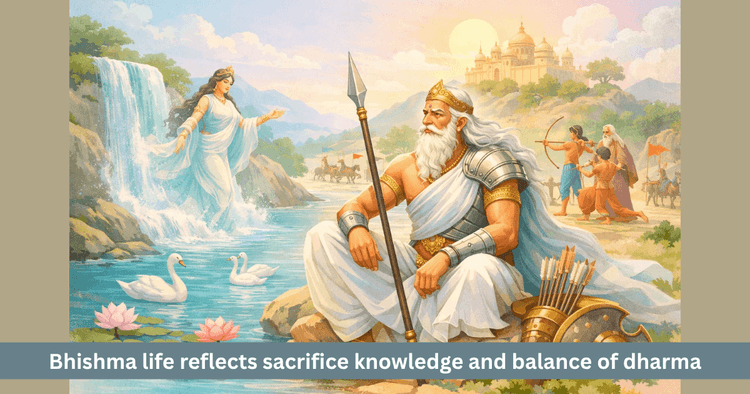
Table of Contents
In the great epics of India, some figures do not merely move through events. Their lives themselves become living interpretations of dharma, duty, self restraint and sacrifice. Bhishma Pitamaha is one such towering personality. To understand him only as the guardian of the Kuru lineage or as a great warrior of the Mahabharata is not enough. He represents a rare union where nobility of birth, the education given by his mother, the discipline received from great teachers and the difficult vows chosen by his own will together create an extraordinary life.
Bhishma is called Gangaputra, the son of Ganga and this title is not merely genealogical. It contains within it the current of his character, the source of his values and the purity of his inner being. Mother Ganga was not only his biological mother. She was also his first teacher, his first protector and his first source of dharmic inspiration. Born as Devavrata, this child was not nurtured only with affection. He was shaped toward a height from which he would one day become one of the greatest protectors of dharma and royal order.
Why is Gangaputra Bhishma considered so unique
The greatness of Bhishma can be seen on many levels at once. He was radiant by birth, deepened by education, immortalized by vow and remembered through ages because of his unwavering commitment to duty even amidst impossible moral dilemmas. Usually, a person may possess valor without sensitivity, knowledge without sacrifice or sacrifice without leadership. In Bhishma, all these qualities appeared together in unusual harmony.
Three foundations stand out behind his greatness.
• The formative influence of Mother Ganga
• The training received from great gurus in both arms and wisdom
• The inner resolve to place duty above personal life
These three together made him not merely a warrior but an ideal man of dharma.
The birth of Devavrata and the motherhood of Ganga
According to the Mahabharata, Devavrata was the son of King Shantanu and Mother Ganga. The motherhood of Ganga here was no ordinary motherhood. She was already of divine nature and her life was not limited by ordinary worldly patterns. From the very beginning, it was clear that this child was not born for a common existence. A special destiny was already forming within him.
Ganga took Devavrata away with her and raised him herself. Here motherhood appears in a very deep form. At times, the role of a mother is not only to give birth but also to guide the child toward his svadharma, his true inner path. Ganga did exactly this. She did not merely keep him safe. She prepared him inwardly so that he would be able to bear the great responsibilities that awaited him.
What kind of education did Ganga give Devavrata
The Mahabharata indicates that Ganga herself gave Devavrata his initial education. This was not limited to formal instruction. It included understanding of dharma, ethical discernment, balance of mind, discipline of speech and the gravity of duty. This inner foundation later became the source of the steadiness for which Bhishma is remembered.
Every great life is shaped by early impressions. In Bhishma’s case, this truth appears with special clarity. Had he received only martial training, he could still have become a great warrior. But what he received made him something greater than a warrior. It made him a warrior of dharma.
Main dimensions of Ganga’s education
• Training in self restraint
• The power of patience and silence
• Placing duty above personal desire
• Using strength within the limits of righteousness
These early impressions created the inner spine upon which the whole of Bhishma’s life would later stand.
Devavrata’s learning under great teachers
When Devavrata’s early education was complete, Ganga sent him to great masters. This too reveals the depth of her motherhood. She knew that no one sided training would be enough. Therefore he was placed in traditions where arms, scriptures, statecraft, Vedic wisdom, ethics and discipline could all be harmonized.
From Parashurama he received incomparable mastery of weapons and martial skill. From sages like Vashistha he received teachings of dharma, ethics, discernment and inner balance. In this way his education remained complete and many layered. It held power along with wisdom, courage along with restraint.
| Dimension of education | Guru or lineage | Effect in Bhishma’s life |
|---|---|---|
| Martial knowledge | Parashurama | Supreme mastery in warfare |
| Dharma and ethics | Vashistha and sages | Seriousness and righteousness in decision making |
| Self restraint | Maternal training and sage tradition | Steadiness in difficult circumstances |
| Rajadharma | Royal and scriptural learning | Responsibility toward kingdom and lineage |
This table shows clearly that Bhishma’s education was not merely intellectual acquisition. It was preparation for a vast role in life.
Was Bhishma only a warrior
This is an important question. If Bhishma is remembered only as a warrior in the Mahabharata war, then a very large part of his personality is lost. He was indeed a warrior but not only that. He was also a statesman, ethical thinker, man of vow, protector of lineage and guardian of order. His life shows that the highest form of strength is not destruction but control.
He had the ability to wage war but an even greater quality within him was the ability to hold, endure and restrain. He saw the complexities of dynastic politics, witnessed the rise of adharma and yet did not abandon the duty he had chosen. This was not easy. It required not only courage but extraordinary inner tapas.
Why is the Bhishma vow regarded as so great
The moment that made Devavrata immortal was the terrible vow he took. When King Shantanu desired to marry Satyavati, a difficulty arose between his personal happiness and the future of the kingdom. Satyavati’s father wanted the throne to pass only to a son born from her lineage. This created a deep conflict, because Devavrata was himself the natural heir to the throne.
At this point Devavrata took the vow that transformed him into Bhishma. He renounced not only the throne but also took a lifelong vow of celibacy, ensuring that no child from his own line would ever create a claim to succession. This was not an emotional impulse of a moment. It was the result of an entire life of discipline, education and dharmic clarity.
Why was this vow called terrible or awe inspiring
- It was not only a renunciation of power but of his personal future.
- It arose not merely from love for his father but also from responsibility toward the kingdom’s stability.
- It was not only a promise but a lifelong austerity.
This is why he came to be called Bhishma, the one who had taken an extremely difficult and fearsome vow.
What did sacrifice mean in Bhishma’s life
Sacrifice is often understood merely as giving something up. In Bhishma’s life, sacrifice was much deeper. He did not renounce only a throne. He renounced the possibility of ordinary companionship, lineage, familial future and personal fulfillment as a human being. Yet there was no bitterness in his sacrifice. This is an important truth.
True sacrifice is that in which the one who sacrifices does not become inwardly diminished but becomes more vast. Bhishma is great in precisely this sense. His renunciation does not make him small. It raises him so high that the whole Mahabharata continues to regard him with reverence.
Did education alone bring Bhishma to this vow
Yes and this is one of the deepest teachings of this episode. Real education does not only fill the mind with information. It makes a person capable of choosing rightly when personal desire and larger dharma stand face to face. Bhishma’s decision shows that his education had not remained at the level of words. It had entered his being.
This is especially important in the modern context. If education gives only skill but not value, a person may become successful but not truly great. Bhishma’s education gave him power guided by value. That is why his sacrifice was not blind. It was conscious, awake and rooted in dharma.
How did Ganga’s influence remain alive in Bhishma
The influence of Mother Ganga can be seen throughout Bhishma’s life. Ganga flows continuously, yet remains pure. She is cool, yet unwavering in her direction. In a similar way, Bhishma appears outwardly firm and grave, yet inwardly sensitive and deeply rooted in dharma. This balance of Ganga remained visible within him.
He was not merely a rigid man of rules. He understood the depth of circumstances. He was not merely obedient. He also felt the weight of moral conflict. This is why his character appears both complex and great at the same time. As the son of Ganga, he carried within himself purity, depth and the flowing awareness of dharma.
What does Bhishma’s life teach in the present age
In the modern world, education is often viewed only as a means to position and success. People ask what career it gives, what status it brings, what benefit it produces. Bhishma’s life offers a different vision. It teaches that the highest purpose of education is to establish discernment, values, restraint and a sense of duty within a person.
His life also teaches that greatness is not built through easy choices. It is built through difficult decisions, self mastery and loyalty to a higher purpose. If one wishes to learn from Bhishma today, one may learn that more important than power is its righteous use and more important than knowledge is its transformation into character.
Major lessons from Bhishma for contemporary life
• The purpose of education is not only success but also formation of character
• Sacrifice becomes meaningful only when joined with dharma and discernment
• The highest form of strength is self restraint
• The path of duty may be difficult, yet it alone gives enduring honor
The lasting light of Gangaputra Bhishma
The life of Bhishma Pitamaha is an extraordinary confluence in which motherhood, education, valor, sacrifice and dharma all appear together. Mother Ganga, by giving birth to him, did not merely offer a son to the world. She offered a personality who would remain a standard of duty and dignity for ages. His teachers gave him weapons and wisdom but his life itself proved the truth of what he had learned.
This is why Bhishma is not merely a character within the Mahabharata. He is the name of an ideal in which a human being may rise above personal comfort in order to live for a larger dharma. His life reminds us that when education enters deeply enough, it gives birth to sacrifice and when sacrifice is joined with dharma, a character is formed that continues to illuminate even beyond time.
Frequently Asked Questions
Why is Bhishma called Gangaputra
Because he was the son of Mother Ganga and King Shantanu and Ganga also raised and educated him in his early life.
How did Devavrata receive the name Bhishma
He took a terrible and awe inspiring vow of lifelong celibacy and renunciation of the throne for his father’s happiness and the kingdom’s stability.
Who educated Bhishma
Mother Ganga gave him his early education and later he received knowledge of weapons and scriptures from great teachers such as Parashurama and Vashistha.
Why is Bhishma’s sacrifice considered so great
Because he did not renounce only the throne but his entire personal future for the sake of dharma, his father and the stability of the kingdom.
What does Bhishma teach us today
He teaches that true education is that which gives character, restraint, duty consciousness and the capacity to make higher decisions.
Get your accurate Kundali
Generate KundaliDid you like it?
Author
Pt. Sanjeev Sharma (63)
Experience: 20
Consults About: Family Planning, Career
Clients In: Punjab, Haryana, Delhi
Share this article with friends and family
About ZODIAQ
ZODIAQ is an online Vedic Astrology platform. It connects clients seeking astrological advice to experienced astrologers with deep knowledge. Our users also generate kundali and perform kundali milan for free. ZODIAQ also offers services to the Astrologers. Astrologers utilize various offerings by ZODIAQ to serve their clients effectively.
If you are a User
Consult with experienced astrologers and seek their guidance. You can also order handwritten Janm Patrika report with life prediction prepared by experienced astrologers. Generate accurate Kundali, perform Kundali Matching and check horoscope and muhurat. Utilize our online library for all the necessary astrological and spiritual information.
If you are an Astrologer
Create accurate kundali for your clients and perform Kundali Matching for up to 5 people at a time. Write comprehensive Janm Patrika report for your clients with ZODIAQ. Check client details anytime by saving it in client directory. Become more productive by tracking how many clients you guide every day.
WELCOME TO
ZODIAQ
Right Decisions at the right time with ZODIAQ
