Lord Rama and Ganga: The Deeper Spiritual Meaning of the Kevat Episode
By Pt. Nilesh Sharma
The symbolic meaning of Kevat’s devotion and crossing Ganga with Rama
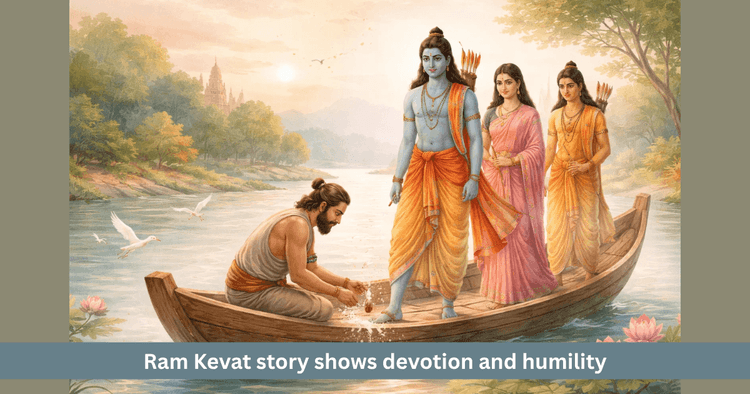
Table of Contents
In Indian culture, the life of Lord Rama is not merely the story of a prince or a king. It is a living embodiment of dharma, restraint, humility, compassion and sacred duty. Among the many moving episodes of the Ramayana, the Kevat episode associated with Mother Ganga is regarded as especially tender, deeply symbolic and spiritually profound. Outwardly, it appears to be only a crossing of a river. Inwardly, however it reveals the relationship between the Divine and the devotee, the nature of life’s transitions, the sanctity of a vow and the subtle strength of loving service.
When Rama left Ayodhya for exile, he was not only departing from a palace. He was entering a new phase of life, one in which royal comfort would give way to tapas, testing, endurance and inward growth. In the midst of this transition came the bank of Ganga and there, through the humble boatman Kevat, this narrative rises into extraordinary depth. It is the moment where God stands not in royal splendor but as a gentle traveler and the devotee appears not through great sacrifice or ritual but through simple loving service.
Why is the Kevat episode considered so heart touching
The Ramayana contains episodes of courage, war, renunciation and moral clarity. The uniqueness of the Kevat episode lies in its simplicity. There are no weapons here, no royal court and no great sermon. There is only a riverbank, a boat, the exiled Rama family and a boatman whose heart is filled with devotion.
This episode teaches that one does not need grandeur to come close to the Divine. Sometimes the deepest devotion expresses itself through the simplest words and the smallest acts. Kevat’s speech contains neither scriptural argument nor philosophical complexity. It carries only affection, reverence, humor and spiritual recognition. That is why this episode remains beloved in both sacred literature and folk memory.
What does Rama’s arrival at the bank of Ganga signify
The bank of Ganga here is not merely a geographical location. It represents the threshold between one stage of life and another. The royal life of Ayodhya has already been left behind and the forest life lies ahead. In this sense, the bank of Ganga becomes a point of transition.
When Rama, Sita and Lakshmana reach this place, the scene quietly reveals many truths of human life.
- An old phase is left behind
- A new path lies uncertain ahead
- The future is not fully visible
- And yet the journey cannot stop
Ganga becomes witness to this passage. She suggests that some journeys in life are not crossed by effort alone but by reverence and surrender.
Why did Kevat ask to wash Rama’s feet
The most beloved and moving moment in this episode is when Kevat expresses his wish to wash the feet of Lord Rama before allowing him to enter the boat. Outwardly, this appears almost playful. He says that since the touch of Rama’s feet turned stone into a woman, his boat might also transform if the feet touch it. Therefore he should first wash the feet.
Within this simple statement lie several layers of meaning.
The first is devotional humor. A true devotee does not fear the Lord but speaks with loving intimacy. The second is recognition of the greatness of Rama’s feet. Kevat knows that this is no ordinary traveler. The third is the yearning for service. He does not directly say that washing Rama’s feet is his blessing. Instead, he asks for the opportunity through a humble excuse. This is the beauty of devotion. It does not demand. It lovingly creates a way to serve.
Was Kevat’s statement only humorous
No. It also carries a deep spiritual indication. The story of stone becoming Ahalya is not only an event in the epic but also a symbol of the unconscious becoming conscious, the inert becoming awakened. Kevat recognizes that Rama’s feet hold the power of transformation. Therefore his reference to the boat is not merely about wood floating on water. It also symbolizes human life, one’s means and one’s own being.
This episode may also be understood in the following way.
| Element of the episode | Deeper meaning |
|---|---|
| Rama’s feet | Divine touch and grace |
| The boat | The means of life and passage |
| Washing the feet | Making oneself pure enough to serve |
| Crossing Ganga | Moving from one stage of life into another |
Thus Kevat’s act is not merely reverence. It is a subtle spiritual recognition. He knows that before divine presence is allowed into one’s life, one must become humble and inwardly prepared.
What is the true nature of the bond between Kevat and the Lord
This episode shows that the relationship between God and the devotee is not only one of worship but also of nearness, trust and inner recognition. Kevat does not see Rama merely as a prince. He sees him as his Lord. Rama does not see Kevat merely as a ferryman. He sees in him a heart full of love. That is why there is no distance in this episode. There is no fear, no excessive formality, only the free flow of a sacred relationship.
The highest form of devotion is often described as one in which the devotee feels close to the Divine while still preserving reverence. Kevat is a beautiful example of this balance. He washes Rama’s feet but not with arrogance. He serves but asks for no reward. He loves but without show.
How does crossing Ganga symbolize the journey of life
Rama’s crossing of Ganga is not merely physical movement from one shore to another. It points toward the unavoidable process by which one must move from one condition of life to another. From palace to forest, from comfort to austerity, from recognition to anonymity, from worldly order to spiritual testing, all this is contained in that crossing.
The symbolism of crossing Ganga includes many deeper meanings.
- Moving from comfort toward austerity
- Moving from identity toward simplicity
- Moving from security toward testing
- Moving from royal life toward the path of higher purpose
Rama remains calm in this entire process. His serenity teaches that one who walks the path of dharma does not keep lamenting change but accepts it with quiet readiness.
The vow of Sita to Mother Ganga
Another very important and touching dimension of this episode concerns Sita. During the exile journey, Sita prayed to Mother Ganga for protection through the difficult path ahead. She also made a vow that if they returned safely, she would worship Ganga and offer ornaments in gratitude.
Here Sita becomes the symbol of sacred promise and pure reverence. A prayer made in times of uncertainty reveals the depth of one’s faith. Sita did not merely ask for safety. She also held within herself the resolve that grace would be answered with gratitude.
What is the spiritual meaning of Sita’s vow
Sita’s vow teaches that prayer is not only asking. It also includes gratitude. When a human being turns toward the Divine or toward sacred nature during difficult times, it is an acknowledgment that one is not self sufficient. This humility gives prayer its depth.
Sita’s vow teaches three important truths.
- Faith is revealed in difficulty
- A vow must not only be spoken but fulfilled
- Gratitude completes devotion
After the exile, when Rama, Sita and Lakshmana returned to Ayodhya, Sita fulfilled her promise. This was not mere ritual. It was the purity of her character.
What kind of devotion does the Kevat episode represent
Many forms of devotion are described in spiritual tradition. The Kevat episode primarily represents service filled with selfless love. He asks for neither reward nor honor. He only longs for the chance to serve. That itself is his wealth.
This offers an important lesson for the present age. Many people serve for recognition, maintain relationships for gain and express reverence for convenience. Kevat reminds us that true devotion is where expectation is little and love is great.
Main qualities of Kevat’s devotion
- Simple speech
- Pure heart
- Longing to serve
- Absence of desire for reward
- Recognition of the Divine without display
What aspect of Rama is revealed in this episode
Throughout this episode Rama appears in his natural dignity and humility. He understands Kevat’s feeling, honors it and accepts his devotion with grace. This is the beauty of Rama. Though divine, he does not reject the love of his devotee. He does not belittle simplicity. He sees the feeling behind the act.
Rama’s conduct teaches that true greatness reveals itself through humility. The higher a being is, the more natural and gentle he can become. Rama is the perfect symbol of this ideal.
What does the triad of Ganga, Kevat and Rama represent
When seen more broadly, this episode contains three central elements.
-
Ganga : Divine grace, purification and the sacredness of life’s passage
-
Kevat : Love, service, devotion and selfless surrender
-
Rama : Dharma, humility, sacred order and divine presence
Together these create a complete spiritual image. If within a person there is the loving spirit of Kevat, if life carries the purifying current of Ganga and if the goal is illumined by the dharma of Rama, then even difficult journeys become sacred.
What is the relevance of this episode in modern life
Modern people often stand at many inner riverbanks. Changing work, leaving home, undergoing crisis, entering a new relationship, facing illness or walking through emotional uncertainty, all are ways of standing between one shore and another.
At such moments, this episode teaches that
- Every transition should be crossed not with fear but with reverence
- Humility often becomes the greatest support in difficulty
- Gratitude and sacred promise give depth to the journey
- Ordinary people can become instruments of divine work
What is the deepest indication of this episode
The deeper meaning of the episode of Rama, Ganga and Kevat is that no journey in life is completed through outer effort alone. It also requires trust, humility, surrender and inner balance. Ganga represents the divine force that carries us across. Kevat represents the loving service that makes that crossing possible. Rama represents the truth that when life is lived in dharma, even hardship begins to take on a higher purpose.
The final spiritual meaning of the story is that when promise, devotion and faith remain together in life, then even exile no longer remains merely a path of sorrow. It becomes a journey of purification, inner maturity and nearness to the Divine.
Frequently Asked Questions
Why did Kevat wish to wash the feet of Lord Rama
He was filled with deep devotion. He knew the greatness of Rama’s feet and desired the blessing of service.
Was crossing Ganga only a physical journey
No. It also symbolized entering a new stage of life.
What vow did Sita make to Ganga
She prayed for protection during exile and vowed to worship Ganga and offer ornaments upon their safe return.
What is the greatest message of the Kevat episode
It teaches that true devotion expresses itself through simple, selfless and loving service.
What does this story teach for life today
It teaches that difficult transitions should be crossed with patience, reverence, sacred promise and humility.
Get your accurate Kundali
Generate KundaliDid you like it?
Author

Pt. Nilesh Sharma (63)
Experience: 20
Consults About: Family Planning, Career
Clients In: Punjab, Haryana, Delhi
Share this article with friends and family
About ZODIAQ
ZODIAQ is an online Vedic Astrology platform. It connects clients seeking astrological advice to experienced astrologers with deep knowledge. Our users also generate kundali and perform kundali milan for free. ZODIAQ also offers services to the Astrologers. Astrologers utilize various offerings by ZODIAQ to serve their clients effectively.
If you are a User
Consult with experienced astrologers and seek their guidance. You can also order handwritten Janm Patrika report with life prediction prepared by experienced astrologers. Generate accurate Kundali, perform Kundali Matching and check horoscope and muhurat. Utilize our online library for all the necessary astrological and spiritual information.
If you are an Astrologer
Create accurate kundali for your clients and perform Kundali Matching for up to 5 people at a time. Write comprehensive Janm Patrika report for your clients with ZODIAQ. Check client details anytime by saving it in client directory. Become more productive by tracking how many clients you guide every day.
WELCOME TO
ZODIAQ
Right Decisions at the right time with ZODIAQ
