The Sons of King Sagara and the Descent of Ganga: The Sole Stream of Liberation
By Pt. Abhishek Sharma
The story of Sagara’s sons and the spiritual significance of Ganga’s descent
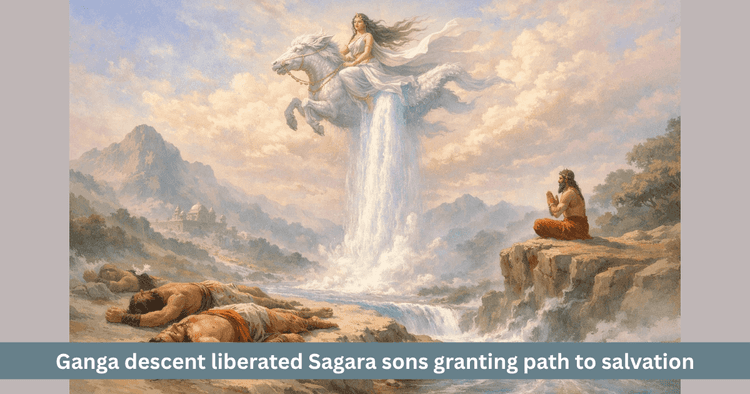
Table of Contents
In Indian sacred tradition, the descent of Mother Ganga to Earth is not merely a mythological event. It is a profound story of ancestral liberation, austerity, resolve and divine grace. This episode teaches that the determined effort of one person can become the cause of welfare for an entire lineage. It also shows that when human error becomes too deep for ordinary correction, divine purification becomes necessary.
According to the Balakanda of the Valmiki Ramayana, King Sagara had sixty thousand sons. During an Ashvamedha sacrifice, the ritual horse disappeared and the princes set out in search of it. Their search was not simply the search for an animal. It became a turning point for their destiny, for their lineage and eventually for the entire spiritual imagination of India.
The Ashvamedha of King Sagara and the disappearance of the horse
King Sagara was a mighty ruler and the Ashvamedha yajna he performed was no ordinary ritual. In Vedic tradition, it was a declaration of sovereign authority, dharma and royal dignity. The sacrificial horse moving freely across lands symbolized the king’s power and legitimacy. therefore when the horse suddenly disappeared, the event became more than an inconvenience. It became a serious spiritual and royal disruption.
The sixty thousand sons of Sagara set out with force and urgency. They dug through the earth, searched tirelessly and finally reached the place where the great sage Kapila was seated in deep meditation. Near him, they saw the horse. That single sight became the source of their ruin.
What mistake did the sons of Sagara make before Kapila Muni
The greatest tragedy of this episode lies in the fact that the princes did not pause to discern. They did not ask, they did not reflect and they did not honor the spiritual stature of the sage before them. Instead, driven by agitation and ignorance, they accused Kapila Muni of stealing the horse and interrupted his tapas.
This was not merely discourtesy. It was adharma born of haste, arrogance and lack of discernment. In Indian thought, to insult or disturb a sage immersed in deep austerity is not simply a social error. It is a violation of cosmic and spiritual order. Their downfall did not begin in battle. It began in impatience, false accusation and inner blindness.
Spiritual lessons hidden in their mistake
- Power without discernment leads toward destruction.
- Immediate judgment without inner clarity can become dangerous.
- The force of tapas cannot be measured through ordinary perception.
The fiery result of Kapila’s tapas
Kapila Muni was immersed in meditation. When his austerity was disturbed and he was falsely accused, the energy of his tapas responded. Many traditional interpretations suggest that this should not be seen merely as personal anger but as the natural consequence of coming into conflict with a concentrated field of spiritual fire. Just as darkness cannot remain before the sun, adharma could not remain before the power of Kapila’s tapas.
By the radiance of his sight alone, all sixty thousand sons of Sagara were reduced to ashes. Their bodies were destroyed and their souls remained in an unfinished, suspended state. This is the most painful aspect of the story. It is not only about death. It is about incompletion. They were not liberated. They were not at peace. They remained awaiting release.
At this point, the story shifts into a deeper spiritual dimension. The question was no longer only how they were destroyed. The question became how they could be redeemed.
Why was ordinary liberation not possible for them
The condition of Sagara’s sons was not considered ordinary. They were destroyed by the blazing force of Kapila’s tapas and because of the nature of their downfall, common rites were not enough for their release. This teaches an important principle. Some karmic consequences are so deep that their resolution also requires an extraordinary spiritual intervention.
It became clear that only a divine force capable of complete purification could grant them liberation. This is where Ganga enters the story. Ganga is not merely a river. She is the celestial stream of purification, the remover of sin and the giver of liberation. If she could descend to Earth and touch the ashes of Sagara’s sons, then their souls could finally be released.
Thus the center of the narrative moves from the princes to the one who would later carry the burden of redeeming them.
Why is Bhagiratha’s resolve regarded as extraordinary
In the lineage of Sagara was born Bhagiratha. When he learned that his ancestors remained in an incomplete state and that their liberation still awaited fulfillment, he resolved that he would bring Ganga down to Earth. This moment transforms the story from a tale of ruin into a grand epic of human effort, ancestral duty and sacred persistence.
Bhagiratha did not take this vow for personal gain. He did not seek wealth, kingdom or fame. What moved him was a deep sense of reverence toward his ancestors, compassion and dharma. This is why even today, any immensely difficult effort undertaken for a noble purpose is remembered as a “Bhagiratha effort.”
The greatness of Bhagiratha’s resolve
| Quality | Meaning |
|---|---|
| Reverence for ancestors | Fulfillment of lineage duty |
| Patience | Capacity for long austerity |
| Tapasya | Self discipline for a higher purpose |
| Collective welfare | Rising above personal benefit |
Bhagiratha teaches that one sincere person can change the destiny of many.
Why was bringing Ganga to Earth such a difficult task
Ganga was a celestial stream and her force was immense. She could not simply descend to Earth unrestrained, because the Earth could not bear the intensity of her fall. Here the story reveals another deep truth. Divine force without containment can overwhelm the world it is meant to bless.
Bhagiratha’s tapas pleased Ganga and she agreed to descend. Yet her very nature made it clear that another divine support would be necessary. Her descent required a power capable of receiving, holding and regulating her force. That power was Shiva.
This also teaches a subtle lesson for life. Great opportunity and divine grace are not enough by themselves. There must also be capacity, stability and inner preparedness to receive them. Thus Bhagiratha’s resolve, Ganga’s compassion and Shiva’s containment together made liberation possible.
What does Shiva holding Ganga in his locks signify
When Ganga began her descent, Shiva received her into his matted locks. This image is one of the most beautiful in sacred literature, yet it also carries profound philosophy. Ganga represents immense descending grace and Shiva’s locks represent restrained consciousness and supreme steadiness. This means that if divine power is to become beneficial in the human world, it must first pass through the medium of patience, containment and stability.
If Bhagiratha represents sacred resolve, then Shiva represents the power to hold what is too vast. Both are necessary. Without effort, grace does not descend. Without containment, grace cannot become fruitful.
Why is the liberation of Sagara’s sons considered so sacred
At last, Ganga flowed upon Earth and Bhagiratha led her to the place where the ashes of Sagara’s sons lay. When the holy stream touched those ashes, they attained liberation. This was not simply contact with water. It was the touch of divine purification, release and grace.
Their incomplete state came to an end. Their lineage found peace through Bhagiratha’s effort. This is why Ganga is called not only a river but also the stream of liberation. In this episode she proves that even where karma is severe, the path of compassion is not closed.
What is the deeper philosophical meaning of this episode
This story offers many levels of reflection. First, it teaches that lack of discernment can affect generations. The mistake of Sagara’s sons created an unresolved burden for the entire lineage. Second, it teaches that one person’s tapas and resolve can become the cause of redemption for many souls. Bhagiratha embodies this truth.
Third and most deeply, it teaches that liberation is not always a matter of personal spiritual effort alone. It can also be connected with reverence for ancestors, collective responsibility and higher purpose. Thus the story is not merely about destruction and release. It is about the interwoven relation of karma, lineage, tapasya and divine grace.
Major philosophical teachings of this episode
- The effect of karma is never isolated.
- Responsibility toward lineage and society is also part of dharma.
- Divine help appears when resolve is true and sustained.
- The path of liberation often opens when one rises above personal comfort.
Why is this narrative relevant even today
In modern life, people often think only within the limits of personal comfort, private gain and individual success. This story offers a wider vision. It tells us that our actions do not belong to us alone. Their influence travels through family, lineage, society and future generations.
In the same way, our noble efforts too do not remain limited to us. One sincere person can alter the destiny of a family. One act of truth and sacrifice can become light for generations. Bhagiratha reminds us that the greatest work of life may sometimes be that in which one rises above the self.
Why is Ganga called the sole stream of liberation here
Ganga may rightly be called the sole stream of liberation in this episode because there was no other path left for the redemption of Sagara’s sons. She was not simply an option. She was the essential answer. In this sense, Ganga becomes the final form of divine grace where human error, unfinished karma and suspended existence require a power greater than ordinary remedy.
This symbol remains powerful even now. There are moments in life when ordinary solutions are not enough. At such times what is needed is not merely convenience but purification. Not merely resolution but grace. Ganga stands for that grace.
Frequently Asked Questions
Why were the sons of King Sagara destroyed
They accused Kapila Muni in ignorance and interrupted his tapas and by the force of his spiritual radiance they were reduced to ashes.
Why could they not be liberated through ordinary means
Because their condition was not an ordinary post death state. Their redemption required divine purification, which was possible only through the touch of Ganga.
Why is Bhagiratha’s effort considered so महान
Because he rose above personal interest and undertook immense tapasya solely for the liberation of his ancestors.
What was Shiva’s role in bringing Ganga to Earth
Ganga’s force was too great for Earth to bear. Shiva held her in his locks and regulated her descent.
What does this story teach for life today
It teaches that our actions affect generations and that one person’s sincere resolve can become a source of welfare for many lives.
Get your accurate Kundali
Generate KundaliDid you like it?
Author

Pt. Abhishek Sharma (63)
Experience: 20
Consults About: Family Planning, Career
Clients In: Punjab, Haryana, Delhi
Share this article with friends and family
About ZODIAQ
ZODIAQ is an online Vedic Astrology platform. It connects clients seeking astrological advice to experienced astrologers with deep knowledge. Our users also generate kundali and perform kundali milan for free. ZODIAQ also offers services to the Astrologers. Astrologers utilize various offerings by ZODIAQ to serve their clients effectively.
If you are a User
Consult with experienced astrologers and seek their guidance. You can also order handwritten Janm Patrika report with life prediction prepared by experienced astrologers. Generate accurate Kundali, perform Kundali Matching and check horoscope and muhurat. Utilize our online library for all the necessary astrological and spiritual information.
If you are an Astrologer
Create accurate kundali for your clients and perform Kundali Matching for up to 5 people at a time. Write comprehensive Janm Patrika report for your clients with ZODIAQ. Check client details anytime by saving it in client directory. Become more productive by tracking how many clients you guide every day.
WELCOME TO
ZODIAQ
Right Decisions at the right time with ZODIAQ
