The Relationship Between Yamaraja and Ganga: The Divine Path from Death to Liberation
By Pt. Amitabh Sharma
The spiritual mystery of death, karma and liberation on the banks of Ganga
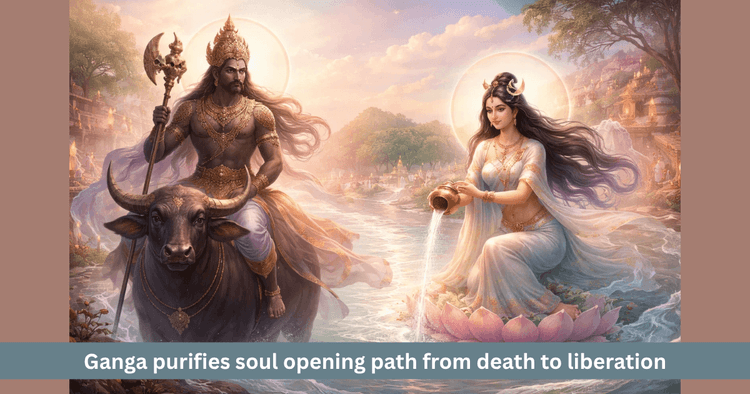
Table of Contents
In the spiritual tradition of India, Mother Ganga is not seen merely as a sacred river. She is regarded as the living current of liberation, purification, inner upliftment and divine compassion. On her banks, both life and death are seen in a striking balance. Birth rites are performed there, tapas are undertaken there, prayers are offered there and many final journeys also reach completion in her presence. This is why every belief connected with Ganga carries within it not only devotion but also a profound spiritual truth.
In this context, the relationship between Yamaraja and Ganga is considered especially significant. The belief that one who leaves the body on the banks of Ganga does not have to go to the court of Yamaraja may appear at first to be only a matter of faith. Yet from the perspective of Indian spiritual philosophy, this idea is deeply related to the purification of the soul, the burden of karma, the process of death and the possibility of liberation. Ganga here is not merely water. She is the stream that can lighten the burden of the soul.
Why is death on the banks of Ganga considered so sacred
In an ordinary view, death appears as fear, loss and ending. But in Indian philosophy, death is not understood only as termination. It is also seen as a transition, a passage and entry into another stage of existence. This is why the place, the state of consciousness and the spiritual atmosphere surrounding death are given deep importance. If the soul is agitated, fearful and attached at the final moment, its onward journey is understood differently. If that same soul is surrounded by peace, reverence and sanctity, its transition is believed to be very different.
Death on the banks of Ganga is considered sacred because the atmosphere there is not merely physical. Water, mantra, remembrance, detachment, impermanence and divine awareness all come together in one place. In that presence, a human being may feel that all life is flowing onward and that liberation begins when one learns how to let go.
Mythological foundation and the divine instruction of Yamaraja
The Vishnu Purana gives an indication of the belief that Yamaraja instructed his messengers not to approach the devotees of Ganga. This does not mean that the law of death comes to an end or that karma ceases to function. The deeper suggestion is that a soul touched by the grace and sanctity of Ganga has already reached a higher degree of purification. Such a soul may not need to undergo the ordinary karmic process in the same way as others.
A profound insight is hidden here. Yamaraja is not the lord of punishment alone. He is the lord of justice and karmic order. His function is to move the soul onward according to its actions. If a soul has already become lighter through Ganga’s grace, devotion and inner purification, then the formal process associated with Yamaloka may no longer remain necessary in the same way.
Why is Ganga called Tripathaga
Ganga is called Tripathaga, meaning the sacred stream that flows through the three worlds. This title is itself very meaningful. It does not merely suggest geographical reach. It reveals that Ganga touches the gross, subtle and divine levels of existence.
This can be understood in the following way
- On the gross level, Ganga touches body, society and culture
- On the subtle level, she becomes the symbol of cleansing memory, mind and inner impressions
- On the divine level, she is seen as the stream of liberation and spiritual ascent
This is why the waters of Ganga are never regarded as ordinary waters. They are seen as a medium through which the soul may be lifted beyond the cycle of birth and death.
What is the true difference between death and liberation
In Indian philosophy, death and liberation are not the same. Death is the leaving of the body but liberation is a far deeper condition. Death comes to all beings but liberation is not automatically attained by all. Liberation means freedom from karmic bondage, transcendence of rebirth and the soul’s movement toward its pure state.
Yamaraja’s role is to guide the soul onward according to karma. But if the soul has already become purified, inwardly balanced and lighter through divine contact, then it may enter a higher state than ordinary death would imply. This is where Ganga becomes significant. Death by the banks of Ganga does not merely mean dying in a holy place. It also means that at the final moment the soul is in the presence of a divine current that can guide it from fear toward reverence, from bondage toward peace and from death toward liberation.
Why are the banks of Ganga called places of liberation
Since ancient times, places situated on the banks of Ganga have been regarded as moksha sthalas, places associated with liberation. Kashi, Prayag, Haridwar and Gangasagar are not only locations on a map. They are meeting points of life and death. Final rites are performed there but so are initiations, acts of charity, austerities, vows and sacred bathing. This itself shows that Ganga is connected not only with endings but with the whole cycle of life.
The spiritual significance of the banks of Ganga may be understood in several ways
| Aspect | Deeper meaning |
|---|---|
| Water | Symbol of outer and inner purification |
| Bank | Boundary between life and death |
| Flow | Continuous change and impermanence |
| Pilgrimage atmosphere | A field that lifts consciousness upward |
The banks of Ganga allow the human being to sense that death too belongs to the same flow as life. It is not outside it.
Does death by the Ganga alone guarantee liberation
This is a very important question. If the teaching is understood only outwardly, it remains incomplete. In Indian spirituality, place certainly matters but consciousness, devotion, conduct and lifelong inner preparation matter even more. Death on the banks of Ganga is revered because it surrounds the soul with an elevated spiritual atmosphere at the final moment. But if a person has lived in complete inner impurity and only the place changes at the end, it would be too simplistic to assume that everything is transformed automatically.
Therefore the deeper meaning of this belief is that
- Ganga’s banks are a place of grace
- The remembrance of Ganga is a means of inner purification
- Death near Ganga is an opportunity for spiritual awakening at the final moment
- Yet the consciousness cultivated throughout life is equally important
What does the relationship between Yamaraja and Ganga teach us
This episode is not meant to make human beings fearful of death. It is meant to encourage purification of life. If the influence of Ganga can raise a soul beyond the ordinary passage associated with Yama, then the teaching is that one should begin, even now, to allow purity, balance, devotion and righteous conduct to flow within. Ganga is not only an outer river. She is also an inner current. When a person begins to wash the impurities within, death itself starts to appear differently.
The real indication of this teaching is not that something special happens only after death. It is that if one washes the inner burden while living, then death no longer remains as frightening. It becomes a passage, not a catastrophe.
The psychological meaning of this sacred relationship
This teaching can also be understood on a psychological level. Yamaraja here may be seen not only as a deity but also as the symbol of justice, inevitability and the final truth of life. Ganga becomes the symbol of forgiveness, coolness, cleansing and emotional release. When a person inwardly connects with Ganga, one learns how to become lighter. As the inner burden reduces, fear of death also begins to soften.
In this sense, the relationship suggests that
- where inner purification increases, fear of death decreases
- where life grows in sacredness, the burden of karma becomes lighter
- where surrender appears, the panic of losing control diminishes
This is why a person seated on the banks of Ganga may sometimes accept the impermanence of life more naturally.
What does this episode mean in the present age
Modern humanity often becomes uncomfortable even at the mention of death because life has been bound tightly to achievements, relationships and identities. The person has not learned how to let go and therefore the thought of ending becomes frightening. In such a time, the relationship between Yamaraja and Ganga offers deep reassurance. It says that death can be approached not through fear but through purification, devotion and inner balance.
For the present age, this teaching offers guidance on three levels
1. Make life lighter
Reduce bitterness, burden and unnecessary attachment
2. Awaken the inner Ganga
Increase self reflection, prayer, compassion and righteous action
3. Understand death as transition
Not as an absolute end but as movement into another state
What is the deepest indication of this teaching
The real meaning of this entire teaching is not merely that if death occurs by the Ganga one is spared from Yamaraja. Its deeper meaning is that when the soul becomes pure, balanced and filled with divine remembrance, then death itself becomes only a transformation. Yamaraja then no longer appears as the symbol of fear but as the symbol of an order that a purified soul may pass through with ease.
Ganga is the divine companion in this process. She teaches that the purpose of life is not only worldly achievement. Inner cleansing, compassion, surrender and refinement of consciousness are equally necessary. One who understands this no longer sees death as terror. It becomes a doorway.
Frequently Asked Questions
Does death on the banks of Ganga truly grant liberation
In spiritual tradition, death by the Ganga is regarded as a deeply sacred condition for the soul but lifelong consciousness, devotion and conduct also remain important.
What does it mean that Yamaraja does not send his messengers to the devotees of Ganga
Its subtle meaning is that a soul purified by the grace of Ganga may rise above the ordinary karmic process.
Why is Ganga called Tripathaga
Because she is regarded as the divine stream that flows through the three worlds and touches gross, subtle and divine levels of existence.
Does this teaching also have a psychological meaning
Yes. Ganga symbolizes inner cleansing and release, while Yamaraja symbolizes justice and the final truth of life.
What is the main lesson of this teaching for today
The deepest lesson is that purifying life through devotion, simplicity and inner balance is the most profound way to lessen the fear of death.
Get your accurate Kundali
Generate KundaliDid you like it?
Author
Pt. Amitabh Sharma (56 Years)
Experience: 20
Consults About: Family Planning, Career
Clients In: Punjab, Haryana, Delhi
Share this article with friends and family
About ZODIAQ
ZODIAQ is an online Vedic Astrology platform. It connects clients seeking astrological advice to experienced astrologers with deep knowledge. Our users also generate kundali and perform kundali milan for free. ZODIAQ also offers services to the Astrologers. Astrologers utilize various offerings by ZODIAQ to serve their clients effectively.
If you are a User
Consult with experienced astrologers and seek their guidance. You can also order handwritten Janm Patrika report with life prediction prepared by experienced astrologers. Generate accurate Kundali, perform Kundali Matching and check horoscope and muhurat. Utilize our online library for all the necessary astrological and spiritual information.
If you are an Astrologer
Create accurate kundali for your clients and perform Kundali Matching for up to 5 people at a time. Write comprehensive Janm Patrika report for your clients with ZODIAQ. Check client details anytime by saving it in client directory. Become more productive by tracking how many clients you guide every day.
WELCOME TO
ZODIAQ
Right Decisions at the right time with ZODIAQ
