Ashwatthama and Kartikeya: Secret of Dhanurveda and Divine Warfare Discipline
By Aparna Patni
Martial wisdom, divine teaching and the spiritual science of warfare
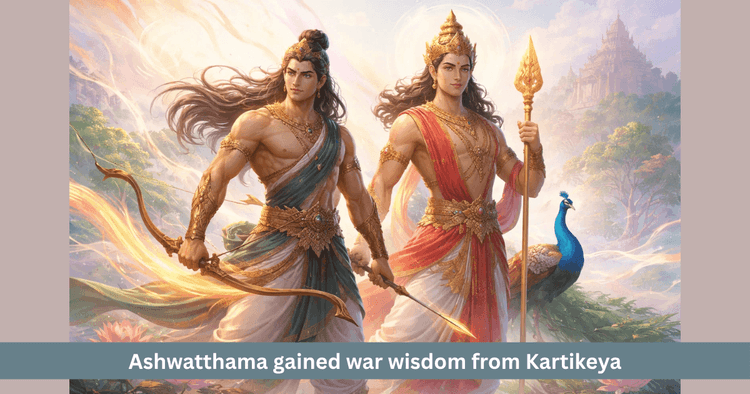
Table of Contents
In the vast narrative of the Mahabharata, there are certain episodes that appear small at first glance, yet within them lie very deep layers of war, tapas, lineage of knowledge, divine grace and consciousness. The connection between Ashwatthama and Bhagavan Kartikeya is one such important episode. Ashwatthama is generally remembered as the son of Dronacharya, a mighty warrior and one of the most intense figures of the Mahabharata war. Kartikeya, on the other hand, is seen as the commander of the divine hosts, the symbol of celestial valor, strategy and disciplined martial force. When these two names come together, the relationship is no longer merely that of a warrior and a deity. It becomes a meeting point of martial knowledge and divine discipline.
It is said in the Drona Parva of the Mahabharata that Bhagavan Kartikeya taught Ashwatthama certain special and secret methods of Dhanurveda. This statement does not merely mean that Ashwatthama learned some additional techniques of weaponry. Its deeper indication is that war was never seen merely as a matter of physical skill. It was also a science of consciousness, stability, memory, discipline and the focused use of inner energy. That is why Dhanurveda was not understood simply as the art of wielding arms. It was regarded as a complete science of warfare, a discipline and even a sacred knowledge.
What Was There in Ashwatthama That Made Him Worthy of This Knowledge
Ashwatthama is a deeply complex character. He was not an ordinary warrior. As the son of Dronacharya, he was raised in an atmosphere of martial learning, weapon science, discipline and the ethos of sacred warfare. He possessed extraordinary memory, skill in combat and inner intensity. Yet there was another element in him as well and that was a blazing force within. When such force is balanced, it becomes heroic power. When it becomes imbalanced, it can become a source of destruction and inner unrest.
This is what makes the connection with Kartikeya so meaningful. Kartikeya is not merely the deity of war. He is the symbol of disciplined warfare, dharmic valor and strategic awareness. If a warrior like Ashwatthama was granted secret teachings of Dhanurveda by Kartikeya, it means that he was not merely strong but also capable of receiving a higher level of martial consciousness.
Why Is Kartikeya Associated With Dhanurveda
The form of Bhagavan Kartikeya is highly distinctive in Indian tradition. He is not merely a warrior deity. He is the deity of the ethics of battle, strategy, courage, speed and disciplined power. His vehicle, his spear, his brilliance and his role as commander of the divine armies all indicate that he symbolizes a force that does not merely strike but acts in the right direction, at the right time, for the side of dharma.
In the context of Dhanurveda, Kartikeya’s importance may be understood through the following:
- He is regarded as the divine presiding force of martial skill
- He symbolizes the power to focus energy upon the goal
- He transforms warfare from mere violence into an instrument of protection of dharma
- He represents the union of weapon knowledge and disciplined consciousness
For this reason, the knowledge given by him to Ashwatthama may be understood not merely as technical instruction but as a higher martial sadhana.
What Is Meant by the Secret Methods of Dhanurveda
If Dhanurveda is reduced to the art of archery alone, only a small part of its true nature is understood. In the ancient Indian martial framework, Dhanurveda meant the science of weapons, knowledge of aim, control of the mind, recognition of timing, understanding the battlefield, maintaining balance between attack and defense and measured use of force. therefore when it is said in the Mahabharata that Kartikeya taught Ashwatthama certain secret methods, it suggests a level beyond ordinary training.
These secret methods may be linked to meanings such as the following:
| Dimension | Deeper Meaning |
|---|---|
| Precision of aim | Not only outer target but inner concentration |
| Use of weapons | Measured and appropriate application of force |
| Martial memory | The ability to read situations instantly |
| Control of energy | Turning anger into directed valor |
| Divine discipline | Fighting while remaining aligned with dharma |
This table makes it clear that the secret of Dhanurveda lay not only in the hand but also in consciousness.
Is This Episode Limited Only to Training in Weapons
No, its meaning is much larger. Kartikeya teaching Ashwatthama secret martial knowledge also suggests that in ancient Indian thought, war itself was a spiritual responsibility. Whoever was granted higher knowledge of warfare was also expected to be capable of bearing that power without abusing it. This makes the episode even more serious, because the later life of Ashwatthama in the Mahabharata also shows that receiving knowledge is not enough. That knowledge must be held with dharma, restraint and inner balance.
From this perspective, the episode gives a twofold teaching:
- Eligibility to receive higher knowledge is rare
- Moral capacity to hold that knowledge is rarer still
What Does the Connection Between Ashwatthama and Kartikeya Teach at the Psychological Level
If this episode is read as an inner journey, then Ashwatthama appears as the symbol of that intense but restless warrior force within the human being that is filled with power but needs direction. Kartikeya symbolizes the divine discipline that structures such power. In this way, the story becomes a beautiful presentation of two states that coexist within the human being.
This relationship may be understood inwardly in the following way:
- The Ashwatthama principle, meaning intense force, quick reaction and warrior impulse
- The Kartikeya principle, meaning strategic awareness, control of energy and dharmic courage
- The secret methods of Dhanurveda, meaning the science of directing inner power in the right way
Thus the story ceases to be merely mythological and becomes highly practical.
Does This Episode Also Indicate the Tradition of Guru Lineage
Yes and very deeply. Ashwatthama was the son of Dronacharya. He was already the inheritor of a great lineage of martial wisdom. Yet if he still received special instruction from Kartikeya, this indicates that in the Indian tradition, knowledge existed in many layers. One guru gives the foundation, another gives vision and yet another reveals deeper secrets. This means that the path of mastery is multilayered.
The episode teaches the following about the guru tradition:
- Not all knowledge becomes complete from a single source
- Higher disciplines may require divine guruhood
- The guru is not always only a person but may also be a deity principle
- As the eligibility of the disciple grows, more subtle knowledge becomes available
How Does This Story Reveal the Relationship Between Martial Knowledge and Dharma
The entire structure of the Mahabharata stands upon the question of whether power is being used for dharma or not. Ashwatthama’s life intensifies that question even further. On one side, he is endowed with immense knowledge. On the other, his later actions become the cause of deep pain and ethical disturbance. therefore the episode connected with Kartikeya reminds us that even receiving divine knowledge is not the final achievement. The real test is the spirit in which that knowledge is used.
In this context, the three levels of martial knowledge may be understood as:
- Acquiring power
- Maintaining control over power
- Using power in alignment with dharma
The third level is the most difficult and that is also one of the great teachings of the Mahabharata.
What Is the Relevance of This Episode in the Present Age
Today the bow and weapon sciences may not appear in the same form as they did in ancient times, yet power, strategy, aggression, mental force and decisiveness are still present in human life. The form of warfare has changed. The struggle is now often more inward than outward. Competition, tension, reaction, ambition and anger, all function like modern forms of the Ashwatthama principle. In such a time, the episode of Kartikeya teaches that energy should not merely be released. It requires structure, restraint and right direction.
For modern life, this episode offers several practical teachings:
- It is not enough merely to possess strength. One must possess disciplined strength
- Knowledge alone is not sufficient. It must be joined with dharmic use
- Reaction is easy but strategic awareness is difficult
- To conquer the inner battlefield, one requires not only outer skill but discipline of consciousness
The Final Illumination of This Episode
The relationship between Ashwatthama and Kartikeya reveals a profound understanding within the Indian tradition, where warfare itself is viewed not merely as violence but as a matter of consciousness, responsibility and discipline. The mention in the Drona Parva of the Mahabharata that Kartikeya taught Ashwatthama certain special secret methods of Dhanurveda indicates that higher power is always linked with eligibility, restraint and divine grace.
therefore the real meaning of this episode is not merely that Ashwatthama was a great warrior. Its deeper meaning is that knowledge which gives direction to energy, consciousness that joins power with dharma and discipline that transforms war into sacred responsibility, this alone is the true spirit of Dhanurveda. Kartikeya is the symbol of that divine discipline and Ashwatthama of powerful eligibility. That is the most serious and enduring message of this episode.
Frequently Asked Questions
Where is the connection between Ashwatthama and Kartikeya mentioned
It is said in the Drona Parva of the Mahabharata that Kartikeya taught Ashwatthama certain special secret methods of Dhanurveda.
Is Dhanurveda only the art of archery
No, Dhanurveda is a broader science of martial skill, concentration, energy control and strategic discipline.
Why is Kartikeya regarded as the presiding force of this knowledge
Because he symbolizes divine martial power, disciplined valor and strategy aligned with dharma.
What is the psychological meaning of this story
It symbolizes the process of giving divine discipline and right direction to intense inner energy.
What lesson does this episode offer for present life
It teaches that power can be used rightly only when it is joined with discernment, restraint and ethical direction.
Get your accurate Kundali
Generate KundaliDid you like it?
Author

Aparna Patni (63)
Experience: 20
Consults About: Family Planning, Career
Clients In: Punjab, Haryana, Delhi
Share this article with friends and family
About ZODIAQ
ZODIAQ is an online Vedic Astrology platform. It connects clients seeking astrological advice to experienced astrologers with deep knowledge. Our users also generate kundali and perform kundali milan for free. ZODIAQ also offers services to the Astrologers. Astrologers utilize various offerings by ZODIAQ to serve their clients effectively.
If you are a User
Consult with experienced astrologers and seek their guidance. You can also order handwritten Janm Patrika report with life prediction prepared by experienced astrologers. Generate accurate Kundali, perform Kundali Matching and check horoscope and muhurat. Utilize our online library for all the necessary astrological and spiritual information.
If you are an Astrologer
Create accurate kundali for your clients and perform Kundali Matching for up to 5 people at a time. Write comprehensive Janm Patrika report for your clients with ZODIAQ. Check client details anytime by saving it in client directory. Become more productive by tracking how many clients you guide every day.
WELCOME TO
ZODIAQ
Right Decisions at the right time with ZODIAQ
