Kartikeya as Protector of Banasura: Mystery of Hari-Hara Divine Duel
By Pt. Abhishek Sharma
A deeper look into duty, dharma and divine balance between Krishna and Kartikeya
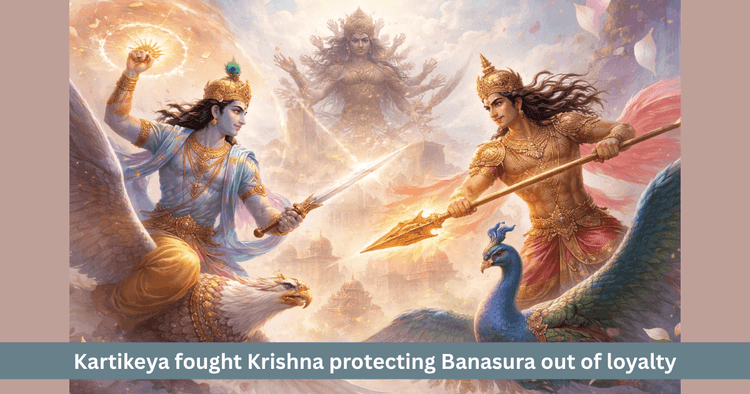
Table of Contents
In Indian sacred literature, some battles cannot be understood merely as stories of force or heroism. Within them operate many levels of dharma, loyalty, divine relationship, duty and cosmic balance. The battle in which Lord Kartikeya stood to protect Banasura and fought against Lord Krishna is one such rare and astonishing episode. At first glance, it raises immediate wonder. Why would Kartikeya, the son of Shiva, take up arms in defense of an asura like Banasura against Krishna himself. Yet when the narrative is examined deeply, it becomes clear that this is not simply a conflict between two divine warriors. It is a story of the subtle tensions between loyalty and righteousness, boon and consequence and the wondrous balance of the divine principles represented by Hari and Hara.
As narrated in the Shrimad Bhagavata Purana, this episode helps us understand that events in the divine world do not always move in simple lines. On one side stands Lord Krishna, the protector of dharma, master of yoga and representative of the Vishnu principle. On the other stands Lord Kartikeya, son of Shiva, commander of the divine hosts and symbol of wisdom and valor. Their battle is not born of personal hostility. It arises from a complex situation in which different divine promises, relationships and responsibilities stand face to face. This is what makes the episode especially profound.
Who was Banasura and why did he become so important
Banasura cannot be dismissed merely as an ordinary demonic character. He was a highly powerful asura king and his story is also linked with deep devotion to Lord Shiva. The Puranic tradition describes him as a devotee who had pleased Shiva and obtained special grace from him. Because of this, the episode involving Banasura is not merely one more tale of slaying a demon. It is also the story of a devotee whose power gradually turned into arrogance.
Banasura possessed a thousand arms and his immense strength had filled him with pride. Several tellings indicate that after receiving great power, mada, intoxication of strength and ahamkara, ego, began to grow within him. Indian sacred literature repeatedly shows that devotion, if not joined with humility, can cause even divine blessings to become instruments of downfall. Banasura becomes an example of this truth.
Why did Krishna attack Banasura
This is the central question of the entire episode. Krishna did not wage war on Banasura because of personal dislike. The real background lies in the story of Banasura’s daughter Usha and Aniruddha, the grandson of Lord Krishna. Usha saw Aniruddha in a dream and fell in love with him. Eventually he was secretly brought to her and when Banasura discovered this, he imprisoned Aniruddha.
At this point the conflict truly begins. Aniruddha was not merely a prince. He represented the honor of the Yadu lineage, the family of Krishna and a sacred relationship that had entered Banasura’s world. By imprisoning Aniruddha, Banasura had gone beyond personal anger. He had created a situation in which Krishna’s intervention became necessary. Thus Krishna attacked Banasura not out of enmity but out of justice, family honor and dharmic responsibility.
Why did Kartikeya stand to protect Banasura
This is where the story becomes truly subtle. If Krishna’s attack appears justified from the standpoint of dharma, why did Kartikeya rise to defend Banasura. The answer lies not only in Banasura’s character but also in the divine protection surrounding him. Banasura was a devotee of Lord Shiva and Shiva had granted him protection. When a devotee comes under the shelter of a deity, that bond too carries weight in the divine world.
Kartikeya, being the son of Shiva, is not merely an independent warrior. He represents the lineage of Hara, the honor of a divine promise and the loyalty that belongs to Shiva’s side. therefore when Banasura came under threat, Kartikeya’s standing for his defense was not simply support of an asura. It was an expression of the loyalty flowing from Shiva’s protection. In this way Kartikeya does not move away from dharma. Rather, he acts according to his own divine responsibility.
Main reasons why Kartikeya stood on the side of Banasura
- Banasura was a devotee of Lord Shiva
- He had received Shiva’s protection
- Kartikeya upheld the honor and loyalty of Shiva’s side
- The battle was not only for a person but also for the dignity of a divine promise
For this reason, the episode has to be viewed beyond simplistic moral categories.
What is the meaning of the battle between the sons of Hari and Hara
This episode is called rare especially because many traditions see it as a duel between the sides of Hari and Hara. On one side is Lord Krishna, representative of Vishnu and the Hari principle. On the other side is Lord Kartikeya, son of Shiva and bearer of Hara’s radiance. The battle is extraordinary because even within apparent conflict there remains a profound divine unity.
Indian tradition does not regard Hari and Hara as ultimate opposites. They are different functional manifestations of the same supreme truth. therefore when conflict appears between their sides, it does not indicate eternal division. It reveals that within divine play, distinct duties, separate responsibilities and context specific roles are possible. In this story there is battle but not hatred. There is conflict but not eternal opposition.
Was this really a war of hostility
No and this point is crucial. If the battle is understood as one of personal ego between two deities, the meaning of the entire episode is lost. Both Krishna and Kartikeya are manifestations of divine consciousness. They do not fight from pride. They act according to duty, promise and divine role.
This itself gives a great teaching for human life. Many times in life two sides may both appear justified in their own way. One side may stand for justice, another for loyalty. One may stand for restoring order, another for preserving a promise. In such moments conflict can arise but it does not always mean that one side is wholly unrighteous. The episode of Krishna and Kartikeya brings forth this deeper moral complexity.
How does the Bhagavata Purana give importance to this episode
The Shrimad Bhagavata Purana does not present this narrative merely as a battle. It also reveals within it the deeper relations between devotee and Lord, lineage and honor, strength and humility. One of the special qualities of the Bhagavata tradition is that it illuminates the spiritual meaning hidden within outer events.
This is exactly what happens here. The Bhagavata suggests that when power becomes joined with arrogance, purification becomes necessary. Krishna’s intervention becomes the means of that purification. At the same time, Kartikeya’s participation in the battle shows that divine loyalty cannot be dismissed lightly. Thus the Bhagavata gives not simply a story of winner and defeated but an insight into the seriousness of divine relationships and the consequences of ego.
What aspect of Kartikeya is revealed by his role as protector of Banasura
Kartikeya is often remembered mainly as a war deity or commander of divine armies. But this episode reveals another dimension of his nature. He is not merely the destroyer of enemies. He is also the upholder of loyalty, guardian of sacred protection and protector of divine honor. By standing to defend Banasura, Kartikeya shows that valor is not expressed only in attack but equally in defense.
His form here teaches that a true warrior is not one who merely knows how to win. A true warrior is one who can stand with full strength for the responsibility entrusted to him. For that reason, the episode reveals Kartikeya less through aggressive conquest and more through faithful commitment to divine duty.
What is the philosophical meaning of the Banasura episode
This narrative also contains a deep philosophical dimension. Banasura becomes the symbol of a being who has power and devotion, yet lacks balance. Krishna represents the divine force that restores dharma and corrects the excess born of pride. Kartikeya represents the force of protection, loyalty and honor toward divine shelter.
Thus the story can be read on three symbolic levels
| Character | Symbolic meaning |
|---|---|
| :contentReference[oaicite:0]{index=0} | Power joined with devotion but corrupted by ego |
| :contentReference[oaicite:1]{index=1} | Restoration of dharma and divine balance |
| :contentReference[oaicite:2]{index=2} | Loyalty, protection and honor of divine commitment |
This table shows that the story is not merely about combat but about the balance of different sacred principles.
What does this episode reveal about the true relationship between Hari and Hara
The most beautiful dimension of this story is that even though conflict appears outwardly, the essential unity of Hari and Hara is never broken. Indian devotional tradition repeatedly emphasizes that Vishnu and Shiva are not truly opposed. They are two divine expressions of one supreme reality. Thus the apparent conflict between their sides becomes part of the larger cosmic balance.
The battle between Krishna and Kartikeya teaches that even when roles differ in the divine world, truth remains one. Outwardly they may appear as two commanders confronting one another but inwardly they are both serving dharma in different ways. That is why this battle symbolizes not enmity but divine complexity.
What does this episode teach for modern life
In modern times, people often want to divide every conflict into a simple line of right and wrong. But many situations in life are more complex. Sometimes both sides contain some truth. One may represent justice, another loyalty. One may stand for outcome, another for relationship. This is why the story offers profound guidance even today.
Main life lessons from this episode
- The balance between loyalty and dharma must be understood
- Power joined with ego eventually requires correction
- Not all sacred conflicts arise from hatred
- Duty often has to be upheld in complex situations
In this way, the episode becomes not merely a Puranic battle but a means to understand modern ethical and relational conflicts as well.
The final radiance of this rare duel
Kartikeya’s battle with Krishna for the protection of Banasura is an astonishing episode but its deeper meaning is even more important. It teaches that in the divine world, roles may become complex, yet their root remains dharma. Krishna stands for the restoration of righteousness. Kartikeya upholds divine loyalty and the dignity of sacred protection. Banasura stands in between as a figure who reveals the consequences of devotion mixed with pride.
This is the lasting message of the story. When power, devotion, loyalty and dharma fall out of balance, conflict arises. But when they are understood deeply, even conflict begins to reveal a higher play. That is the true mystery of this rare duel between the sons of Hari and Hara.
Frequently Asked Questions
Who was Banasura
Banasura was a powerful asura king who is regarded as a devotee of Lord Shiva.
Why did Krishna attack Banasura
Because Banasura had imprisoned Aniruddha, leading Krishna to intervene.
Why did Kartikeya protect Banasura
Because Banasura was under the shelter of Shiva and Kartikeya upheld the loyalty and dignity of that divine protection.
What is the source of this episode
This story is regarded as being described in the Shrimad Bhagavata Purana.
What is the central teaching of this story
It teaches that the balance between loyalty, dharma, power and humility is essential for understanding divine order.
Get your accurate Kundali
Generate KundaliDid you like it?
Author

Pt. Abhishek Sharma (63)
Experience: 20
Consults About: Family Planning, Career
Clients In: Punjab, Haryana, Delhi
Share this article with friends and family
About ZODIAQ
ZODIAQ is an online Vedic Astrology platform. It connects clients seeking astrological advice to experienced astrologers with deep knowledge. Our users also generate kundali and perform kundali milan for free. ZODIAQ also offers services to the Astrologers. Astrologers utilize various offerings by ZODIAQ to serve their clients effectively.
If you are a User
Consult with experienced astrologers and seek their guidance. You can also order handwritten Janm Patrika report with life prediction prepared by experienced astrologers. Generate accurate Kundali, perform Kundali Matching and check horoscope and muhurat. Utilize our online library for all the necessary astrological and spiritual information.
If you are an Astrologer
Create accurate kundali for your clients and perform Kundali Matching for up to 5 people at a time. Write comprehensive Janm Patrika report for your clients with ZODIAQ. Check client details anytime by saving it in client directory. Become more productive by tracking how many clients you guide every day.
WELCOME TO
ZODIAQ
Right Decisions at the right time with ZODIAQ
