Why Lord Kartikeya is Brahmachari in North India and Married in South India
By Aparna Patni
The deeper spiritual meaning of regional devotion and the diverse forms of Lord Kartikeya in Indian tradition
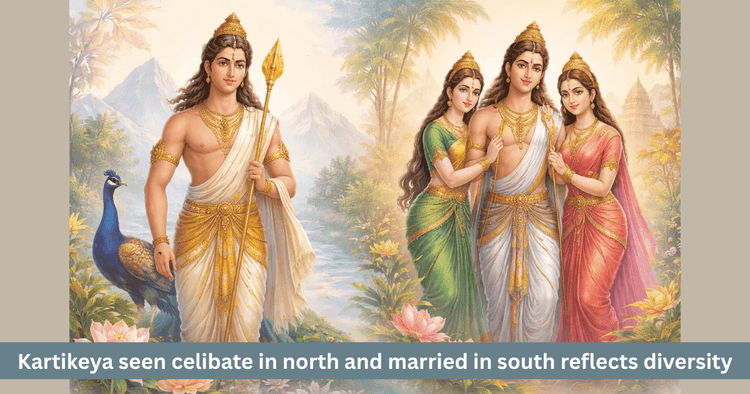
Table of Contents
Lord Kartikeya is one of those deities in the Indian spiritual tradition whose divine identity remains one, yet whose worship takes on different emotional forms in different regions. This very diversity deepens his worship. In North India he is often remembered as a brahmachari, meaning a celibate deity, while in South India he is worshipped together with his two consorts Devasena and Valli. At first sight this difference may appear to be only a regional variation but at a deeper level it reveals a very subtle understanding within Indian sacred thought.
This difference does not suggest contradiction. Rather, it shows that Indian tradition does not confine a deity within one narrow frame. Different communities receive the qualities of tapa, meaning disciplined austerity, shakti, meaning spiritual force, duty, household balance, restraint and compassion according to their own lived experience. The different forms in which Lord Kartikeya is worshipped in North and South India are a beautiful expression of this living tradition.
Why is this difference important
Whenever two traditions are found around the same deity, people naturally wish to know which belief is correct. In the case of Lord Kartikeya this question becomes even more natural. Is he truly celibate or should he be worshipped as a married deity. The answer cannot be given only as yes or no, because the matter here is not of historical dispute but of spiritual symbolism and living sacred tradition.
In Indian tradition one deity often appears in many forms. This plurality does not exist to create confusion. It exists to show that divine reality is greater than the limited categories of the human mind. In Lord Kartikeya one can see detachment, valor and discipline on one side, while on the other side one also finds relationship, acceptance, household dharma and harmony. That is why the traditions of North and South India together speak a wider truth.
Why is Kartikeya considered celibate in North India
In the folk traditions of North India, Lord Kartikeya usually appears as a young ascetic warrior, a disciplined hero and a celibate deity. Here his image is that of a radiant son who symbolizes battle, restraint and self mastery. In this devotional mood, the focus remains more upon his tapa, valor, renunciation and inner concentration.
This form became especially meaningful in regions where the inspirational character of the deity was linked with social conduct. Here celibacy does not merely indicate unmarried status. It also symbolizes preservation of energy, control of the senses, inner centeredness and unwavering commitment to duty. That is why in North India the celibate form of Kartikeya evokes the feeling of disciplined radiance.
Main signs within the North Indian devotional understanding
• Kartikeya is seen as a disciplined youthful deity.
• His form is linked with tapa, detachment and self restraint.
• Celibacy is understood not only as marital status but also as spiritual concentration.
• In this form he appears as a radiant deity fully dedicated to duty.
Why is Kartikeya worshipped with both consorts in South India
In South India Lord Kartikeya, especially in the forms of Murugan, Subrahmanya and Skanda, is deeply beloved. Here his worship is not limited only to valor. He is also revered as a deity of love, grace, family, the dignity of relationship and intimate concern for devotees. In this tradition he is established together with his two consorts Devasena and Valli.
The presence of Devasena and Valli is not only a marital story. Through them two distinct dimensions of Kartikeya’s divine nature are expressed. On one side there is the dignity connected with divine order, sacred lineage and celestial structure. On the other side there is the warmth of lived human life, natural love and closeness to the world. South Indian tradition does not see this dual form as contradiction. It sees it as part of the deity’s fullness.
What is the symbolic meaning of Devasena and Valli
In South Indian devotional understanding, Devasena is often associated with divine order, sacred dignity and heavenly structure. Valli, on the other hand, is understood as a symbol of simple love, nearness to the earth and intimate human tenderness. When Lord Kartikeya is worshipped with both of them, the image becomes more than a marriage story. It turns into a profound expression of sacred balance.
This balance teaches that divine life is not only of austerity, nor only of relationship but may also be of the harmonious union of both. In the South Indian devotional mood, Lord Kartikeya appears as a deity who is power, affection, warrior spirit and protector of family life all at once. That is why his married form is so deeply cherished there.
Meanings suggested by Kartikeya with Devasena and Valli
• Devasena carries the feeling of divine order and dignified शक्ति, meaning sacred force.
• Valli represents natural love and closeness to ordinary life.
• The combined form of Kartikeya joins both divine and human dimensions.
• This worship teaches that strength and affection can move together.
Is this connected with the balance between Shiva’s ascetic and household forms
Yes, one of the most beautiful ways to understand this belief is to see it as a balance between two major dimensions of Lord Shiva. Shiva is the great yogi, the being of tapa and inward detachment. At the same time he is also Parvatipati, meaning the husband of Parvati, a father, a householder and the center of a divine family. The North Indian and South Indian forms of Kartikeya appear to express these two directions of the wider Shiva principle.
In North India, the celibate form of Kartikeya may be felt as being closer to the ascetic side of Shiva. In South India, his married form recalls Shiva’s householder balance and his complete acceptance of life. In this way the different worship of Kartikeya becomes a reflection of the larger wholeness of Shiva himself.
Why should this difference be understood as expansion and not contradiction
When modern minds approach sacred tradition, they often want one fixed answer. Yet Indian spiritual thought many times emphasizes not rigid certainty but the breadth of truth. The celibate and married forms of Lord Kartikeya are both part of this wider truth. One form does not cancel the other. Together they enrich the understanding of the deity.
That is why this difference should not be seen as dispute. It is one of those rare examples where folk tradition, puranic memory and regional devotion together show that divine reality cannot be reduced to one social definition. Lord Kartikeya can at once be the ideal of austerity and the deity of household harmony.
How does folk tradition keep this understanding alive
In Indian religion, scripture alone does not say everything. Folk memory, regional narratives, festivals, temple traditions and beliefs passed down within families across generations also carry great importance. The different devotional understandings of Lord Kartikeya in North and South India belong to this living stream.
In one place, a mother may narrate the celibate form of Kartikeya to inspire restraint in her son. In another place, a family may remember him with Valli and Devasena for blessings in married life and domestic harmony. This is the strength of Indian tradition, that it can connect the same deity with different life situations while preserving his sacred dignity.
A simple table to understand this theme
| Aspect | North Indian understanding | South Indian understanding |
|---|---|---|
| Main form | Celibate Kartikeya | Kartikeya with Devasena and Valli |
| Main symbol | Austerity, restraint, concentration | Relationship, fullness, household balance |
| Spiritual mood | Detachment and self mastery | Love and divine acceptance |
| Relation to Shiva | Ascetic dimension | Householder dimension |
Can both beliefs be true at the same time
Within Indian spiritual tradition, the answer may be understood as yes. Truth here is not only the name of an outward event. Truth is also that which becomes a guide for human life through the form of the deity. If in one region the celibate form of Lord Kartikeya inspires discipline and spiritual practice, that is meaningful. If in another region his married form symbolizes love, balance and family harmony, that too is equally meaningful.
This is the special nature of divine forms, that they address different levels of human life. A seeker, a householder, a warrior, a loving devotee and a disciplined student may all find different forms of inspiration in Lord Kartikeya. Therefore the coexistence of both traditions is not unusual in Indian sacred understanding.
What does Shiva’s son Kartikeya teach us
This dual regional form of Lord Kartikeya gives a very important teaching. It is not enough to understand life in only one direction. At times tapa meaning austerity is needed. At times the tenderness of relationship is needed. At times self restraint is necessary. At times acceptance and affection are equally necessary. A life that learns to balance both becomes more mature.
For this reason the North Indian and South Indian devotional moods of Kartikeya are not merely religious information. They remind the human being of two necessary paths within life. One path stabilizes inner strength and the other makes it loving. Together they make life balanced and meaningful.
Which sources are associated with this belief
This understanding is commonly linked with lok parampara, meaning living folk tradition and Shiva Purana. Folk tradition preserved the various forms of Lord Kartikeya according to regional devotion, while puranic memory provided the wider sacred framework of the Shiva family. That is why the idea of Kartikeya as celibate in North India and married in South India is understood not as a recent social imagination but as part of a long standing religious understanding.
A quiet teaching of balance
The different beliefs about Lord Kartikeya in North and South India do not truly speak of division. They speak of balance. One form says that tapa, discipline and inner strength are necessary in life. The other reminds us that relationship, affection, householder dharma and fullness are equally sacred.
When both are held together, Kartikeya no longer remains only a deity of war or only a deity of family life. He becomes the symbol of that divine balance through which a human being may recognize both the inner yogi and the inner householder. This is the most beautiful and deepest teaching of this belief.
Frequently asked questions
Why is Lord Kartikeya regarded as celibate in North India
In North Indian folk belief, his form appears more strongly as that of an ascetic, restrained and self controlled youthful deity.
With whom is Kartikeya worshipped in South India
In South India he is generally worshipped with his two consorts Devasena and Valli.
Does this difference show contradiction
No. It reveals different spiritual and cultural dimensions of the same deity.
How is this belief connected with Shiva
It is understood as reflecting the balance between Shiva’s ascetic and householder forms.
Can both forms be accepted together
Yes, in Indian tradition both are accepted as complementary dimensions of Lord Kartikeya’s wider divinity.
Get your accurate Kundali
Generate KundaliDid you like it?
Author

Aparna Patni (63)
Experience: 20
Consults About: Family Planning, Career
Clients In: Punjab, Haryana, Delhi
Share this article with friends and family
About ZODIAQ
ZODIAQ is an online Vedic Astrology platform. It connects clients seeking astrological advice to experienced astrologers with deep knowledge. Our users also generate kundali and perform kundali milan for free. ZODIAQ also offers services to the Astrologers. Astrologers utilize various offerings by ZODIAQ to serve their clients effectively.
If you are a User
Consult with experienced astrologers and seek their guidance. You can also order handwritten Janm Patrika report with life prediction prepared by experienced astrologers. Generate accurate Kundali, perform Kundali Matching and check horoscope and muhurat. Utilize our online library for all the necessary astrological and spiritual information.
If you are an Astrologer
Create accurate kundali for your clients and perform Kundali Matching for up to 5 people at a time. Write comprehensive Janm Patrika report for your clients with ZODIAQ. Check client details anytime by saving it in client directory. Become more productive by tracking how many clients you guide every day.
WELCOME TO
ZODIAQ
Right Decisions at the right time with ZODIAQ
