Kartikeya’s Feminine Transformation Near Shiva and Shakti
By Pt. Nilesh Sharma
A Puranic insight into divine energy, sacred boundaries and identity
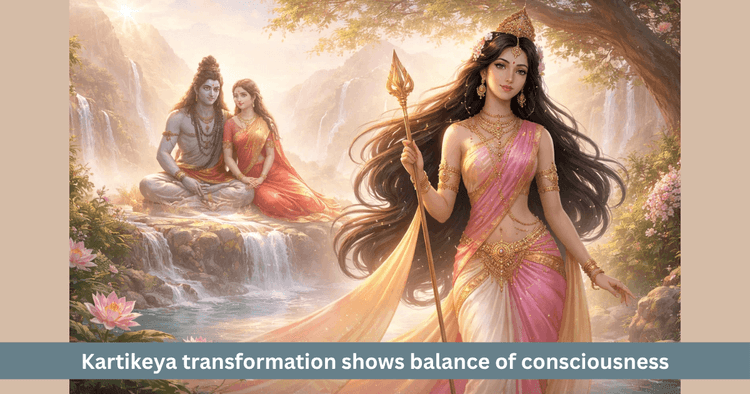
Table of Contents
In the Indian Puranic tradition, certain stories do not merely describe an outward event. They reveal very subtle dimensions of consciousness, sacred boundaries, power and transformation. The episode related to Bhagavan Kartikeya belongs to that very category. Kartikeya is generally seen as the embodiment of heroism, warfare, brilliance, discipline and divine valor. Yet some Puranic narratives reveal another side of him, showing that divinity cannot be confined to one fixed identity. Wherever the mystery of Shiva and Shakti is active, form, energy and experience may all move beyond ordinary rules.
It is said in Padma Purana that there was a time when Bhagavan Shiva and Maa Parvati were in seclusion and entry into that state was forbidden. That prohibition was not merely an outer rule. It reflected the sanctity of a particular field of consciousness. At that time, Bhagavan Kartikeya entered that space and under the influence of that divine condition, he assumed a feminine form for some time. At first glance this may appear to be an astonishing or unusual event but its deeper meaning is not limited to a change of form. It suggests that near the union of Shiva and Shakti, entry is not merely physical. It is a matter of inner suitability, energy and spiritual balance.
This Is Not Merely a Story of Change of Form
If this episode is seen superficially, it may appear to be only an extraordinary event. Yet the style of the Indian Puranas is never merely to produce wonder. Such stories express truths that are difficult to explain in ordinary language. Kartikeya assuming a feminine form points toward the fact that in the presence of Shakti, energy itself may alter its balance and where the principle of divine power is intensely active, even form may become fluid.
One central indication of this story is that masculine and feminine are not merely biological identities. They are also energetic and philosophical principles. In Indian thought, Shiva represents consciousness, while Shakti represents creative energy. When a being enters a field where Shakti is intensely active, the inner equilibrium of that being may also shift. This is the deeper spiritual basis of the narrative.
What Does the Seclusion of Shiva and Parvati Represent
To understand this episode, it is first necessary to understand that the seclusion of Shiva and Parvati is not merely domestic privacy. It indicates a divine state in which consciousness and energy, silence and creation, purusha and prakriti, exist in a particular union. That is why entry was not considered ordinary. The prohibition here means not rejection but sacred boundary.
This seclusion may be understood in several deeper ways:
- It is a field of divine balance
- A transformative energy is active there
- Entry requires not curiosity alone but inner readiness
- In that state ordinary dualities become subtle and take on new meaning
This is why Kartikeya’s entry becomes far more than a casual event. It becomes the cause of a profound spiritual effect.
The Contrast Between Kartikeya’s Usual Form and This Episode
The usual image of Kartikeya is one of great radiance, heroism and disciplined action. He is the commander of the celestial hosts, the conqueror of destructive forces and in many traditions the ideal of divine courage. For that reason, his assuming a feminine form creates a powerful contrast in the narrative. That contrast is precisely what makes the story philosophically important. It shows that divinity cannot be fixed within one permanent form, gendered appearance or energetic pattern.
This episode teaches us that:
- Divinity is inherently multiform
- At the level of energy, transformation can move beyond ordinary limits
- Identity is often more energetic than merely external
- Wherever Shakti is strongly present, form itself need not remain fixed
What Could the Feminine Form Mean Philosophically
In Indian tradition, the feminine form is not reduced to body alone. It is also associated with creation, receptivity, sensitivity, energy, nurturance and Shakti. Seen in that light, Kartikeya’s assumption of a feminine form may not be understood as punishment but as a sign of energetic rebalancing. Just as entering a particular sacred field may cause consciousness to absorb the dominant principle of that field, the strong presence of Shakti here appears to have brought about a transformation in form.
It is important to understand that this story does not compare one form as lower or higher. It presents the masculine and feminine as complementary dimensions of existence. In that sense, the episode is deeply meaningful even today, because it suggests that form may change but divinity remains intact.
Does This Story Also Express the Principle of Sacred Boundary
Yes and quite clearly. In Indian tradition, sacred boundary is not merely a social rule. It is the knowledge that certain states of reality demand a particular reverence and preparedness. The restriction upon entering the seclusion of Shiva and Parvati shows that every sacred state has its own laws. When those laws are crossed, the result may not only be outer but also transformative at the level of consciousness.
The episode offers the following indications regarding sacred boundary:
| Episode | Deeper Meaning |
|---|---|
| Seclusion of Shiva and Parvati | Field of divine balance and intimate energy |
| Restriction of entry | Sacred boundary and inner eligibility |
| Entry of Kartikeya | Innocence, spontaneity or approach without preparation |
| Feminine transformation | Effect of divine energy and transformation |
This makes it clear that the story is not only about an event. It is also about spiritual discipline.
What Does Transformation Near Shiva and Shakti Signify
In Indian philosophy, the union of Shiva and Shakti is not static. It is creative and transformative. Wherever that union is active, change may take place at every level of existence, form, mind, energy and perception. Kartikeya’s feminine form may therefore be understood as a symbolic expression of this transforming power.
This transformation may be understood at three levels:
1. At the level of energy
The inner structure shifts under the predominance of Shakti
2. At the level of consciousness
The being experiences itself through a different energetic mode
3. At the philosophical level
It becomes evident that existence is greater than fixed duality
For this reason, the episode is not only about bodily change. It points toward the fluid and multilevel nature of being.
Does This Story Move Beyond Conventional Ideas of Male and Female
Certainly. This story suggests that Indian spirituality holds a very subtle understanding of masculine and feminine. They are not seen only as biological categories but also as dimensions of consciousness and energy. Kartikeya’s episode indicates that both principles are present within existence and under certain divine conditions they may become visible in transformed ways.
This perspective also teaches us that:
- Identity is never merely superficial
- Divinity cannot be confined to one single form
- In the field of Shakti, transformation is natural
- The feminine principle is not only softness but also primordial creative power
Why Is This Story Relevant in the Present Time
In the present age, when many discussions revolve around identity, form, gender and energy, this episode offers a deeply spiritual perspective. It reminds us that Indian Puranic thought carried a highly subtle and multilayered understanding of identity. Transformation was not always seen as something strange or merely unusual. It could also be understood as the result of divine influence, energetic balance and subtle spiritual states.
The present relevance of the episode may be understood in these ways:
- It offers an inner and spiritual perspective on identity
- It teaches both sacred boundary and inner eligibility
- It shows that divinity is not fixed but living and multiform
- It encourages attention to essence rather than only outer appearance
The Final Illumination of This Episode
At first glance, the story of Kartikeya assuming a feminine form may seem surprising. Inwardly, however it is a subtle and beautiful narrative. It teaches that where the field of Shiva and Shakti is active ordinary rules may change. This transformation does not indicate punishment, deficiency or shame. Rather, it reveals the divine truth that both the masculine and feminine principles exist within the foundation of reality itself.
therefore the deeper meaning of this story is that consciousness changes near Shakti, the importance of sacred boundary increases and transformation becomes natural in the field of divinity. This episode invites us to look beyond outer form and recognize essential truth. That is its greatest teaching.
Frequently Asked Questions
Where is the story of Kartikeya’s feminine form found
It is said in Padma Purana that under the influence of the secluded state of Shiva and Parvati, Kartikeya assumed a feminine form for some time.
Is the meaning of this story merely miraculous
No, its deeper meaning is connected with energetic transformation, sacred boundary and the mystery of Shiva and Shakti.
What does the feminine form signify in this episode
It may be understood as a symbol of Shakti, receptivity and a shift in energetic balance.
Does this story also teach sacred boundary
Yes, it clearly indicates that every divine field has its own sacred discipline and eligibility.
What lesson does this offer in present life
It teaches that identity and form should be understood not only externally but also at the level of consciousness and energy.
Get your accurate Kundali
Generate KundaliDid you like it?
Author

Pt. Nilesh Sharma (63)
Experience: 20
Consults About: Family Planning, Career
Clients In: Punjab, Haryana, Delhi
Share this article with friends and family
About ZODIAQ
ZODIAQ is an online Vedic Astrology platform. It connects clients seeking astrological advice to experienced astrologers with deep knowledge. Our users also generate kundali and perform kundali milan for free. ZODIAQ also offers services to the Astrologers. Astrologers utilize various offerings by ZODIAQ to serve their clients effectively.
If you are a User
Consult with experienced astrologers and seek their guidance. You can also order handwritten Janm Patrika report with life prediction prepared by experienced astrologers. Generate accurate Kundali, perform Kundali Matching and check horoscope and muhurat. Utilize our online library for all the necessary astrological and spiritual information.
If you are an Astrologer
Create accurate kundali for your clients and perform Kundali Matching for up to 5 people at a time. Write comprehensive Janm Patrika report for your clients with ZODIAQ. Check client details anytime by saving it in client directory. Become more productive by tracking how many clients you guide every day.
WELCOME TO
ZODIAQ
Right Decisions at the right time with ZODIAQ
