Kartikeya and Peacock’s Tail: The Mystery of Divine Symbolism
By Pt. Amitabh Sharma
Peacock form of Indra, Kartikeya’s blessing and deeper spiritual symbolism
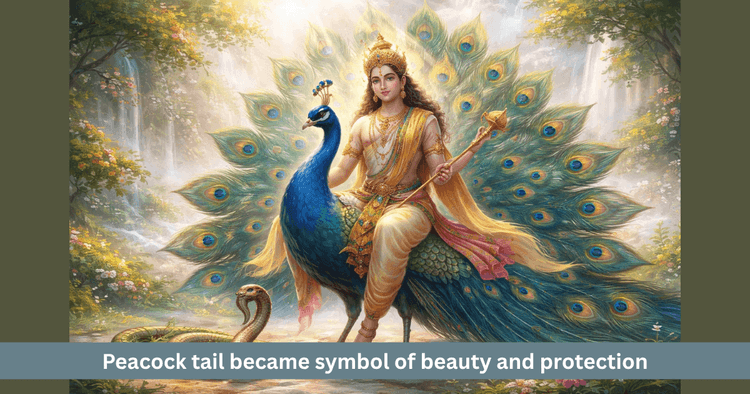
Table of Contents
The stories connected with Lord Kartikeya and his beloved peacock mount are not merely stories of beauty. They also carry meanings of divine protection, valor, grace and deep symbolism. One such beautiful belief says that during the war associated with Ravana, Indra Deva, meaning Lord Indra, took the form of a peacock. Pleased by this divine form, Lord Kartikeya granted the peacock a blessing that its feathers would always remain beautiful and that it would become the destroyer of serpents. In this episode one does not find only the glory of a vehicle but also the emergence of beauty, strength and protection through divine grace.
At first sight, this episode may appear simple but several layers are hidden within it. On one side there is Indra taking the form of a peacock. On another there is Kartikeya accepting that form and blessing it. Then there is the meaning behind the peacock’s tail and its power over serpents. That is why this story does not seem like a mere old remembrance. It teaches that when divine powers accept a form, that form no longer remains ordinary in nature. It becomes an image sanctified by blessing.
Why is this story considered so appealing
In Indian tradition, animals, birds and forms of nature are not treated as decorative details alone. When they become linked with deities, they begin to carry spiritual meanings. The peacock is one such bird. Its feathers, its movement, its radiance and its natural alertness give it a place distinct from ordinary creatures. When that same peacock becomes the vehicle of Lord Kartikeya, its significance deepens even further.
This story is especially attractive because it brings together war, transformation, blessing and the splendor of nature in one flow. It suggests that divine beings do not bless only human life. They can also grant sacred meaning to forms in nature. The beauty of the peacock’s tail and its connection with serpents are understood as the result of that divine grace.
What does Indra’s peacock form during the war with Ravana signify
According to this belief, during the war linked with Ravana, Indra Deva took the form of a peacock. This should not be seen merely as an act of hiding or changing form. In Indian sacred tradition, when deities take on a special form, it often signifies the divine acceptance and meaningful elevation of that form. When a deity like Indra appears as a peacock, the peacock no longer remains only a bird of the forest. It becomes a form touched by divinity.
Indra is associated with heaven, power, rain, majesty and leadership among the devas. His becoming a peacock suggests that even within a beautiful form of nature, divine presence can be established. That is why the blessing later given by Lord Kartikeya gives this story even greater dignity.
Indications received from Indra’s peacock form
• The peacock came to be seen as a bird touched by divine presence.
• This form came to symbolize not only natural beauty but also divine protection.
• Indra’s appearance in this form suggests a living bond between nature and divinity.
• Through this, the peacock became not only a vehicle but also a blessed being.
Why did Lord Kartikeya bless the peacock
The most beautiful part of the story is that Lord Kartikeya was pleased with the peacock and gave it a special blessing. Here his form is not only that of a warrior but also that of a compassionate deity. He is not merely the victorious god of battle. He also recognizes the form in which service, surrender and divine feeling are present. The blessing given to the peacock is the result of that recognition.
The blessing did not mean giving outward beauty alone. The peacock received the boon that its feathers would always remain beautiful and that it would become a force fatal to serpents. This means that Lord Kartikeya granted the peacock not only splendor but also radiance, protection and active divine force.
What is the mystery of the peacock’s tail
The tail of the peacock has long been regarded as something unique in Indian aesthetic imagination. The circular patterns, luminous spread and richness of its feathers were not dismissed as natural ornament alone. Sacred stories connected this beauty with blessing, grace and inner radiance. That is why it is said that through the blessing of Lord Kartikeya, the feathers of the peacock would remain beautiful forever.
The beauty of the tail here is not only outward brilliance. It is also a symbol of that divine touch which transforms an ordinary form into an extraordinary one. When divine grace falls upon a being, even its form becomes meaningful. The mystery of the peacock’s tail is understood through this sanctified beauty.
Why is the peacock called the destroyer of serpents
The story also says that Kartikeya blessed the peacock so that it would remain the destroyer of serpents. In Indian symbolic tradition this carries a deep meaning. The serpent can at times represent fear, hidden danger, poison and unseen threat. The peacock, by contrast, appears as a symbol of radiance, alertness, divine beauty and living protection. When the peacock is called the destroyer of serpents, it may be understood not only as a natural opposition but also as the victory of light over poison.
Lord Kartikeya himself is the destroyer of hostile forces and the protector of dharma. It is therefore considered fitting that his vehicle too should carry a form capable of symbolizing mastery over fearsome elements. For this reason the peacock becomes not only a bird of beauty but also a sign of protective power.
Symbolic meanings of the peacock and serpent relationship
• The peacock symbolizes awakened strength and divine protection.
• The serpent can signify hidden fear or poisonous danger.
• Kartikeya’s blessing shows that beauty and power can remain together.
• This episode conveys the triumph of divine grace over fear.
Is this story only a folk tale or something more
Stories such as this are not only pleasing folk tales. They establish a deeper relationship between nature, deity and seeker. When one looks at the peacock’s tail, one does not see only color. One may also remember divine compassion. When the peacock is viewed as the destroyer of serpents, one does not see power alone. One also sees the sign of the protection of dharma.
This is one of the special strengths of Indian storytelling. It gives divine meaning even to birds, trees, mountains and rivers. Because of this, the story does not allow the peacock to remain merely a vehicle or a decorative symbol. It transforms it into a living sign of Lord Kartikeya’s grace.
Why is the peacock so important as the vehicle of Kartikeya
The choice of the peacock as the vehicle of Lord Kartikeya is itself meaningful. Kartikeya is radiant, youthful, courageous and unwavering in purpose. The peacock too is seen as alert, beautiful, energetic and striking. In this way, a remarkable harmony appears between deity and vehicle. The peacock seems like the outward extension of Kartikeya’s divine brilliance.
If this story is considered alongside that symbolism, the peacock becomes more than a bird that accompanies the Lord. It becomes the being that, through divine blessing, received both beauty and protective force. That is why the peacock vehicle makes the splendor of Lord Kartikeya even more expressive.
What can a seeker learn from this story
This episode is not meant only for religious curiosity. It carries a deep teaching for the seeker as well. In life, people often treat outward beauty and inner strength as separate things. Yet this story teaches that when grace descends upon a form, beauty, courage and protection can all exist together.
This teaching also applies inwardly. If the mind is pure, if resolve is sacred and if life is offered in devotion to the divine, then a radiance may arise within a person that is both beautiful and capable of guarding against poisonous influences. The mystery of the peacock’s tail lies not only in the feathers of a bird but also in this principle of divine grace.
Inner teachings offered by this story
• Divine grace can make even an ordinary form extraordinary.
• Beauty and strength are not opposites.
• Becoming the vehicle of the Lord signifies both service and blessing.
• Through inner purity, life too can become radiant like the peacock’s feathers.
A simple table to understand this theme
| Element | Symbolic meaning |
|---|---|
| Indra as peacock | Divine acceptance and sanctification of nature |
| Kartikeya’s blessing | Boon of beauty, strength and protection |
| Peacock’s tail | Grace, radiance and divine splendor |
| Destroyer of serpents | Victory over poison, fear and danger |
| Peacock vehicle | The living extension of the deity’s brilliance |
What does this memory associated with Uttara Ramayana suggest
The memory of this story is generally associated with the Uttara Ramayana. There one finds the devotional understanding that during the war linked with Ravana, Indra Deva appeared in the form of a peacock and Lord Kartikeya, being pleased, granted that peacock a remarkable blessing. Because of this, the beauty of the peacock’s feathers and its serpent opposing nature came to be seen not merely as natural traits but as qualities touched by divine grace.
This remembrance does not allow the story to remain only a local belief. It places it within the wider sacred tradition, where every form of nature can be elevated by divine blessing.
Divine grace and the beauty of nature
This episode of Lord Kartikeya and the peacock’s tail teaches a very gentle and profound truth. Divine grace is not limited only to victory in battle. It can make a form beautiful, empower it against dangerous forces and grant it a permanent place close to the deity.
That is why, on seeing the peacock, one may remember not only its colors but also the blessing resting upon it. This boon of Kartikeya teaches that the beauty of nature is not always only something to admire. At times it can also be the visible form of divine grace.
Frequently asked questions
What is the mystery of Kartikeya and the peacock’s tail believed to be
It is believed that through the blessing of Lord Kartikeya, the feathers of the peacock remained forever beautiful and received power against serpents.
To which episode is Indra’s peacock form connected
This belief is associated with the time of the war linked with Ravana, when Indra Deva is said to have appeared in peacock form.
Why is the peacock called the destroyer of serpents
Because according to the story, Kartikeya blessed it so that it would become a force effective against serpents and a symbol of their destruction.
Does this story explain only beauty
No. Along with beauty, the story also explains divine protection, grace and the power of guardianship.
With which tradition is this belief generally associated
It is generally associated with the sacred memory connected with the Uttara Ramayana.
Get your accurate Kundali
Generate KundaliDid you like it?
Author

Pt. Amitabh Sharma (56 Years)
Experience: 20
Consults About: Family Planning, Career
Clients In: Punjab, Haryana, Delhi
Share this article with friends and family
About ZODIAQ
ZODIAQ is an online Vedic Astrology platform. It connects clients seeking astrological advice to experienced astrologers with deep knowledge. Our users also generate kundali and perform kundali milan for free. ZODIAQ also offers services to the Astrologers. Astrologers utilize various offerings by ZODIAQ to serve their clients effectively.
If you are a User
Consult with experienced astrologers and seek their guidance. You can also order handwritten Janm Patrika report with life prediction prepared by experienced astrologers. Generate accurate Kundali, perform Kundali Matching and check horoscope and muhurat. Utilize our online library for all the necessary astrological and spiritual information.
If you are an Astrologer
Create accurate kundali for your clients and perform Kundali Matching for up to 5 people at a time. Write comprehensive Janm Patrika report for your clients with ZODIAQ. Check client details anytime by saving it in client directory. Become more productive by tracking how many clients you guide every day.
WELCOME TO
ZODIAQ
Right Decisions at the right time with ZODIAQ
