Was Lord Kartikeya’s Peacock Once an Asura?
By Pt. Abhishek Sharma
The transformation of Surapadman into Kartikeya’s peacock: a story of ego, forgiveness, and divine compassion
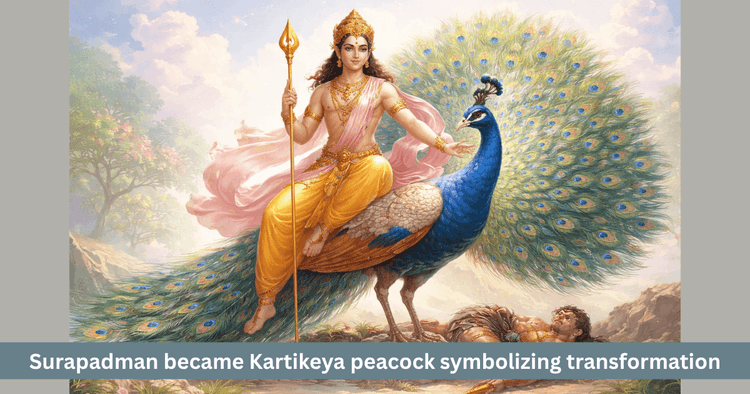
Table of Contents
Among the stories associated with Lord Kartikeya, one of the most striking beliefs is that his peacock mount is not merely a symbol of beauty, valor and brilliance. Tradition presents a deeper account behind it, one that brings together ego, war, forgiveness, transformation and divine compassion. People often know only that the peacock is Kartikeya’s vehicle but in sacred tradition it is also believed that this peacock was once a fierce asura named Surapadman. That is what makes this episode spiritually profound and deeply memorable.
This is not simply a tale of a battle between gods and demons. It shows that the true nature of divine power is not limited to punishment. When a being, even after terrible downfall, turns toward refuge, Ishvara can still recognize the hidden possibility within that soul. That is why the end of Surapadman did not remain mere destruction. He continued in a transformed form, forever connected to Lord Kartikeya.
What is the traditional basis of this episode
In South Indian traditions, especially in Kanda Puranam, this account is narrated with deep reverence. Lord Kartikeya fought to protect the devas who were suffering under the oppression of asuras. At that time Surapadman was an immensely powerful asura. He possessed strength, force earned through austerity and an intense desire for victory but that power was not used for dharma. It was used for domination and fear. When he stood against Kartikeya, it was not merely a clash of two warriors. It was a confrontation between distorted power and divinely aligned power.
In Tamil devotional tradition, Lord Kartikeya is remembered not only as a god of war but also as a deity of wisdom, discipline, youthful force, protection of dharma and grace. That is why in the story of Surapadman his form appears not only as a conqueror but also as the compassionate one who transforms.
Who was Surapadman and why did his pride become so intense
Surapadman is understood in tradition as an asura who came to believe that he was undefeatable because of his great powers. When power becomes separated from discernment, it stops being a force of protection and turns into a force of destruction. That is what happened to Surapadman. He had strength, influence and a deep attachment to his own authority. Slowly that attachment hardened into ego.
In the Indian spiritual view, being an asura is not always only about a race or a birth identity. It can also point to an inner condition. When a person begins to believe that strength alone is the final truth, when the suffering of others no longer matters and when the ability to bow disappears, that tendency becomes asuric in nature. The story of Surapadman quietly points toward this inner truth as well.
Key traits associated with Surapadman
• He was extremely powerful and because of that his unchecked confidence continued to grow.
• He used his strength not for protection of dharma but for control and domination.
• In his mind, victory and fear replaced compassion and balance.
• In the final moment remorse awakened within him and that became the doorway to his transformation.
Why is the battle between Lord Kartikeya and Surapadman considered so significant
The battle of Lord Kartikeya is not only an outer conflict. It also symbolizes the inner struggle in which ignorance, ego and misdirected desire are confronted by light, discipline and divine awareness. In many traditions Kartikeya is described as a radiant youthful deity. The Shakti spear in his hand is not seen merely as a weapon but as a symbol of focused consciousness. That is why when he faces Surapadman, the battle becomes more than physical.
It is also important that the destruction of the asura is not the final meaning of this story. In the last moment, when Surapadman asks for forgiveness, the narrative turns into something much deeper. This is the point where Lord Kartikeya’s nature appears in its highest form. He does not merely kill. He sees whether even this fallen force can be turned toward a sacred purpose.
Did Surapadman truly become the peacock and the rooster
According to tradition, when the war reached its final stage and Surapadman was defeated, he sought forgiveness from Lord Kartikeya. In that moment divine justice and divine compassion both become visible together. Lord Kartikeya did not end him in an ordinary way. He divided him into two parts. One part became the peacock, which became his vehicle and the other became the rooster, which was established upon his banner.
This is the most remarkable aspect of the story. The very force that once opposed the divine was later placed in the service of the divine. What once represented ego later became a medium of surrender. This reveals a profound principle of Indian thought, that every force does not always need to be erased. At times its purification and change of purpose are even more meaningful.
The direct meaning of this transformation
• The part that became the peacock now carries the Lord, which means power has become offered in surrender.
• The part that became the rooster stands on the banner, which means former ferocity has become a symbol of divine proclamation.
• The end of the asura did not remain simple destruction but turned into sacred use.
• This story shows that God is not only a giver of punishment but also a transformer.
Why was the peacock chosen as the vehicle
In Indian tradition the peacock is associated with beauty, awareness, alertness, dignity and radiant force. Its feathers are visually captivating but it also carries a natural watchfulness. For a deity like Lord Kartikeya, the peacock is not merely decorative symbolism. It shows that when controlled strength is placed upon the divine path, it becomes both beautiful and purposeful.
Within the context of this episode, the peacock carries another meaning as well. Surapadman was once filled with ego. When that very being becomes the peacock and comes beneath the Lord, its meaning changes completely. It is no longer at the center. It becomes the ground of divine work. For inner spiritual practice, this is an extremely deep sign.
What does the rooster on the banner signify
The rooster on Lord Kartikeya’s banner is understood on many levels. The rooster announces the arrival of dawn. It signals awakening after darkness. Seen in that light, one part of Surapadman upon the banner seems to declare that what once stood in ignorance has now become a message of awakening.
A banner itself symbolizes identity, direction and victory. When a sign appears on the banner of a deity, it is never a mere decoration. It carries the philosophical meaning of that deity’s power. The rooster on Kartikeya’s banner shows that divine victory is not only over an enemy. It is rooted in the movement from darkness toward light.
Why is this story also a story of forgiveness
Many people hear this episode only as a war between deity and asura but its deepest heart lies in forgiveness. If Lord Kartikeya had wished, he could have fully destroyed Surapadman. Yet he did not choose that path. He accepted the remaining surrender within the defeated asura. That is what makes this tale extraordinary.
Forgiveness here is not weakness. It is the sign of the highest strength. One who destroys the fallen may still be called heroic. But one who transforms the fallen stands even higher. This divine greatness of Kartikeya separates the story from an ordinary war narrative.
Spiritual insights offered by this episode
• However strong ego may become, it can still change through divine touch.
• Surrender does not become meaningless even in the final moment.
• In the presence of God, destructive power can be redirected into service.
• Forgiveness and justice are not always opposites. At times they complete one another.
How can devotees connect this story to their own lives
This episode should not remain only as the memory of an ancient divine war. It continues within human life even now. Every person carries some form of Surapadman within. At times it appears as stubbornness, at times as anger and at times as an inflated sense of self importance. Alongside that, every person also carries the possibility of placing that unbalanced force into a higher purpose.
This episode of Lord Kartikeya teaches that suppressing inner intensity is not the only solution. A greater path is to purify it, guide it and transform it into surrender. That is why this story is valued for spiritual practice, character formation and self discipline.
What is the message of this story at the level of sadhana
When a seeker begins to see faults within, another truth also becomes clear. Every fault is not only evil. Sometimes it is also energy being used in the wrong direction. Anger contains energy. Ambition contains energy. Forceful insistence contains energy. If that same force is turned toward dharma, service and sadhana, the person can change from within.
The story of Kartikeya and Surapadman inspires exactly this change. It says do not become frightened merely by seeing your inner darkness. Place it before the Lord. It is possible that one day that very force may become the peacock of your life, lifting you upward.
Main symbols within this episode
| Symbol | Meaning |
|---|---|
| Surapadman | Ego, unbalanced power, opposing tendency |
| Kartikeya | Protection of dharma, brilliance, discipline, divine compassion |
| Peacock | Transformed power, surrender, divine service |
| Rooster | Awakening, proclamation, awareness after darkness |
| Banner | Victory, direction, divine identity |
Why does this story remain relevant in the present age
The modern person also seeks strength, recognition and influence. The real problem begins where power loses humility. That is why the story of Surapadman remains relevant even today. It teaches that rising high is not enough. One must also become purified.
This story also says that a person’s final truth is not determined only by the worst moment of that person’s life. If remorse awakens and the being bows before the right divine force, the future form can change. That is the compassion of this story and that is its spiritual beauty.
A quiet light for remembrance
Lord Kartikeya’s peacock is not only a beautiful vehicle. It is a living symbol that even asuric force can finally be turned into divine service. Surapadman becoming the rooster upon the banner shows that what once stood in opposition can later become a sign of victory.
When Kartikeya is remembered through this episode, the feeling that arises is not only one of heroism. It also carries reassurance. The most difficult, the hardest and the most intense part within a human being can also receive a new form through divine grace. That is the greatest teaching of this episode.
Where is this story remembered in sacred tradition
In South Indian religious tradition this episode is especially associated with Kanda Puranam. There the devotional understanding is preserved that after defeating the fierce asura Surapadman, Lord Kartikeya did not cast him only into destruction. He divided him into two parts. One part became the peacock, his vehicle and the other became the rooster placed upon his banner. That is why this episode is honored not only as a tale of battle but also as a tale of transformation through forgiveness.
Frequently asked questions
Is Lord Kartikeya’s peacock truly believed to be linked with Surapadman
Yes. In tradition it is believed that one part of the defeated asura Surapadman became the peacock and that very peacock became Lord Kartikeya’s vehicle.
What did the second part of Surapadman become
According to tradition the second part became a rooster, which was established upon Lord Kartikeya’s banner.
What is the deepest spiritual meaning of this story
Its deepest meaning is that ego and destructive force can, through divine grace, become power offered in surrender.
Why did Lord Kartikeya not destroy Surapadman completely
The story suggests that he accepted the asura’s final surrender and along with justice he also revealed compassion.
Why is it important to understand both the peacock and the rooster together
Because the peacock represents transformed service while the rooster represents awakening and divine proclamation. Together they reveal the full meaning of the episode.
Get your accurate Kundali
Generate KundaliDid you like it?
Author

Pt. Abhishek Sharma (63)
Experience: 20
Consults About: Family Planning, Career
Clients In: Punjab, Haryana, Delhi
Share this article with friends and family
About ZODIAQ
ZODIAQ is an online Vedic Astrology platform. It connects clients seeking astrological advice to experienced astrologers with deep knowledge. Our users also generate kundali and perform kundali milan for free. ZODIAQ also offers services to the Astrologers. Astrologers utilize various offerings by ZODIAQ to serve their clients effectively.
If you are a User
Consult with experienced astrologers and seek their guidance. You can also order handwritten Janm Patrika report with life prediction prepared by experienced astrologers. Generate accurate Kundali, perform Kundali Matching and check horoscope and muhurat. Utilize our online library for all the necessary astrological and spiritual information.
If you are an Astrologer
Create accurate kundali for your clients and perform Kundali Matching for up to 5 people at a time. Write comprehensive Janm Patrika report for your clients with ZODIAQ. Check client details anytime by saving it in client directory. Become more productive by tracking how many clients you guide every day.
WELCOME TO
ZODIAQ
Right Decisions at the right time with ZODIAQ
