Skanda Shashthi and the 6 Inner Enemies: Inner Battle of Discipline
By Pt. Sanjeev Sharma
Understanding kama, krodha, lobha, moha, mada and matsara as spiritual challenges
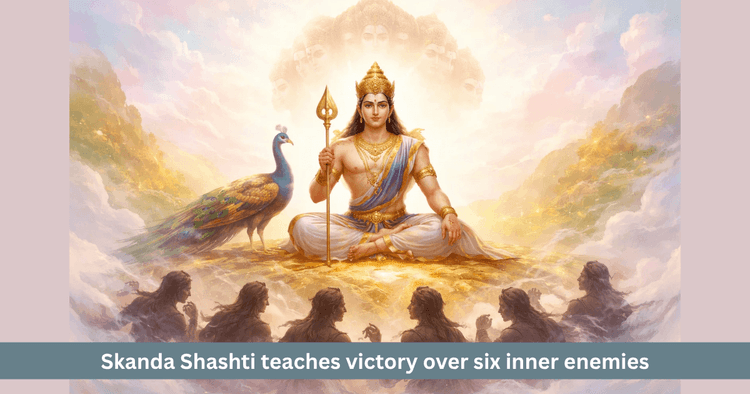
Table of Contents
In the spiritual tradition of India, some sacred observances are not meant only for ritual worship, fasting or celebration. They are occasions through which the hidden struggles of the human mind are understood and transformed. Skanda Shashthi is one such deeply significant observance. It is commonly associated with the worship of Lord Kartikeya, Skanda, Murugan or Subrahmanya and is remembered as the period in which Lord Skanda attained victory over demonic forces. Yet beyond this outer mythic meaning, the observance also carries a profound inward significance. It points not merely toward an outer war but toward the battle within.
In the traditions of spiritual philosophy and yogic understanding, the six days of Skanda Shashthi are seen as a period of practice meant for overcoming the six inner enemies of human consciousness. These six are kama, krodha, lobha, moha, mada and matsara. If one observes carefully, most human suffering arises less from outer conditions and more from these inner disturbances. External situations only provide the occasion. The true turbulence rises from within. Therefore the vrata of Skanda Shashthi is not only a means of worshipping the deity. It also becomes a tapas of inner purification.
This observance reminds us that Lord Kartikeya is not only the deity who conquers outer asuric forces. He is also the symbol of the awareness that recognizes inner darkness, courage guided by wisdom and spiritual discipline. That is why his six day sacred observance is linked to the conquest of six inner enemies. The symbolism is beautiful. Just as Kartikeya attained victory over outer negativity, the seeker too must attain victory over the asuric tendencies within.
Why is Skanda Shashthi more than a festival
Many people observe religious festivals only as tradition. They fast, perform worship, hear the sacred story and return to ordinary life. But Indian spiritual discipline rarely limits a sacred observance to outward ritual alone. Behind every observance there is an inner journey. Skanda Shashthi is especially important in this regard because it shifts attention away from the idea of an outer enemy and invites the seeker to confront the inner tendencies that truly create suffering.
Human beings often blame the world, people, fate, planets or circumstances for their troubles. Yet if one looks inward, it becomes clear that restlessness is largely born from one’s own reactions. When desire remains unrestrained, kama arises. When desire is obstructed, krodha appears. When something is obtained, lobha grows. Attachment to it becomes moha. Success then becomes mada and comparison with another gives rise to matsara. Thus these six enemies are not isolated faults. They are interconnected patterns of inner disturbance.
The six day structure of Skanda Shashthi gives the seeker an opportunity to recognize, face and transform them one by one.
Who are the six inner enemies
In spiritual thought they are often called the shadripu, the six inner enemies. These are not visible outside, yet they deeply affect peace, wisdom, relationships and clarity of judgment.
| Inner enemy | Essential nature | Result |
|---|---|---|
| Kama | Unrestrained desire | Restlessness and dissatisfaction |
| Krodha | Reaction and aggressive energy | Damage to wisdom and relationships |
| Lobha | Endless urge to possess | A feeling of constant insufficiency |
| Moha | Misguided attachment | Distance from truth |
| Mada | Pride and intoxication of ego | Blindness and downfall |
| Matsara | Jealousy | Inner burning and sorrow |
This table shows that these six are not merely moral terms. They are living psychological forces that continue to act in human life.
What is the deeper indication of the six days of Skanda Shashthi
The connection between the six days of Skanda Shashthi and the six inner enemies is a remarkable structure of spiritual discipline. It does not mean that a person becomes fully transformed in only six days. It means that within these six days one can begin consciously. One can observe the layers within. One can understand that the real war is inward.
The practice of these six days may be understood in the following way.
First day: Seeing kama
Kama does not refer only to physical desire. It includes every unrestrained urge that keeps the mind cut off from the present and trapped in endless wanting. Something more is wanted, something else is needed, something greater must be obtained. In this way the mind becomes restless. If the energy of desire remains impure, it scatters consciousness. But if guided properly, the same energy can be transformed into devotion, creativity, disciplined aspiration and sacred purpose.
On the first day the seeker may reflect
- Which desires make the mind restless
- Which longings leave the heart feeling empty
- Whether the difference between need and craving is clearly seen
Victory over kama does not mean suppression of desire. It means purification of desire.
Second day: Understanding the fire of krodha
Anger often appears in the name of justice but its root is frequently wounded ego, frustrated desire or hidden insecurity. The greatest danger of anger is that it quickly clouds intelligence. One who is composed at other times may in anger act far away from one’s true nature.
On the second day the seeker may reflect
- When and why anger arises
- Whether anger is actually born from fear, hurt or insult
- Whether it is possible to pause before reacting
Victory over krodha does not mean extinguishing all fire. It means transforming it into righteous energy.
Third day: The subtle grip of lobha
Greed is not limited to money. One may be greedy for recognition, praise, knowledge, comfort, attention or status. The root of greed is the sense that what one has is never enough. Therefore even a materially rich person may remain inwardly poor.
On the third day the seeker may ask
- What is the object of my endless hunger
- Why do I gather more than I need
- Is the experience of enoughness available within
Victory over lobha is not display of renunciation. It is the awakening of contentment.
Fourth day: The layers of moha
Moha is that condition in which one clings to a person, object, identity or idea so tightly that truth becomes blurred. Moha is not love. Love allows freedom, while moha grasps and binds. Moha does not let one see what has changed, what is temporary and what must be released.
On the fourth day the seeker may reflect
- What am I clinging to in an unhealthy way
- Do I love people or do I seek to possess them
- Can I accept change with maturity
Victory over moha does not mean losing love. It means freeing love from possession.
Fifth day: The blindness of mada
Mada is not just open arrogance. It is also the subtle intoxication in which one becomes proud of power, learning, beauty, austerity, lineage, position or even spiritual practice. The danger of mada is that it makes a person blind to oneself.
On the fifth day the seeker may ask
- What makes me feel inwardly superior
- Do I unconsciously look down upon others
- Do my attainments make me humble or hard
Victory over mada does not mean thinking poorly of oneself. It means seeing oneself in truth.
Sixth day: The poison of matsara
Matsara is deeper than simple jealousy. It is not only pain at another’s success. Sometimes it is the feeling that another’s rise is one’s own loss. Matsara quietly consumes inner peace and makes comparison a habit of living.
On the sixth day the seeker may observe
- Whose growth or success creates discomfort within
- Whether comparison steals joy from one’s own life
- Whether another’s progress can be accepted without agitation
Victory over matsara means recognizing one’s own path and learning to be inspired rather than consumed by another’s success.
Are these six enemies interconnected
Yes and that is one of the deepest insights of this discipline. They do not remain isolated. They are different expressions of one disturbed inner field.
- When kama is obstructed, krodha arises
- When desire is fulfilled, lobha often grows
- Lobha gives birth to moha
- From moha grows mada regarding what one possesses
- And when another possesses more, matsara appears
Thus Skanda Shashthi teaches not only that each tendency should be examined separately but that their hidden relationship must also be understood.
How is Kartikeya related to these six enemies
Lord Kartikeya is often called Shanmukha, the six faced one. Many traditions interpret his six faces as awareness in six directions, six forms of knowledge or six levels of consciousness. In this light, the six days of Skanda Shashthi and the six inner enemies form a profound correspondence. If the enemies are six, then awareness too must arise in six forms. If darkness surrounds from many directions, then divine consciousness must illumine from all sides.
Kartikeya here appears not only as the deity of outer war but as the conqueror of inner disorder. His Vel pierces ignorance. His vision cuts through confusion. His six faced form suggests that the inner battle requires many sided alertness.
How can the discipline of Skanda Shashthi be practiced practically
The observance becomes truly meaningful only when it becomes a discipline and not merely an outer celebration. For this, a few simple but profound practices may be followed.
Suggested practices for the six days
- Daily reflection on one specific inner enemy
- Sitting in silence and observing one’s reactions
- Prayer to Kartikeya combined with self examination
- Restraint in speech, food and reactive behavior
- Cultivating gratitude in place of comparison
- Returning to breath instead of immediate anger
- Redirecting desire into prayer, seva or disciplined effort
The purpose of such practice is not to condemn oneself but to recognize what is within. Only what is seen can be transformed.
How does yoga shastra support this understanding
Yoga Shastra repeatedly teaches that without purification of the mind, spiritual progress cannot remain stable. Postures alone, chanting alone and outward austerity alone are incomplete if the movements of the mind remain unexamined. The discipline of yama, niyama, pratyahara, dharana and dhyana was shaped precisely so that the seeker may understand and refine these inner tendencies.
In spiritual philosophy, kama, krodha, lobha, moha, mada and matsara are understood as obstacles that hold consciousness down. The six day observance of Skanda Shashthi gives this yogic psychology a devotional and symbolic expression.
The spiritual importance of the source tradition
The basis of this insight is found in the interpretive traditions of spiritual philosophy and yoga shastra. This means that the teaching is not merely folk belief. It belongs to a long discipline that regards the recognition of the inner enemies as essential to spiritual growth.
This is important because it shows that Skanda Shashthi is not only a remembrance of mythic victory but also an invitation to inner tapas. Only when outward celebration and inward discipline come together does the observance become complete.
Why is this discipline even more necessary today
The modern person may appear materially advanced, yet inwardly remains deeply disturbed. Desire is endless, anger is quick, greed is normalized, attachment has taken digital forms, pride hides in subtle achievements and jealousy is constantly fueled by a culture of comparison. In such a time, the message of Skanda Shashthi becomes especially relevant.
It reminds us that if the inner enemies remain ungoverned, outer success will still fail to bring peace. Real victory is the one attained within.
The final light of this teaching
The six days of Skanda Shashthi teach that the worship of Lord Kartikeya is not meant only for outer victory but also for triumph in the inner war. Kama, krodha, lobha, moha, mada and matsara are the real inner asuras that take a human being away from the truth of one’s own being. If during these six days the seeker begins to recognize, observe and transform these enemies, then this observance can bring a profound change in life.
This is the secret of the practice. Outwardly one remembers the victory of Lord Skanda. Inwardly one turns the gaze toward one’s own darkness. When these two come together, Skanda Shashthi no longer remains a festival alone. It becomes a sacred opportunity for inner purification, awakening of consciousness and victory within.
Frequently Asked Questions
What practice are the six days of Skanda Shashthi associated with
They are associated with the discipline of overcoming the six inner enemies of the mind.
What is meant by shadripu
Shadripu refers to the six inner enemies that disturb peace and wisdom.
Is Skanda Shashthi only a festival of worship
No. It is also a festival of self examination, restraint and inner purification.
How is Kartikeya connected to this inner discipline
Kartikeya symbolizes victory over both outer and inner negativity and therefore his worship also relates to inner battle.
What does this observance teach in the present age
It teaches that real peace and success require victory over the enemies within.
Get your accurate Kundali
Generate KundaliDid you like it?
Author

Pt. Sanjeev Sharma (63)
Experience: 20
Consults About: Family Planning, Career
Clients In: Punjab, Haryana, Delhi
Share this article with friends and family
About ZODIAQ
ZODIAQ is an online Vedic Astrology platform. It connects clients seeking astrological advice to experienced astrologers with deep knowledge. Our users also generate kundali and perform kundali milan for free. ZODIAQ also offers services to the Astrologers. Astrologers utilize various offerings by ZODIAQ to serve their clients effectively.
If you are a User
Consult with experienced astrologers and seek their guidance. You can also order handwritten Janm Patrika report with life prediction prepared by experienced astrologers. Generate accurate Kundali, perform Kundali Matching and check horoscope and muhurat. Utilize our online library for all the necessary astrological and spiritual information.
If you are an Astrologer
Create accurate kundali for your clients and perform Kundali Matching for up to 5 people at a time. Write comprehensive Janm Patrika report for your clients with ZODIAQ. Check client details anytime by saving it in client directory. Become more productive by tracking how many clients you guide every day.
WELCOME TO
ZODIAQ
Right Decisions at the right time with ZODIAQ
