Soorasamharam and Skanda Shashti: The Final Victory of Divine Light
By Pt. Suvrat Sharma
The deeper meaning of Skanda’s victory over asuric forces and inner darkness
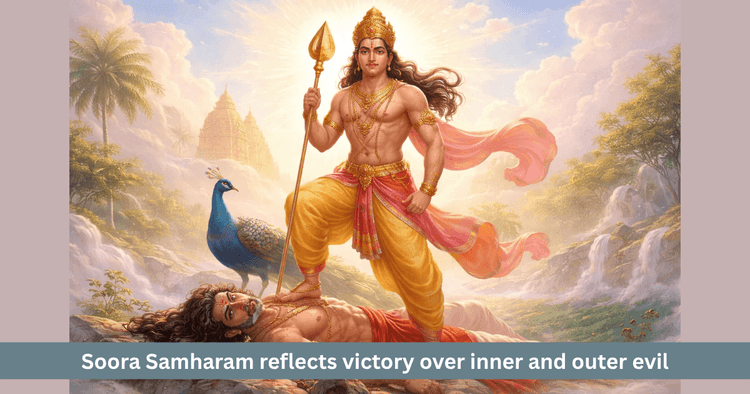
Table of Contents
In the devotional traditions of South India, many festivals connected with Lord Skanda, Murugan, Kartikeya and Subramanya are observed with deep reverence and emotion, yet Soorasamharam is regarded as holding a particularly exalted place among them. It is not merely a festival but the remembrance of that divine moment when Lord Skanda brought an end to asuric force and established dharma, courage and light. Celebrated on the final day of Skanda Shashti, this sacred observance awakens not only the joy of victory in the hearts of devotees but also the inner assurance that goodness, truth and divine resolve ultimately prevail.
This festival is important for another reason as well. The battle remembered here is not only external. The memory of Soorasamharam teaches that evil does not always appear as an outer enemy. It may also arise as ego, fear, confusion, cruelty or adharma. That is why this festival is not merely a remembrance of an ancient episode but a living spiritual message for every age and every seeker.
What is Soorasamharam
Soorasamharam is the great observance celebrated on the final day of Skanda Shashti in remembrance of Lord Skanda’s destruction of asuric forces. In South Indian tradition, it is not regarded merely as a religious ritual but as the culminating festival of the victory of dharma, the destruction of adharma, divine heroism and the fervor of devotion. For this reason, on this day Murugan temples especially become centers of profound worship, sacred celebration and dramatic devotional remembrance of the event.
The heart of this festival is not simply a story of war. Its central meaning is that when evil crosses its limits, divine force does not remain a silent witness. It becomes active and restores balance. This is the true heart of Soorasamharam.
Why is it celebrated on the final day of Skanda Shashti
Skanda Shashti itself is one of the most important sacred observances dedicated to Lord Skanda. It is regarded as a time of discipline, fasting, recitation, self restraint and surrender to the divine. When the observance reaches its final day, Soorasamharam reveals the highest meaning of that entire period of spiritual practice. It shows that the final fruit of austerity, prayer and divine remembrance is not only peace but also decisive victory over adharma.
This final day is also deeply symbolic. Just as a seeker, after days of discipline, overcomes some great inner obstacle, in the same way the final day of Skanda Shashti presents Soorasamharam as the vision of triumph attained through spiritual perseverance.
Main meanings of Soorasamharam on the final day of Skanda Shashti
• This observance symbolizes victory born from disciplined practice.
• On the final day the full manifestation of divine force appears.
• It reminds the devotee that patience and devotion do not go in vain.
• Soorasamharam is like a proclamation of the destruction of adharma at the end of sadhana, meaning spiritual practice.
Why is Soorasamharam called such a great festival of South India
In South India, Lord Murugan is not only a deity of worship. He is deeply woven into daily life, family devotion, cultural memory, regional identity and spiritual emotion. In his festivals one sees devotion, music, ritual, movement, sacred viewing and collective participation all at once. Soorasamharam is the height of this devotional experience. That is why it may be called not only a temple festival but also a festival of the collective consciousness of the community.
It is also loved on a grand scale because it carries a direct and universal message. The victory of good over evil is something every person can connect with. Whether one sees it through spiritual life, through society or through personal struggle, Soorasamharam becomes meaningful at every level.
With which destruction of asuric force is this observance associated
In South Indian sacred understanding, Soorasamharam is associated with Lord Skanda’s destruction of asuric force. More specifically, it is remembered in connection with the divine battle in which the Lord brought an end to demonic oppression and re established dharma. This devotional understanding receives a strong traditional foundation through Kanda Puranam, where this sacred episode is elaborated in depth.
Here the destruction of the asura does not mean only defeating an enemy. It means ending that force which stands against balance, dharma and the divine path. For this reason, the heroism of Lord Skanda is regarded not merely as valor but as righteous divine justice.
Is Soorasamharam only a remembrance of war
No. To understand Soorasamharam only as a war episode would be to limit its deeper meaning. This observance remembers that point where divine force ends injustice and gives the seeker confidence that however great darkness may appear, its end is possible. The battle here is not only an outer event but also a symbol of inner spiritual struggle.
Many asuric tendencies can remain hidden within human life as well. Anger, ego, jealousy, fear, laziness and confusion may work in the same way that outer adharma does. In this sense, Soorasamharam teaches the lesson of inner sadhana through an outer sacred story.
The meaning of Soorasamharam in inner life
• It symbolizes the victory of humility over ego.
• It carries the message of courage over fear.
• It reflects the establishment of clarity over confusion and light over darkness.
• It teaches the seeker that inner adharma too can be ended.
Why does this victory seem so natural in the form of Lord Skanda
The form of Lord Skanda is itself an extraordinary union of radiance, discipline, wisdom, heroism and divine resolve. He is the son of Shiva, the commander of the divine hosts and the brilliant deity who manifests for the protection of dharma. Therefore when his victory is celebrated in Soorasamharam, it does not seem like an isolated event. It appears as a natural extension of his divine nature, role and sacred responsibility.
His vel, meaning his sacred spear, his youthful radiance, his martial skill and his unwavering dedication to dharma all combine to reveal him as the deity in whom victory arises not merely from force but from a purpose aligned with dharma. That is why Soorasamharam feels like a deeply natural festival of his divine form.
How is Soorasamharam experienced in temples
In many Murugan temples of South India, the festival of Soorasamharam is observed in a deeply moving way. On this day there are special acts of worship, hymns, ceremonial offerings, sacred processions and in many places a visual devotional reenactment of the destruction of the asuric force. Devotees do not merely watch the event. They participate in it emotionally. For them it becomes a union of sacred seeing, sacred listening and inner upliftment.
Collective memory is very important in such observances. When an entire community remembers divine victory together, it does not merely keep a story alive. It also establishes within itself the faith that the side of dharma is never truly weak.
The inward link between Soorasamharam and spiritual practice
This festival is not only the final point of religious observance. It is also a mirror of sadhana. During the days of Skanda Shashti, through fasting, recitation, restraint and devotion, the seeker begins to see inner impurities more clearly. The final day of Soorasamharam indicates that some deeper knot within must now be cut away. For this reason the observance is regarded as spiritually powerful.
Here Lord Skanda is not only the deity who is worshipped outside. He becomes the form of divine force working within the seeker. The power that can cut inner imbalance is the true experience of Soorasamharam.
A simple table to understand this festival
| Element | Meaning |
|---|---|
| :contentReference[oaicite:0]{index=0} | Festival of asura destruction and victory of dharma |
| :contentReference[oaicite:1]{index=1} | Sacred period of discipline, fasting and devotion |
| Final day | Supreme moment of divine victory |
| :contentReference[oaicite:2]{index=2} | Protector of dharma, commander of the divine hosts and radiant victor |
| Inner meaning | Spiritual victory over harmful tendencies |
Does Soorasamharam remain relevant in life today
Yes, this observance remains as relevant today as it must have been in earlier times. The names of the asuras may have changed but their forms still exist. Injustice, greed, confusion, violence, mental unrest and inner imbalance still surround human life. That is why Soorasamharam is not only a sacred memory but also a profound inspiration for modern life.
It reminds us that however widespread evil may appear, its end remains possible. It also teaches that victory is found not only in outer struggle but also in correcting the direction of one’s inner life. For this reason the remembrance of Lord Skanda in this festival remains living and relevant.
How does Kanda Puranam give religious dignity to this observance
The traditional memory of this festival is associated with Kanda Puranam. In South Indian devotion this text holds a special place because it presents in rich detail the divine deeds, battles, radiant nature and destruction of asuric force by Lord Skanda. Soorasamharam receives special religious dignity from this puranic memory.
When a festival remains alive in both sacred text and living tradition, its effect becomes even deeper. Soorasamharam is one such observance in which story, ritual, devotion and philosophical meaning come together.
What does this festival of the victory of good over evil teach us
The greatest message of Soorasamharam is that goodness, dharma, truth and divine courage never go fruitless. Sometimes their victory becomes visible quickly, at other times it takes longer but in the end the light of dharma cuts through the darkness of adharma. This festival presents that truth not only in words but as a living sacred celebration.
For the devotee, this remembrance is deeply consoling. When conflict increases in life, when injustice appears too strong and when despair begins to arise within, Soorasamharam says that divine force is still active. Victory is not only a tale. It is a possible reality.
Main teachings received from this festival
• Dharma ultimately prevails.
• Adharma may appear powerful, yet its end is possible.
• Devotion and spiritual discipline make the seeker worthy of victory.
• In both outer and inner struggles, divine remembrance offers support.
The victorious light of remembrance
Soorasamharam is not merely a festival but a radiant center of South India’s living spiritual consciousness. In it the heroism of Lord Skanda, the intensity of devotion, the collective faith of the community and the inner hope of the seeker all come together. That is why this festival is not merely observed. It is experienced.
When this observance is celebrated on the final day of Skanda Shashti, it seems to declare that however long the period of darkness may be, the final victory of light is certain. This is the enduring message of Soorasamharam and this is its deepest spiritual dignity.
Frequently asked questions
What is Soorasamharam
It is the great festival observed on the final day of Skanda Shashti in remembrance of Lord Skanda’s destruction of asuric force and the victory of dharma.
Why is it regarded as a great festival of South India
Because devotion to Lord Murugan is deeply widespread in South India and this observance is regarded as one of the most powerful collective celebrations of the victory of good.
Is Soorasamharam only a remembrance of an outer battle
No. It also has an inner meaning. It symbolizes victory over inner adharma, fear, ego and confusion.
With which text is this festival generally associated
It is generally associated with the sacred memory found in Kanda Puranam.
What is the importance of Soorasamharam for a seeker
It reminds the seeker that through devotion, restraint and surrender to the divine, victory can be gained over both inner and outer forms of evil.
Get your accurate Kundali
Generate KundaliDid you like it?
Author
Pt. Suvrat Sharma (63)
Experience: 20
Consults About: Family Planning, Career
Clients In: Punjab, Haryana, Delhi
Share this article with friends and family
About ZODIAQ
ZODIAQ is an online Vedic Astrology platform. It connects clients seeking astrological advice to experienced astrologers with deep knowledge. Our users also generate kundali and perform kundali milan for free. ZODIAQ also offers services to the Astrologers. Astrologers utilize various offerings by ZODIAQ to serve their clients effectively.
If you are a User
Consult with experienced astrologers and seek their guidance. You can also order handwritten Janm Patrika report with life prediction prepared by experienced astrologers. Generate accurate Kundali, perform Kundali Matching and check horoscope and muhurat. Utilize our online library for all the necessary astrological and spiritual information.
If you are an Astrologer
Create accurate kundali for your clients and perform Kundali Matching for up to 5 people at a time. Write comprehensive Janm Patrika report for your clients with ZODIAQ. Check client details anytime by saving it in client directory. Become more productive by tracking how many clients you guide every day.
WELCOME TO
ZODIAQ
Right Decisions at the right time with ZODIAQ
