The Secret Behind Ganesha’s Head: Shani’s Gaze and Cosmic Balance
By Pt. Suvrat Sharma
Understanding the deeper meaning of Shani’s gaze, Parvati’s love and Shiva’s role in transformation and cosmic order
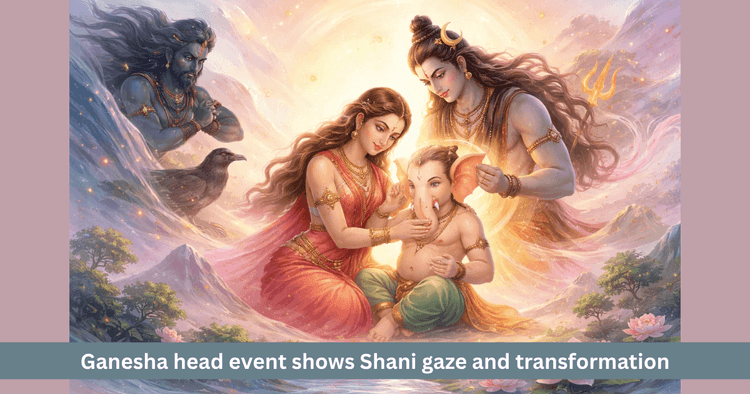
Table of Contents
In Indian sacred narratives, every story is not merely an event. It is also a means of understanding the subtle laws of consciousness, energy, karma and cosmic order. This episode connected with Shani Deva and Ganesha reveals exactly that depth. At first glance, it appears to be a miraculous and tragic event. But when its deeper signs are understood, it becomes clear that this is not merely a story of destruction. It is also a story of transformation, destiny, maternal love, karmic force and the birth of a higher form.
In this episode three powers appear together. The first is the maternal emotion of Mata Parvati, filled with natural affection and pride toward her child. The second is the gaze of Shani Deva, which is not just an act of seeing but a force that activates the hidden direction of karma. The third is the restorative power of Bhagavan Shiva, who establishes a broken form into a new and more meaningful identity. The event that unfolds between these three teaches that what appears sudden and harsh in life may later become the reason for a great transformation.
Why is this episode so important
This episode is important because no one here appears as simply good or bad. There is no villain, no ordinary accident and no empty coincidence. Every force is acting according to its own nature. Mata Parvati’s insistence is born of love. Shani Deva’s hesitation is born of knowledge and responsibility. And the result that finally appears becomes the doorway to a cosmic transformation without which Ganesha’s form as Gajanana, meaning the elephant faced one, could never have manifested.
This is the greatest secret of the story. In life there are events that look like pain, loss or misfortune when seen only from the outside. But when viewed in a wider context, those same events open the way for a greater purpose. The episode of Ganesha’s head being severed stands as a symbol of this truth.
What does the Brahmavaivarta Purana narrative say
According to a traditional account associated with the Brahmavaivarta Purana, when Mata Parvati gave birth to her son Ganesha, she invited the devas to come and see him. It was an occasion of joy and blessing. The divine beings were beholding the beauty, radiance and auspiciousness of the newborn child. The entire atmosphere was filled with celebration, maternal happiness and sacred delight.
In that same gathering, Shani Deva was also present, yet he kept his eyes lowered. This was not an act of disrespect. He fully understood the nature of his own gaze. He knew that his sight was not ordinary. It was a force that activates the depth of karma and destiny wherever it falls. That is why he did not wish to look directly upon the infant Ganesha.
When Mata Parvati noticed that Shani Deva was not looking at her son, the matter seemed unusual to her. In a mother’s heart, it is natural to wish that every deity look upon her child with blessing and acceptance. So she insisted that Shani should behold Ganesha. Shani humbly expressed his hesitation. He indicated that the effect of his gaze was not simple. Yet before the force of maternal insistence, his restraint did not remain.
Why had Shani Deva kept his gaze lowered
This question is one of the deepest parts of the story. Shani Deva’s lowered eyes were not merely the result of fear. They were proof of self awareness. He knew that the effect of a force is not determined only by intention but also by nature. Shani’s gaze is the gaze of justice. It removes covering from karma. It does not look at appearance. It brings hidden direction into action.
This is why Shani Deva was cautious about his own influence. Such caution is not a sign of harshness but of responsibility. He did not wish to cause harm, yet neither could he deny his own nature. In this episode Shani teaches that true power is the power that knows both its influence and its limits.
Teachings that arise from Shani’s hesitation
• Every force has its own nature
• Self knowledge means understanding one’s impact
• Humility may become the highest form of power
• Caution is often another form of compassion
Why was Ganesha’s head severed the moment Shani looked
The moment Shani Deva raised his gaze and looked upon the infant Ganesha, his head became separated from his body. At first sight, this event appears severe and terrifying. This is why the story is often reduced to the idea of Shani’s destructive gaze. But if the event is understood more deeply, it becomes clear that this is not mere destruction. It is the beginning of a necessary transformation.
In Indian symbolic thought, the head is not merely a bodily limb. It represents identity, consciousness, direction and the form of intellect. The removal of Ganesha’s earlier head indicates that his form was now about to pass beyond ordinary human limitation and transform into a shape that would later become the universal symbol of wisdom, discernment, removal of obstacles and vast vision. Therefore this moment is not only one of sorrow but also the threshold of a higher form.
Is Shani’s gaze truly destructive
To describe Shani’s gaze only as destructive would be incomplete. Shani’s influence removes that which is not yet stable and reveals the truth that was hidden underneath. This is why, even in astrology, Shani is not regarded merely as a punishing force. He is the giver of karmic result. His purpose is to bring a person face to face with one’s actions, weaknesses, incompleteness and unfinished maturity.
The same principle appears in the episode of Ganesha. What Shani’s gaze brought was not an end. It created the path for a higher and more meaningful form. That is why it is important to understand that in life Shani’s influence often brings the kind of change that first appears as loss but later becomes the foundation of growth.
Deeper meanings of Shani’s gaze
• It activates hidden karma
• It removes temporary form to make space for new truth
• It opens the path of inner purification through outward difficulty
• It can reshape a person or a situation into a more mature form
What does Mata Parvati’s insistence symbolize in this story
Mata Parvati’s insistence is not merely an event. It is a natural expression of maternal love. A mother wishes to see her child surrounded by love, blessing and acknowledgment from the world. This feeling is so natural and pure that at times it can move ahead of caution. Parvati’s insistence reveals this very truth.
The story also teaches that love is never wrong, yet love must remain balanced by wisdom. Her insistence was born of affection, while Shani’s hesitation was born of knowledge. When love and karmic force came face to face, the result was not merely conflict but an event that would later make Ganesha’s form universal. No one here should be called guilty. The story teaches that there are moments in life where two truths stand together and their outcome becomes a third and deeper truth.
What is the spiritual meaning of Shiva placing the elephant head
The placing of the elephant head upon Ganesha’s body is not merely a miraculous repair. It is a deeply symbolic act. In Indian tradition the elephant signifies wisdom, memory, patience, steady power and broad vision. The elephant does not fear obstacles. It creates the path. It walks with calmness, yet its presence is powerful. The moment Ganesha receives the elephant head, his identity rises beyond that of a divine child and becomes that of the remover of obstacles, the giver of wisdom and the presiding force over new beginnings.
Here Shiva’s role is deeply significant. He is the deity of both dissolution and renewal. He does not allow the event to end in sorrow alone. He turns it into a new identity. This is one of the deepest messages of the story. When something breaks in life, what is made afterward determines the true direction. Shiva did not merely restore life to Ganesha. He gave him a higher meaning.
Symbolic meanings of the elephant head
• Discernment, which can distinguish truth from error
• Patience, which remains steady in difficulty
• Broad vision, which sees beyond narrow limits
• Memory and wisdom, which guide life with clarity
What is the psychological meaning of this story
This story is not only about divine beings. It also carries a deep psychological meaning. In life there are sudden events that shake a person’s identity, plans or confidence. It may feel as though everything is finished. Yet with time, those same events often give rise to a new form, a new understanding or a new strength. Ganesha’s head being severed and his new form being established symbolizes this inner journey.
Here Shani’s gaze stands for those circumstances that cannot be stopped. Parvati’s insistence stands for those human emotions that are natural and pure. Shiva’s restoration stands for the healing consciousness that gives life meaning again after crisis. In this way, the story teaches that every harsh event is not merely a collapse. Sometimes it is the beginning of a greater hidden form.
What does this story teach us today
Today many people immediately interpret difficult events as simple misfortune. Loss, failure, humiliation, broken relationships, shattered plans or unexpected change are often seen only through a negative lens. But the story of Ganesha offers a different way of seeing. It says that within every severe event there may also be a seed of transformation. The only condition is that one should have the patience to understand it, the vision to see it and the willingness to accept life in a new form after it happens.
The story also teaches that every force has its own nature. It is easy to blame Shani, yet the narrative does not do so. He acts according to his nature. Parvati insists according to her nature. Shiva recreates according to his nature. Life is similar. Every person and every circumstance comes with a nature of its own. Wisdom lies not merely in finding fault but in understanding the larger meaning.
What is the deepest secret behind Ganesha’s head being severed
The deepest secret in this episode is that destruction and transformation are often two stages of the same process. What is removed is not always removed for emptiness. Sometimes it is removed so that a higher form may be born. Ganesha’s earlier head being removed, the elephant head being placed and his later establishment as the first deity to be worshipped together prove that harsh transformation is not the end. It can become the beginning of a more exalted form.
That is why this story should not be seen only as a tale of fear, curse or misfortune. It is the story of a cosmic balance in which karma, love, insistence, gaze, loss and renewal together reveal a higher truth. That is the real power of this narrative.
Frequently Asked Questions
Why did Shani Deva hesitate before looking at Ganesha
Because he knew the power of his own gaze and wanted to prevent any harmful consequence.
Was Ganesha’s head being severed only the result of Shani’s destructive gaze
No. It should not be seen only as destruction. It was part of a wider cosmic design through which Ganesha’s Gajanana form could emerge.
What is the meaning of Mata Parvati’s insistence
It is the natural form of maternal love, which seeks complete blessing and acknowledgment for the child.
What is the symbolic meaning of Ganesha receiving the elephant head
It symbolizes wisdom, patience, discernment, broad vision and the power to move through obstacles.
What lesson does this story offer for life today
It teaches that every difficult transformation should not be seen only as misfortune. Many times it becomes the basis for a more developed form of life.
Get your accurate Kundali
Generate KundaliDid you like it?
Author
Pt. Suvrat Sharma (63)
Experience: 20
Consults About: Family Planning, Career
Clients In: Punjab, Haryana, Delhi
Share this article with friends and family
About ZODIAQ
ZODIAQ is an online Vedic Astrology platform. It connects clients seeking astrological advice to experienced astrologers with deep knowledge. Our users also generate kundali and perform kundali milan for free. ZODIAQ also offers services to the Astrologers. Astrologers utilize various offerings by ZODIAQ to serve their clients effectively.
If you are a User
Consult with experienced astrologers and seek their guidance. You can also order handwritten Janm Patrika report with life prediction prepared by experienced astrologers. Generate accurate Kundali, perform Kundali Matching and check horoscope and muhurat. Utilize our online library for all the necessary astrological and spiritual information.
If you are an Astrologer
Create accurate kundali for your clients and perform Kundali Matching for up to 5 people at a time. Write comprehensive Janm Patrika report for your clients with ZODIAQ. Check client details anytime by saving it in client directory. Become more productive by tracking how many clients you guide every day.
WELCOME TO
ZODIAQ
Right Decisions at the right time with ZODIAQ
