Ravana and Shani Deva: Ego, Karma and the Turning Point of Destiny
By Pt. Abhishek Sharma
Exploring how Ravana’s ego, Shani’s karmic force and Hanuman’s intervention reveal the balance between power and humility
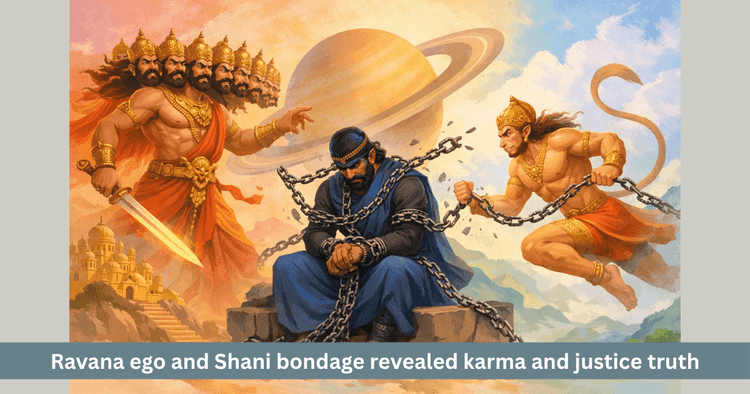
Table of Contents
In Indian sacred narratives, Ravana does not appear only as a villain. He is shown as an immensely powerful, learned and accomplished being who is at the same time consumed by deep ego. In his life, greatness and downfall move side by side. The episode connected with Shani Deva reveals this inner contradiction with great depth. It is not merely about one mythic incident. It is about the truth that when power becomes separated from humility, it begins to move toward destruction.
This episode becomes even more meaningful because within it karma, time, cosmic order and ego are all seen working together. On one side stands Ravana, who in the pride of his might attempts to control even the nine planetary forces. On the other side stands Shani, the symbol of slow but certain karmic result. And then there is Hanuman, who breaks that bondage and restores the movement of dharmic balance. In this way the story becomes not just a mythological event but a visible expression of deep life principles.
Why did Ravana try to bind the Navagrahas
According to a tradition associated with the Ananda Ramayana, Ravana in the intoxication of his own strength brought the Navagrahas, the nine planetary forces, under his control. He is said to have hung them upside down beneath the steps of his throne so that their influence would not affect his life and so that cosmic powers too would bend before his will.
This act is symbolically very important. Ravana is not merely binding the planets. He is actually trying to dominate time, destiny and the laws of nature. This is the highest expression of ego. When a person begins to believe that one’s intelligence, achievement, influence or kingdom is so great that no law applies any longer, the beginning of downfall has already started. Ravana’s attempt represents exactly that state of mind. He forgot that cosmic forces may be suppressed for a while but they cannot be permanently overruled.
Symbolic meanings of Ravana’s act
• He tried to control destiny itself
• He thought his strength was greater than cosmic balance
• He assumed that ego could stand above law
• He attempted to suppress divine order through external force
Why is Shani Deva so important in this episode
In Indian astrology and sacred tradition, Shani Deva is not merely a planetary force. He is the symbol of karmic result, justice, patience and inevitable consequence. His movement is slow but his effect is deep. He does not deliver quick results, yet when he does, those results become lasting lessons. This is why Shani is related less with fear and more with responsibility. For the one who lives with truth, discipline and humility, Shani can bring maturity, stability and strength. But for the one lost in injustice, misuse of power and adharma, Shani opens the path of difficult consequence.
This was the central truth in Ravana’s life. He had greatness but it had become separated from maryada, meaning rightful restraint. He had knowledge but it had become cut off from discernment. He had power but it had moved away from dharma. Shani does not overlook such imbalance forever. This is why in this episode he is not just a captive planet. He is the symbol of the karmic force that was suppressed, yet waiting to become active again.
What is the meaning of Hanuman freeing Shani
When Hanuman reached Lanka and through his divine action fire arose there, in that same sequence Shani Deva too was freed from bondage. This is not merely a heroic moment. Its deeper meaning is that when dharma becomes active, it does not only stop one injustice. It also releases all the truths that had been suppressed by that injustice. Hanuman here is not simply burning Ravana’s city. He is also breaking that artificial control through which Ravana had started to believe himself invincible.
The release of Shani by Hanuman teaches that adharma may appear great but it is never eternal. At some moment, a force arises that restores balance again. That is the true meaning of dharma. Dharma is not only a matter of worship. It is also the process of restoring cosmic balance.
Teachings from Hanuman’s role here
• Dharma does not only protect, it also releases
• A truth that has been suppressed can awaken again at the right time
• The empire of adharma may appear powerful, yet it is never permanent
• Restoration of balance often comes through a decisive intervention
Why did Ravana’s downfall begin when Shani cast his gaze
Shani’s gaze does not merely mean seeing. It means the activation of karmic consequence. When Shani was freed and his gaze fell upon Ravana, this did not mean that everything ended in a single moment. It meant that the adharma, ego, injustice and misuse of power that had long been gathering beneath the surface now began to ripen into visible result.
This is Shani’s nature. He does not create sudden drama. He brings slow, deep and inescapable consequence. Ravana’s downfall too followed this pattern. It did not happen at once but the structure he had built gradually began to weaken. His confidence had already become arrogance. His power had already moved away from wisdom. His strength was no longer protecting him but enlarging his faults. Shani’s gaze simply brought all this to the surface.
Why does the fruit of karma come late yet remain certain
This story introduces us to one of the deepest laws of karma. Human beings often think that if the result of wrongdoing does not come immediately, then perhaps they have escaped it. But in Indian thought karma is not a system of instant reaction. It is linked with time, circumstance and ripened consequence. Shani is one of the greatest symbols of this karmic process. He teaches that the result may come late but if karma is distorted, the fruit will surely appear.
This is exactly what happened in Ravana’s life. His ego remained covered by power for a long time. But what is covered is not erased. It only waits for time. The moment Shani’s gaze became active, that hidden process began to unfold. This is why Shani should not be seen merely as a frightening force. He is the symbol of justice emerging through time.
Things to understand about karmic result here
• Not every result comes immediately, yet none is truly stopped
• Power may hide wrong karma for some time but cannot erase it
• Time often reveals what a person assumes is safely concealed
• Shani’s slow movement represents the deep process of justice
What is the philosophical meaning of this story
At the philosophical level, Ravana binding the planets shows that when a person tries to control the larger laws of life, that person has already lost inner balance. Here the planets are not only astrological forces. They also symbolize time, rhythm, karma, destiny and cosmic order. By suppressing them, Ravana assumed he could create a separate law for himself. That was his philosophical error.
The story itself provides the answer. The cosmos does not move according to the will of any single individual. It moves through balance. When a person violates that balance, one may appear victorious for some time but in the longer course that same imbalance becomes the cause of downfall. This is the deepest secret of Ravana and Shani.
Is this episode only about Ravana or about every human being
This story is not only about Ravana. It is about every person who at some point begins to believe that because of success, knowledge, influence, position or talent, no further law, relationship or dharma is needed. That is the inner Ravana. And Shani’s gaze becomes active wherever a person becomes blinded by one’s own ego.
In this sense, Shani’s influence is not meant only to frighten. It is meant to awaken. If life brings difficulty, delay, pressure, broken plans or a forced encounter with one’s own actions, then that may not be punishment alone. It may also be the opportunity to correct hidden imbalance. This is the living and practical meaning of the story.
Why this story still matters today
• Modern people too often live under the illusion of control
• Achievement without humility creates imbalance
• Karma may act slowly, yet its lesson remains certain
• Dharma still means balance in life even today
What does the triangle of Hanuman Shani and Ravana teach
In this story three powers appear together. Ravana represents ego. Shani represents karmic justice and inevitable consequence. Hanuman represents dharma, devotion and the restoration of balance. When these three meet in one episode, a very deep principle of life becomes visible. Ego may suppress justice for a while but the moment devotion and dharma awaken, hidden justice becomes active again and the process of downfall begins.
This principle is not only mythological. It is also deeply practical. When a person moves into control and arrogance, one enters the direction of Ravana. When time confronts that person with one’s own karma, Shani becomes active. And when one returns to truth, service, humility and dharma, the force of Hanuman restores balance again.
What is the final light of this story
Ultimately, this episode of Ravana and Shani Deva teaches that ego can never become greater than time, karma and cosmic balance. A person may be powerful but cannot rise above the laws of life. A life cut away from dharma may shine for a while, yet it cannot remain stable. One who tries to escape karma must one day face the web one has woven.
That is why this story is not merely meant to frighten. It is meant to warn and awaken. It teaches that the rightful place of power is humility, the rightful place of knowledge is dharma and the rightful place of success is balance. When this balance remains, even Shani’s gaze need not be only a source of fear. It can become a serious grace that helps correct life.
Frequently Asked Questions
Why did Ravana bind the Navagrahas
It symbolized his ego. He wanted to control even cosmic forces through his own power.
What is the meaning of Hanuman freeing Shani
It symbolizes dharma restoring the suppressed balance and justice of the cosmos.
What happened when Shani cast his gaze upon Ravana
The stored consequences of Ravana’s ego, injustice and adharma began to become active and the process of his downfall started.
Is Shani’s gaze only inauspicious
No. It makes a person face one’s karma. Its purpose includes not only hardship but also purification and maturity.
What does this story teach in today’s life
It teaches that no human being can rise above time, karma and the laws of life. Humility and balance are the only lasting strength.
Get your accurate Kundali
Generate KundaliDid you like it?
Author

Pt. Abhishek Sharma (63)
Experience: 20
Consults About: Family Planning, Career
Clients In: Punjab, Haryana, Delhi
Share this article with friends and family
About ZODIAQ
ZODIAQ is an online Vedic Astrology platform. It connects clients seeking astrological advice to experienced astrologers with deep knowledge. Our users also generate kundali and perform kundali milan for free. ZODIAQ also offers services to the Astrologers. Astrologers utilize various offerings by ZODIAQ to serve their clients effectively.
If you are a User
Consult with experienced astrologers and seek their guidance. You can also order handwritten Janm Patrika report with life prediction prepared by experienced astrologers. Generate accurate Kundali, perform Kundali Matching and check horoscope and muhurat. Utilize our online library for all the necessary astrological and spiritual information.
If you are an Astrologer
Create accurate kundali for your clients and perform Kundali Matching for up to 5 people at a time. Write comprehensive Janm Patrika report for your clients with ZODIAQ. Check client details anytime by saving it in client directory. Become more productive by tracking how many clients you guide every day.
WELCOME TO
ZODIAQ
Right Decisions at the right time with ZODIAQ
