The Episode of Shani and Hanuman: Balance of Power, Ego and Devotion
By Aparna Patni
A spiritual story revealing deeper truths about ego, karma and humility
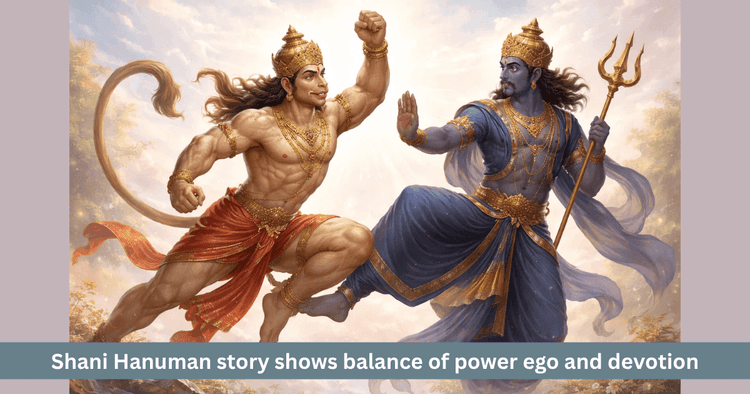
Table of Contents
In Indian sacred narratives, the episodes that unfold between deities and great beings are never meant only as dramatic events. They are vehicles through which deeper laws of life are revealed. The episode between Shani Dev and Hanuman Ji belongs to this very category. At first glance, it may appear to be a tale of confrontation, yet inwardly it is a profound teaching on ego, power, karma, devotion, humility and divine balance. That is why this episode does not remain a simple story of combat. It becomes a symbol of a spiritual process that also unfolds within human life.
According to Parashara Samhita, there came a time when Shani Dev developed great pride in his own power. He began to believe that no one could escape his gaze, his testing or his influence. In the beginning, this may seem like confidence, yet when power loses humility, confidence gradually becomes ego. This is exactly the inner shift that the story presents. And from that point onward, the real movement of the episode begins.
Was Shani’s Pride Only a Display of Strength
Shani Dev is regarded in astrology as the giver of karmic results. He grants outcomes according to actions, whether they are pleasant or difficult. His influence is considered deep, slow and unfailing. Because of this, even the thought of Shani creates seriousness in the mind. Yet in this story, Shani represents not only justice but also that condition in which the one who administers justice becomes overly attached to personal power.
A deeper signal is hidden here. Whenever any force becomes centered on itself instead of its purpose, imbalance begins. The pride of Shani teaches that strength alone is not enough. Along with strength, there must also be self restraint.
This part of the narrative may be understood through a few key points:
• Power remains beneficial only as long as it stays within dharma
• Ego takes power away from its true purpose
• The pride of Shani teaches that even the giver of justice is not beyond examination
• Every great force must at some point learn the lesson of humility
What Did It Mean to Challenge Hanuman Ji
When the pride of Shani increased, he challenged Hanuman Ji to battle. This was not merely an outer invitation to fight. It was like the meeting of two very different forms of power. On one side stood the force of Shani, symbolizing karma, testing, discipline and punishment. On the other side stood Hanuman Ji, symbolizing devotion, surrender, pure strength and the protection of dharma.
Hanuman Ji possesses immeasurable strength, yet the source of that strength is not personal pride. His power is born of devotion to Rama. That is why he never uses strength for selfishness, display or fear. Within him, immense force and deep humility exist together. This is the most important difference in the story. Shani’s challenge carried hidden pride, while Hanuman’s response carried both dharma and compassion.
What Did This Battle Truly Symbolize
As the battle began, it became clear that this was not merely a test of force. It was a meeting of two energies. One was the energy that makes a person bow before karma. The other was the energy that can, through devotion, balance even the harshest condition. For this reason, the episode cannot be understood only as a tale of valor. It is also a dialogue between ego and surrender, punishment and compassion, power and devotion.
The deeper meaning of this conflict is that real power is not the power that can dominate others. Real power is the power that can remain under dharma. Hanuman Ji represents that divine balance.
Why Did Hanuman Ji Use His Tail
According to the story, Hanuman Ji wrapped Shani Dev in his tail and began to drag and rub him across mountains. This scene is not merely symbolic of punishment or retaliation. In Indian sacred symbolism, the tail of Hanuman is a powerful emblem of energy, movement, force and active dharma. In the episode of Lanka, the same tail becomes an instrument for the burning of adharma. Here too, it becomes the means through which ego is broken.
This teaches that Hanuman Ji’s strength is intense but never uncontrolled. It remains under dharma. He does not destroy Shani. Rather, through experience he teaches him that when strength becomes separated from humility, it must eventually bow.
This symbol may be understood in the following way:
• Hanuman’s tail symbolizes divine energy and active dharma
• Shani being wrapped in it indicates ego being bound
• Being rubbed across mountains represents learning through direct experience
• This is not destruction but a process of purifying pride
What Did Shani Learn From This Experience
When Shani Dev encountered the force and divine surrender of Hanuman Ji, he realized that influence alone is not enough. If power lacks compassion, dharma and humility, it can itself become a source of imbalance. This is the deepest turning point of the story. Shani is not overcome merely by force. He is transformed by the truth of devotion.
He comes to understand that the source of Hanuman Ji’s strength is not personal greatness but complete surrender to Rama. This is the kind of strength that no worldly hardness can overpower. The strength born of devotion is not like the strength born of ego. It is pure, balanced and beneficial.
Why Is the Moment of Forgiveness So Important
When the pride of Shani was completely dissolved, he asked Hanuman Ji for forgiveness. This was not merely the confession of one who had been defeated. It was the outcome of an inward journey in which power recognized humility. Hanuman Ji forgave him. This is where the spiritual height of the story truly appears. There is no revenge here. There is only the restoration of balance.
At that moment Shani gave a vow that anyone devoted to Hanuman Ji would not be subjected to unnecessary suffering from him. This is why even today there remains a strong belief that worship of Hanuman helps reduce the more difficult effects associated with Shani. This faith is not only religious feeling. It is also a symbol of the deeper principle that devotion can soften even the hardest conditions of life.
Why Does Hanuman Devotion Bring Peace to the Influence of Shani
The answer to this question lies not only in faith but also in symbolism. Shani makes a person aware of limits, karma and reality. Hanuman Ji grants fearlessness, surrender, service, faith and inner strength. When a person becomes steady in Hanuman devotion, an inner balance develops that makes the difficult teachings of Shani easier to bear and understand.
Some of the principal effects of Hanuman devotion may be seen in this way:
• Fear decreases in the mind
• One faces difficulties with patience and courage
• Ego reduces and surrender increases
• The testing of Shani can become not merely painful but a true spiritual opportunity
What Is the Psychological Meaning of This Story
If understood psychologically, Shani represents that part within us which may become hard, judgmental, controlling and burdened. Hanuman represents the part within us that is pure, devotional, fearless and rooted in dharma. When the inner Shani of a person becomes filled with ego, life can grow heavy, fearful and severe. But when the inner Hanuman awakens, the same life begins to fill with courage, service and devotion.
Thus, this is not only a story about deities. It is also a story about the energies working within every human being. In each person there is a stern side that judges and a sacred side that serves and surrenders. Only when the two come into harmony does peace arise.
What Does This Episode Teach the Present Age
In the present time, people often seek power but not humility. They want influence but not surrender. They want achievement but not service. In such a world, the episode of Shani and Hanuman becomes especially relevant. It teaches that true power is power joined with devotion. If force does not carry humility, it may become destructive. If devotion does not carry courage, it may become passive. Hanuman Ji embodies the perfect divine balance of both.
This episode offers the following teachings:
• Ego, no matter how great, must eventually bow
• Devotion is not merely tenderness but also a mighty force
• Without humility, power remains incomplete
• To balance difficult influences, service and surrender are necessary
• The real victory in life is not over others but over one’s own ego
When Power Becomes Purified in Devotion
The episode of Shani and Hanuman ultimately reveals that the true worth of power emerges only when it is joined with dharma, devotion and humility. Hanuman Ji’s strength is immeasurable, yet free from pride. Shani’s power is deep, yet when pride entered it, it had to bow before Hanuman. This is the enduring message of the tale.
therefore it may be said that this episode is not merely a story of confrontation. It is a symbol of the truth that when power is bathed in surrender, it becomes beneficial. And when ego bows before devotion, real balance is established in life. This is the deepest teaching of the story.
Frequently Asked Questions
Why did Shani Dev challenge Hanuman Ji
According to the story, Shani Dev had developed great pride in his own power and in that pride he challenged Hanuman Ji.
Why did Hanuman Ji wrap Shani in his tail
This was not merely an act of force. It symbolized the breaking of ego and the teaching of humility to power.
Does devotion to Hanuman reduce the difficult effects of Shani
According to traditional belief, the devotion, service and surrender associated with Hanuman Ji are considered helpful in balancing difficult effects of Shani.
What is the main message of this story
The main message is that devotion, humility and strength rooted in dharma can balance the hardness born of ego.
What does this episode teach in present life
It teaches that real power is the power joined with service, surrender and humility, not merely with influence and pride.
Get your accurate Kundali
Generate KundaliDid you like it?
Author

Aparna Patni (63)
Experience: 20
Consults About: Family Planning, Career
Clients In: Punjab, Haryana, Delhi
Share this article with friends and family
About ZODIAQ
ZODIAQ is an online Vedic Astrology platform. It connects clients seeking astrological advice to experienced astrologers with deep knowledge. Our users also generate kundali and perform kundali milan for free. ZODIAQ also offers services to the Astrologers. Astrologers utilize various offerings by ZODIAQ to serve their clients effectively.
If you are a User
Consult with experienced astrologers and seek their guidance. You can also order handwritten Janm Patrika report with life prediction prepared by experienced astrologers. Generate accurate Kundali, perform Kundali Matching and check horoscope and muhurat. Utilize our online library for all the necessary astrological and spiritual information.
If you are an Astrologer
Create accurate kundali for your clients and perform Kundali Matching for up to 5 people at a time. Write comprehensive Janm Patrika report for your clients with ZODIAQ. Check client details anytime by saving it in client directory. Become more productive by tracking how many clients you guide every day.
WELCOME TO
ZODIAQ
Right Decisions at the right time with ZODIAQ
