The Hidden Play Between Shani and Shiva: Time, Karma and Divine Balance
By Pt. Amitabh Sharma
Understanding the subtle dialogue between Shani and Shiva through time, karma, transformation and the deeper meaning of Sade Sati
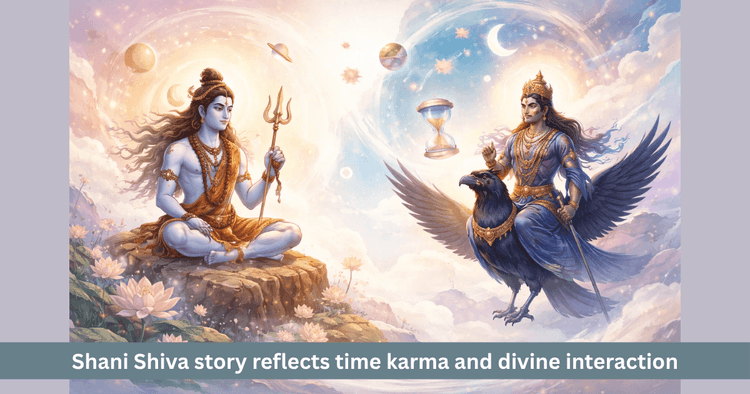
Table of Contents
In Indian Puranic tradition, the events that take place between deities are never understood as mere entertaining tales. They are seen as symbolic expressions of cosmic laws, spiritual balance and the deeper truths of life. The episode of the hidden play between Shani Dev and Bhagavan Shiva is one such profound symbol. At first glance, the story may seem interesting and unusual but when it is understood carefully, it reveals a remarkable teaching about time, karma, transformation, acceptance and divine play. That is why this story is not merely an event but a spiritual indication that explains the direction of life itself.
According to the account found in the Skanda Purana, one day Shani Dev told Bhagavan Shiva that he was about to bring the influence of Sade Sati upon him. This statement may appear simple on the surface, yet it carries deep meaning. The influence of Shani is not only a sign of difficulty. It symbolizes that period of time in which testing, maturity, delay, self reflection and karmic consequence become active together. When such a force speaks even to Bhagavan Shiva, the story gains a far deeper significance.
Does the Influence of Shani Apply Even to the Deities
The first major question raised by this story is whether the influence of Shani is limited to human beings or whether it also touches the deities. The answer offered by this episode is very subtle. Shani appears here not as a deity of personal anger but as the universal law of karma and time. That is why his influence is not based on favoritism toward any individual. It is part of that cosmic order in which time tests every state, transforms every condition and takes every existence through a process of maturity.
This is the most significant point of the story. Shani indicates that the law of time and karma is so vast that in some form it touches all levels of existence, from ordinary life to divine expression. This does not mean that the Divine is bound. It means rather that the Divine, through play, also reveals respect for those very laws established for the balance of creation.
This indication may be understood through a few main points:
• Shani is not merely a giver of hardship but also the giver of karmic result and the testing of time
• His influence is considered impartial
• The story suggests that cosmic laws apply equally to all
• Even the Divine may reveal those laws through sacred play
Why Did Bhagavan Shiva Change His Form
According to the story, Bhagavan Shiva hid himself in the form of an elephant in order to remain away from the gaze of Shani. If this is understood only outwardly, it may seem like a playful act. Yet its deeper meaning is much greater. Bhagavan Shiva is himself understood as the symbol of time, dissolution, detachment and supreme consciousness. In such a case, his assumption of another form is not a sign of fear but a sign of divine adaptability.
In life, there are many situations that are not best met through direct confrontation but through transformation. Shiva taking the form of an elephant teaches exactly this. Even the greatest power may at the right time adjust its expression according to the need of the circumstance. This is not weakness. It is a sign of balance, wisdom and divine understanding. It also reveals that not every challenge is answered through visible resistance. At times the right response is to change form, to pause, to withdraw or to adapt oneself in harmony with the situation.
Does the Form of the Elephant Also Carry Symbolic Meaning
Yes, the form of the elephant is deeply meaningful in this story. In Indian symbolic understanding, the elephant represents patience, gravity, wisdom, the ability to bear weight and silent strength. When Bhagavan Shiva takes the form of an elephant, the act is no longer merely concealment. It also reveals the message that during serious tests of time, one requires stability, the ability to bear heavy conditions and silent endurance.
An elephant does not move in panic. It is not the symbol of restlessness but of grounded strength. From this perspective, Shiva’s elephant form teaches that in difficult times one may have to change one’s pace, change one’s outer behavior and awaken a deeper steadiness within.
This symbol may be understood in the following way:
• The elephant signifies patience and endurance
• It represents the capacity to hold heavy circumstances
• It stands for a slow yet stable response
• It teaches that the highest form of power is not always fierce
What Did Shani Indicate the Following Day
In the story, when Shani Dev spoke with Bhagavan Shiva the following day, he said that his influence was so powerful that even Shiva had to change his form because of it. If read superficially, this statement may sound like pride. Yet its meaning is very subtle. Shani is not expressing personal superiority here. He is expressing the inevitable force of time and karma.
Before time, every form changes. Before karma, every condition is examined. What appears permanent is also touched by the cycle of transformation. This statement of Shani reminds us that no state in life remains fixed forever. Change itself is the law of the world. That is why the gaze of Shani unsettles, pauses, tests and ultimately causes a person to stand in a truer form.
What Is the Philosophical Meaning of This Story
The philosophical meaning of this entire episode is that time, karma and divine consciousness are not opposed to one another. They complete one another. Bhagavan Shiva represents the consciousness that stands beyond time, while Shani represents the movement of time, the ripening of karma and the process of justice. When these two meet in dialogue, the person gains the opportunity to understand that life’s difficulties are not merely punishments. They are part of a larger process.
This story teaches that:
• Time cannot be avoided
• Karmic result cannot easily be escaped
• Change must be understood rather than resisted
• Divine play teaches deep acceptance of life’s process
For this reason, the episode is not merely a story but a mature way of seeing life.
Should Sade Sati Be Seen Only Through Fear
In common understanding, the very mention of Sade Sati often produces fear. Yet the message of this story is quite different. Sade Sati does not mean suffering alone. It is a period in which a person must stand honestly before one’s karma, habits, ego, decisions and the reality of life. For one who is not inwardly prepared, such a time may indeed feel heavy. But for one who sees it as a chance for self reflection and correction, the same period can bring profound maturity.
The force of Shani pauses us so that we may truly see. It creates delay so that we may understand. It creates pressure so that we may become inwardly stronger. In this way, Sade Sati is not an enemy but a stern and necessary teacher of life.
What Does This Story Teach Modern Life
In the present time, people often try to escape difficult situations. They want instant solutions to every problem. Every test is treated as misfortune. In such a context, the story of Shani and Shiva offers an entirely different perspective. It teaches that every challenge carries its own purpose. Some conditions cannot be removed but they can be understood, accepted and lived through with balance.
This teaching becomes very useful for modern life:
• Not every difficult period is a sign of destruction
• Sometimes changing form is itself wisdom
• Slow processes may also be deep processes
• Acceptance can be more powerful than resistance
• Respect for time brings peace into life
What Is the Unseen Dialogue Between Time, Karma and the Divine
The most beautiful part of this story is that there is no war between Shani and Shiva. There is an unseen dialogue. On one side stands the force of time and karma. On the other stands divine consciousness and the light of sacred play. Neither destroys the other. Each reveals the other. Shani shows that testing is unavoidable. Shiva shows that even within testing, consciousness, balance and transformation remain possible.
therefore it can be said that this hidden play between Shani and Shiva is not merely an interesting tale. It is a symbol of the profound truth that time and karma cannot be completely avoided but by understanding, accepting and living them wisely, life can become far more balanced and peaceful. This is the enduring and subtle teaching of the story.
Frequently Asked Questions
What did Shani Dev say to Bhagavan Shiva
According to the story, Shani Dev told Bhagavan Shiva that he was about to bring the influence of Sade Sati upon him.
Why did Bhagavan Shiva take the form of an elephant
He assumed the form of an elephant as a divine play of adaptation and the elephant also symbolizes patience and steadiness.
Is the meaning of this story limited only to an event among the gods
No, this story offers a deep teaching about time, karma, change and adaptation in difficult phases of life.
Why is the gaze of Shani considered so powerful
Because Shani is associated with karmic result, the testing of time and the maturity gained through life’s trials.
What is the main teaching of this story
The main teaching of this story is that time and karma cannot be fully avoided but by understanding and accepting them, life becomes more balanced.
Get your accurate Kundali
Generate KundaliDid you like it?
Author

Pt. Amitabh Sharma (56 Years)
Experience: 20
Consults About: Family Planning, Career
Clients In: Punjab, Haryana, Delhi
Share this article with friends and family
About ZODIAQ
ZODIAQ is an online Vedic Astrology platform. It connects clients seeking astrological advice to experienced astrologers with deep knowledge. Our users also generate kundali and perform kundali milan for free. ZODIAQ also offers services to the Astrologers. Astrologers utilize various offerings by ZODIAQ to serve their clients effectively.
If you are a User
Consult with experienced astrologers and seek their guidance. You can also order handwritten Janm Patrika report with life prediction prepared by experienced astrologers. Generate accurate Kundali, perform Kundali Matching and check horoscope and muhurat. Utilize our online library for all the necessary astrological and spiritual information.
If you are an Astrologer
Create accurate kundali for your clients and perform Kundali Matching for up to 5 people at a time. Write comprehensive Janm Patrika report for your clients with ZODIAQ. Check client details anytime by saving it in client directory. Become more productive by tracking how many clients you guide every day.
WELCOME TO
ZODIAQ
Right Decisions at the right time with ZODIAQ
