Five Divine Ancient Bridges
By Pt. Narendra Sharma
A deep exploration of divine bridges beyond Ram Setu that connect realms, dharma and higher consciousness
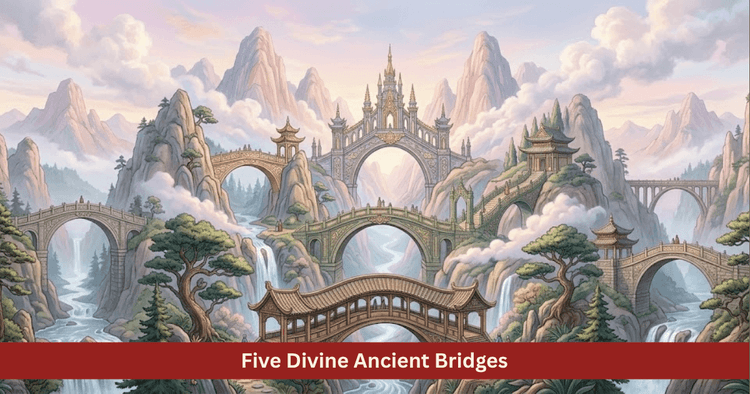
Table of Contents
Where a bridge is not only stone
In the Indian spiritual tradition, a bridge does not mean only a way to cross a river, sea or valley. A bridge means connection between 2 realms, a path between 2 states and the point where human effort meets divine grace. Ram Setu is the most famous symbol of this truth, yet the epics, Puranas, Vedic hints and philosophical traditions speak of other divine bridges as well. These remind us that in the Sanatana vision, existence itself is woven through sacred crossings.
The special quality of these bridges is that they are not merely physical. Some are made of light, some of water, some of sacrifice, some of consciousness and some of sacred rhythm. That is why remembering them does not open only a story. It opens the deeper principles of dharma, moksha, knowledge, time, ancestral duty and inner ascent. This article focuses on 5 such ancient divine bridges, apart from Ram Setu, that hold a unique place in the spiritual imagination of Bharat.
A quick view of the divine bridges
| Name of bridge | Primary element | What it connects | Spiritual meaning |
|---|---|---|---|
| Indra Setu | Light and merit | Human realm and heaven | The link between dharma and reward |
| Ganga Setu | Descending sacred water | Heaven, earth and ancestral realm | Grace and liberation |
| Soma Setu | Lunar rhythm and nectar | Mortality and the path of gods | Time, renewal and immortal awareness |
| Nala Setu on Saraswati | Knowledge and skill | Human effort and Vedic wisdom | Access to higher understanding |
| Vajra Setu | Sacrifice and power | Lower force and higher consciousness | Awakening through selflessness |
What is common in these 5 bridges
- They are not only paths but spiritual principles
- Each bridge gives form to one aspect of dharma
- They carry the resonance of gods, tapas, yajna, water, light and sacrifice
- They apply to the outer world and to inner sadhana
- Their message remains as relevant today as it was in ancient times
The Vedic and philosophical meaning of Setu
In Sanskrit, the word Setu carries the deep meanings of boundary, embankment, connection and that which enables crossing. In the Vedas and Upanishadic thought, Setu often appears as a principle that prevents existence from falling into fragmentation. Where there is separation, a Setu creates relationship. Where there is ignorance, a Setu opens the way to understanding. Where there is fear of death, a Setu gives assurance of passage.
For this reason, the importance of Setu in Indian thought does not remain limited to architecture. The guru shishya tradition is also a Setu. Yajna is a Setu. Mantra is a Setu. A river is a Setu. Dharma is a Setu. Human life itself is a Setu standing between body and soul, karma and result, birth and liberation. These ancient divine bridges should be understood through that larger vision.
Philosophical dimensions of Setu
- The journey from this world to the next
- The movement from ignorance to knowledge
- The experience of the infinite through the finite
- The meeting of human effort and divine grace
- The link between memory and liberation
What was Indra Setu
Indra Setu is understood in Vedic imagination as a radiant pathway through which the virtuous reach heaven. Indra is not only the king of the gods. He is also a guardian of rita, yajna, heroic force and celestial order. For this reason, the idea of Indra Setu is not just the image of a bridge but a symbol of the divine law through which a dharmic life becomes the very road to heaven.
This bridge reminds us of a deep moral principle. Whatever actions a human being performs become the pathway ahead. In the Vedic world, yajna, dana, truth, courage and duty were understood as powers that continued to shape the soul's journey even after death. Indra Setu stands for the truth that heaven is not reached by accident but through the joined force of dharma and divine grace.
Spiritual indication of Indra Setu
- The path to heaven is not external but born of karma
- Dharma itself becomes a bridge
- Yajna and merit redirect the soul
- Life is the test and the bridge is its result
Psychological meaning
Indra Setu also teaches the modern seeker that every noble action creates a higher path within. Whenever a person chooses truth, discipline and responsibility, a stairway to heaven is being built inside.
Why is Ganga Setu unique
The descent of Ganga to earth is one of the most tender, sacred and luminous events in Indian memory. The story of Bhagiratha's tapas, Shiva's jata, meaning matted locks and the river descending from heaven is not only the tale of a river. It is a vast narrative of grace, austerity and the liberation of ancestors. Some traditions describe this descent as a divine bridge of water that joins heaven, earth and the ancestral realm.
The meaning of Ganga Setu is that liberation is not only a philosophical idea. It is also flowing grace. Bathing in Ganga, offering tarpan, immersing ashes and going on pilgrimage are considered sacred acts for this reason. Here water is not merely water. It becomes the carrier of memory, purification, compassion, samskara, meaning sacred impression and moksha, meaning liberation. Ganga Setu shows that when divine force descends to earth, it does not only sustain life. It also gives hope of going beyond the cycle of birth and death.
Main dimensions of Ganga Setu
| Dimension | Meaning |
|---|---|
| Bhagiratha's tapas | Human resolve |
| Shiva's jata | Divine containment and compassion |
| Ganga's flow | Descent of heavenly power |
| Liberation of ancestors | Memory and release |
| Pilgrimage tradition | Earthly points of divine contact |
The deeper message of Ganga Setu
- Grace descends from above but tapas is needed to invite it
- Purification is not only of the body but also of lineage and consciousness
- Water becomes the bridge that joins realms
Soma Setu as the bridge of time and nectar
In the Vedas, Soma holds a deeply mysterious and layered place. Soma is nectar, divine offering, lunar essence and the symbol of a sacred rhythm in which decline and replenishment move together. Soma Setu is imagined as the bridge that links the mortal world to the path of the gods and to immortal awareness. It is not a bridge of stone. It is a bridge of time, moon cycle and yajnic consciousness.
In ancient Vedic ritual, the offering and drinking of Soma was not seen as ritual alone. It was a symbolic ascent. It was as if the seeker rose beyond limited bodily awareness and touched a higher order for a moment. Soma Setu teaches that time is not merely linear but cyclical. Every loss contains a seed of renewal. Every Amavasya, meaning new moon, hides a future Purnima, meaning full moon. Every ending carries the preparation for fresh light.
What Soma Setu teaches
- Time itself is a bridge
- The moon shows continuity within change
- Yajna links the human being with the divine path
- Immortality is not only of the body but of awakened consciousness
Indication for the seeker
A person who learns rhythm, discipline, fasting, japa, meaning sacred repetition and the subtle language of lunar movement begins to activate the teaching of Soma Setu within.
What does Nala Setu on Saraswati mean
Nala is remembered as a divine engineer and the son of Vishvakarma, the celestial architect. He is most famous for the construction of Ram Setu, yet some traditions also preserve the idea that in crossing the mighty Saraswati, divine skill order and intelligence were equally necessary. Saraswati is not only a river. She is also the presiding force of speech, knowledge, inspiration and Vedic wisdom. In this light, Nala Setu on Saraswati becomes more than a way across water. It becomes a symbol of access to higher understanding.
The disappearance of Saraswati makes this symbol even deeper. Knowledge is not always visible on the surface. At times it remains hidden under the sands of time, within the layers of tradition, in the meanings of language and in the subtle transmission of the guru's word. The idea of Nala Setu tells us that without patience, interpretation, right method and guided intelligence, knowledge cannot be crossed into. The bridge here is not a shortcut. It is the correct path.
What Nala Setu on Saraswati represents
- Guidance is needed to reach knowledge
- Divine skill is not only construction but interpretation
- Saraswati the river and Saraswati the wisdom current mirror each other
- Hidden streams require inner bridges to be reached
Meaning in modern life
Even today, scriptural wisdom and sacred tradition require a Nala Setu like intelligence, patient, disciplined and guided by right understanding. Information alone is not enough. One also needs the bridge of interpretation.
Vajra Setu and the secret of sacrifice
Vajra is linked with the divine weapon of Indra, yet its spiritual meaning is far deeper. The Vajra fashioned from the bones of Rishi Dadhichi is among the highest symbols of sacrifice, fearlessness and protection of dharma. In some philosophical and tantric readings, Vajra Setu is seen as the path of force that joins heaven and earth or the lower and higher levels of human consciousness. In later yogic thought, this also resonates with the ascent through the sushumna nadi, meaning the central subtle channel.
The real teaching of Vajra Setu is that the strongest bridges are built through sacrifice. As long as ego remains protected, the road to higher worlds does not open fully. Dadhichi did not merely give Indra a weapon. He established that self offering protects dharma. In that sense, Vajra Setu becomes the bridge from ignorance to wisdom, fear to courage and mortality to the taste of the deathless.
Central elements of Vajra Setu
| Element | Meaning |
|---|---|
| Dadhichi's sacrifice | Self offering |
| Vajra | Invincible force of dharma |
| Indra | Protection of divine order |
| Sushumna indication | Ascent of consciousness |
| Setu | A path formed by sacrifice |
Sadhana meaning of Vajra Setu
- Without tapas there is no radiance
- Without sacrifice strength remains incomplete
- The higher path of consciousness does not open through self centered living
Are these bridges only stories
To treat these divine bridges as only literal history or only imagination would narrow their real significance. In the Indian tradition, story, symbol and philosophical truth often merge into one another. The event happens outwardly but its meaning opens inwardly. Indra Setu is the symbol of moral ascent. Ganga Setu is the symbol of grace. Soma Setu is the symbol of sacred rhythm and time. Nala Setu is the symbol of wisdom and interpretation. Vajra Setu is the symbol of sacrifice and awakening.
Seen in this way, these bridges are still active today. When a human being lives by dharma, that person is walking on Indra Setu. When one enters purification and compassion, one touches Ganga Setu. When one accepts the cycles of life and renews the self, one stands on Soma Setu. When one reaches knowledge through patience, one becomes a seeker of Nala Setu. When one offers ego for a greater truth, one begins building Vajra Setu.
How to read these sacred narratives
- Not only as outer events
- As spiritual maps
- As indications for sadhana
- As formulas of dharma, knowledge and moksha
- As symbols that apply directly to one's own life
The bridges of human life
Ancient stories become meaningful only when they descend into present life. Even today, human beings stand before many inner and outer distances. Families are divided. Generations struggle to understand each other. Tradition and modernity often stand apart. Even within the self, the mind and soul may appear separated. In such a time, the principle of Setu becomes more necessary than ever.
That is why remembering these divine bridges is not only religious curiosity. It is direction for life. Every human being must build certain bridges within. A bridge of forgiveness. A bridge of dialogue. A bridge of guru kripa, meaning the grace of the teacher. A bridge of self reflection. A bridge of trust in the Divine. The one who builds bridges rises above fragmentation. The one who builds only walls eventually becomes imprisoned within.
Necessary bridges in life
- Understanding between past and future
- Balance between family and individuality
- Unity between knowledge and conduct
- Harmony between bhakti, meaning devotion and viveka, meaning discernment
- Trust between the human being and the Divine
Where true crossing begins
The glory of Ram Setu is incomparable, yet the sky of the Sanatana tradition is far wider. Within it are other bridges that remind us that the real meaning of life lies in crossing over. Indra Setu teaches that dharma never goes in vain. Ganga Setu shows that grace can descend. Soma Setu reveals that time itself is a sacred practice. Nala Setu reminds us that true knowledge needs the right path. Vajra Setu establishes that no unbreakable bridge is built without sacrifice.
Remembering these 5 divine bridges does not only take a person into the past. It offers a way to read the present. The question is not only which bridges the gods created. The real question is which bridge a human being is building in life. That question is the question of dharma and also the question of liberation.
FAQ
Which divine bridges are remembered apart from Ram Setu
Apart from Ram Setu, traditions remember Indra Setu, Ganga Setu, Soma Setu, Nala Setu on Saraswati and Vajra Setu as important divine bridge concepts.
What does Indra Setu mean
Indra Setu symbolizes the heavenly path formed through dharma, merit and a life shaped by sacred action.
Why can Ganga Setu be called a divine bridge
Because the descent of Ganga is seen as a sacred water path connecting heaven, earth and the ancestral realm through purification and liberation.
What does Soma Setu represent
Soma Setu represents lunar rhythm, yajnic consciousness, nectar like renewal and the journey from mortal life to higher awareness.
What is the spiritual message of Vajra Setu
Vajra Setu teaches that sacrifice, tapas and self offering create the most enduring path from ignorance to wisdom and from fear to courage.
Get your accurate Kundali
Generate KundaliDid you like it?
Author
Pt. Narendra Sharma (63)
Experience: 20
Consults About: Family Planning, Career
Clients In: Punjab, Haryana, Delhi
Share this article with friends and family
About ZODIAQ
ZODIAQ is an online Vedic Astrology platform. It connects clients seeking astrological advice to experienced astrologers with deep knowledge. Our users also generate kundali and perform kundali milan for free. ZODIAQ also offers services to the Astrologers. Astrologers utilize various offerings by ZODIAQ to serve their clients effectively.
If you are a User
Consult with experienced astrologers and seek their guidance. You can also order handwritten Janm Patrika report with life prediction prepared by experienced astrologers. Generate accurate Kundali, perform Kundali Matching and check horoscope and muhurat. Utilize our online library for all the necessary astrological and spiritual information.
If you are an Astrologer
Create accurate kundali for your clients and perform Kundali Matching for up to 5 people at a time. Write comprehensive Janm Patrika report for your clients with ZODIAQ. Check client details anytime by saving it in client directory. Become more productive by tracking how many clients you guide every day.
WELCOME TO
ZODIAQ
Right Decisions at the right time with ZODIAQ
