Mystery of Kakbhushundi
By Pt. Narendra Sharma
Explore the ancient spiritual story behind Kakbhushundi's crow like form, curses, ego, repentance and devotion to Lord Ram
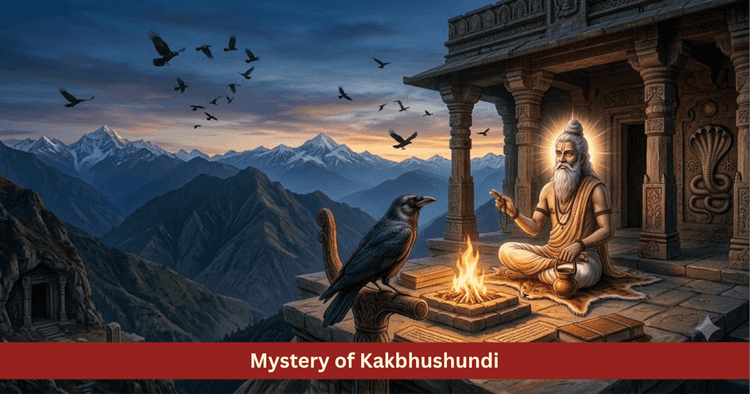
Table of Contents
Essence of the story and main points
| Aspect | Description |
|---|---|
| Main figure | Kakbhushundi |
| Core foundation | Sorrow, arrogance, curse, repentance, devotion and spiritual transformation |
| Connection with Ramayana | Great devotee of Lord Ram and knower of Ram Katha |
| Special identity | A divine sage with the face of a crow |
| Spiritual message | Respect for guru, humility, devotion and the mystery of destiny |
| Special belief | Chiranjeevi form and witness across ages |
What should be understood in this story
- This is not only a story of an unusual form
- It reveals a deep connection between suffering and spiritual awakening
- Disrespect toward the guru can damage spiritual progress
- A curse may become not only punishment but also redirection
- Without humility, knowledge remains incomplete
- Devotion to Ram can ultimately transform life
An important caution before understanding the tale
| Topic | What to keep in mind |
|---|---|
| Puranic story | Understand it through a spiritual and symbolic lens |
| Curse | Not only punishment but also a sign of karmic consequence and learning |
| Change of form | It may also be seen as an outer symbol of inner tendencies |
| Devotion | The final center of the story is divine refuge |
Where an unusual form hides ages of spiritual effort
The moment one hears the name Kakbhushundi, a question naturally arises. Why did a great sage, a supreme knower and a devoted lover of Lord Ram appear with the face of a crow. This question does not create curiosity alone. It opens the door to that deep Indian spiritual tradition in which outer form is never the final identity of a being. Behind form there are karma, impressions, curses, austerity, devotion and a long journey of awakening.
This is why the story of Kakbhushundi is considered extraordinary. It holds not only mystery but also the harsh realism of life. It contains destruction of family, wandering, grace of the guru, the fall caused by ego, then repentance, then curse and finally such devotion to Ram that the limits of form are transcended. The deeper one reflects upon this story, the clearer it becomes that this is not merely an ancient tale but a mirror of human nature.
What was the first great turning point in his life
The early life of Kakbhushundi is described as deeply painful. A terrible famine changed the direction of his existence. The land dried up, food disappeared and survival itself became difficult. This tragedy broke his home from within. One by one, family members perished due to hunger and deprivation. This was not only physical suffering. It was also a wound that shattered inner security and trust in life.
When a human being passes through such deep loss, questions begin to arise within. Why did this happen. What is destiny. What is the meaning of life. For Kakbhushundi too, this pain did not become the end. It became the beginning of a much greater spiritual inquiry. At times destiny first removes outer support so that inner support may be sought. His journey deepens from this very point.
A temple, a teacher and a new refuge
After famine and separation, when he reached another region, he found shelter in a temple. This was not only shelter of roof and food. It was a doorway to a new consciousness. There he was received by a compassionate priest or guru like guide. For the first time, he heard serious reflections on life, devotion, liberation and the purpose of human birth. A mind that had seen only loss was touched for the first time by spiritual meaning.
In the presence of the guru, service, listening and study began. He started serving devotees, hearing scriptural discussions and slowly moved toward the path of dharma. Yet there is a vast difference between hearing wisdom and truly becoming transformed from within. A subtle weakness still lived inside him. That weakness was the hidden possibility of ego. This later becomes the next decisive turn in his story.
Teachings from this phase
- Suffering leads a person toward deeper questions
- A true guru can change the direction of life
- Service becomes the beginning of inner refinement
- A spiritual environment alone is not enough, humility is also necessary
The incident of insulting the guru and Shiva's curse
With time, Kakbhushundi began receiving honor for scriptural discussion and spiritual discourse. People started listening to him, praising him and slowly the hidden ego within began to receive nourishment. One day he was speaking before an assembly. At that moment his guru entered the temple. Everyone present stood up in respect but he remained seated. The reason was not simple forgetfulness. Deep within was the fear that if he rose, his importance might appear diminished before his followers.
That single moment became the most difficult test of his spiritual life. In Indian spiritual tradition, disrespect toward the guru is seen as a very serious fault. In the traditional telling, Lord Shiva became displeased by this conduct and declared a severe punishment. The essential message of this episode is that even years of knowledge and practice may be stained by one moment of ego. On the spiritual path, downfall often begins not from the outside but from invisible pride within.
Was this curse only a punishment
To understand Shiva's curse only as punishment would be incomplete. In Indian sacred narratives, a curse often appears as a force that changes the direction of life. It brings a person face to face with the hidden fault within. It leads one to a point where ego must break, vision must change and the possibility of self knowledge may arise. In Kakbhushundi's life too, this event did not become the final point of destruction. It became the event that exposed the pride seated within him.
A deeper truth must be understood here. In spiritual life, inner purity matters more than outer knowledge, discourse or popularity. If humility is absent, knowledge itself may become a burden. Shiva's curse reveals this very truth, that no seeker can attain real elevation after insulting the guru principle.
How did he receive another curse later
After the earlier punishment and its consequences, he received another human birth. This birth became an opportunity for correction. This time he took part in spiritual discussions more actively and wished to understand the highest truth in greater depth. Yet in spiritual life it is not enough merely to avoid a past mistake. The subtle tendencies of the mind continue to test the seeker. In that very process, during one gathering, he entered into a philosophical disagreement with Maharishi Lomas.
Disagreement was not the fault but it turned into disrespect. The discussion became argument and his conduct displeased Maharishi Lomas. The sage then cursed him to be born among crows. This became an even deeper turning point in his life. Yet this time an important difference was seen. Earlier, ego had been dominant. Now awareness of his mistake arose immediately. He at once sought forgiveness, dropped further argument and asked for blessing. This is the point where the first true sign of inner transformation becomes visible.
Inner teaching of the second turning point
| Event | Deeper lesson |
|---|---|
| Disagreement | Humility is necessary even in the search for truth |
| Curse of Lomas | Argument joined with ego leads to downfall |
| Immediate repentance | Beginning of transformation |
| Asking for blessing | Birth of surrender |
How did he come to bear a crow like form
According to traditional descriptions, the effect of the curse given by Sage Lomas appeared in his later form. He remained a being of divine awareness and wisdom, yet his face was described as crow like. At first sight this may appear strange but spiritually it is deeply meaningful. His form became a living symbol of all that had happened within him. Whenever anyone looked at him, behind that appearance stood the whole journey of curse, karma, humility and devotion.
In Indian symbolism, the crow is often linked with memory, alertness, karmic connection and ancestral consciousness. Therefore the form of Kakbhushundi should not be seen merely as a punitive distortion. It became a permanent reminder of how deep the consequence of ego can be and also of how divine grace can turn any form into a vessel of wisdom. What looked like a curse from the outside became a means of austerity and awakening from within.
Is Kakbhushundi truly regarded as Chiranjivi
Ancient belief also describes Kakbhushundi as a Chiranjivi. Chiranjivi means one whose existence extends beyond ordinary lifespan and continues through ages. In the traditions connected with him, it is said that he witnessed many changes of time, saw events of different yugas and experienced multiple manifestations and lilas of Lord Ram. This vision makes him distinct from ordinary figures.
His dialogues with Garuda are regarded as especially profound. In these exchanges, there is deep contemplation on devotion, wisdom, maya, time, birth, death and the nature of the Divine. For this reason Kakbhushundi is not seen merely as a character but as a witness of spiritual realization. He reminds seekers that time may change but divine truth, devotion and self discernment never lose relevance.
Why is his devotion to Lord Ram considered so deep
In the end, the greatest identity of Kakbhushundi is not his form or even his curse but his unbroken devotion to Lord Ram. This devotion binds together all the broken chapters of his life. Suffering gave him questions, the guru gave direction, ego caused his fall, curse shook him but Ram bhakti gave him stability. This is why he is regarded as such a great knower of Ram Katha, because for him the story of Ram was not merely something recited. It was something lived and realized.
Ram devotion produced in him that maturity in which form became secondary and spiritual rasa, meaning divine essence, became primary. At that stage the face of a crow no longer remained an obstacle, because consciousness had become filled with Ram. This is the miracle of devotion. It can give meaning even to the harshest events of life. Kakbhushundi becomes a living symbol of the truth that when the mind rests in the Divine, even the hardest lines of destiny may receive a new interpretation.
Why is Kakbhushundi seen as a great devotee
- He did not abandon devotion even after suffering
- He continued seeking truth even after curses
- He fell through ego, yet returned through humility
- He held Ram Katha not only as scripture but as experience
- He kept devotion alive beyond time and form
What does his story teach the modern mind
The greatest value of Kakbhushundi's story is that it introduces a person to the hidden layers within oneself. Every human being passes through pain at some point. Every person may carry the desire for recognition, comparison, pride and validation. Every seeker may at times mistake knowledge for attainment, while true knowledge should actually lead toward humility. In this way the story feels deeply relevant even today, though its form is ancient.
It also teaches that no mistake is final if repentance comes in time and the right direction is chosen. A curse may become a beginning. Humiliation may become instruction. Loss may become awakening. And above all, devotion can sustain a person even amidst the heaviest karmic burden. This is the lasting and luminous message of Kakbhushundi's story.
Where the mystery becomes a teaching
What really happened to Kakbhushundi cannot be answered in one single line. He passed through famine and loss, then found refuge in the guru, then received a curse due to ego, then another curse changed his form and finally devotion gave divine meaning to everything. So his crow like face is not a random strangeness but the visible symbol of an entire spiritual journey.
His story reminds us that the final worth of a person is not decided by outer form, fame or even downfall. It is decided by the direction in which one rises after falling. Kakbhushundi is revered because he turned even his curse into a path of devotion. That is what makes him mysterious and worthy of reverence at the same time.
FAQ
Who was Kakbhushundi
Kakbhushundi was a great devotee of Lord Ram, a knower of Ram Katha and a divine sage form regarded in tradition as Chiranjivi.
Why did Kakbhushundi have a crow like face
According to traditional narrative, the curse of Sage Lomas shaped his crow linked form, which is also seen as a symbol of ego and karmic consequence.
Why did Kakbhushundi receive a curse
He is said to have received curse first due to disrespect toward his guru and later due to disrespectful argument with Maharishi Lomas.
What is the main message of Kakbhushundi's story
The main message is that ego leads to downfall, humility leads to transformation and devotion gives divine direction to life.
Is Kakbhushundi regarded as Chiranjivi
Yes, in ancient spiritual belief he is regarded as a Chiranjivi form who remains present across ages.
Get your accurate Kundali
Generate KundaliDid you like it?
Author

Pt. Narendra Sharma (63)
Experience: 20
Consults About: Family Planning, Career
Clients In: Punjab, Haryana, Delhi
Share this article with friends and family
About ZODIAQ
ZODIAQ is an online Vedic Astrology platform. It connects clients seeking astrological advice to experienced astrologers with deep knowledge. Our users also generate kundali and perform kundali milan for free. ZODIAQ also offers services to the Astrologers. Astrologers utilize various offerings by ZODIAQ to serve their clients effectively.
If you are a User
Consult with experienced astrologers and seek their guidance. You can also order handwritten Janm Patrika report with life prediction prepared by experienced astrologers. Generate accurate Kundali, perform Kundali Matching and check horoscope and muhurat. Utilize our online library for all the necessary astrological and spiritual information.
If you are an Astrologer
Create accurate kundali for your clients and perform Kundali Matching for up to 5 people at a time. Write comprehensive Janm Patrika report for your clients with ZODIAQ. Check client details anytime by saving it in client directory. Become more productive by tracking how many clients you guide every day.
WELCOME TO
ZODIAQ
Right Decisions at the right time with ZODIAQ
