The Curse of Narada upon Father Brahma
By Pt. Narendra Sharma
Unraveling the scriptural mystery behind the cosmic conflict of Brahma and Narada
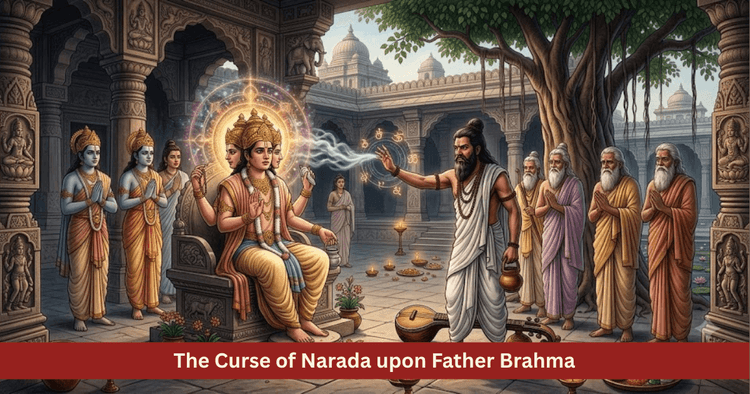
Table of Contents
When Autumn Arrives Even in Monsoon
According to Vedic astrology and mythological philosophy the ups and downs encountered in the life journey of every human being are the direct results of the accumulated karmic accounts of previous births. When under the influence of the cosmic wheel of time the planetary positions become unfavorable such moments arrive in life when the silence of autumn spreads unexpectedly even during the pleasant month of monsoon. This trial of relationships is not confined merely to ordinary human beings but even the divine deities had to pass through this fire ordeal. An ancient episode that occurred between Lord Brahma the creator of the universe and his highly wise son Devarishi Narada serves as a living testimony to this truth. This saga is not merely a domestic dispute but it unravels the deep connections between cosmic equilibrium, duty, and destiny. Due to the impact of this very transit and time the independent adoration of Brahma is considered almost forbidden across the entire earth today.
Timetable and Special Astrological Rules of this Cosmic Event
Since this episode is a historical and cosmic event its foundational elements, affected houses, and recommended astrological remedies are systematically clarified in the table below.
| Primary Affected Houses | Responsible Planetary Elements | Mental and Spiritual Regimen | Recommended Astrological Remedies | Core Practical Benefits |
|---|---|---|---|---|
| Fifth House and Ninth House | Sun, Jupiter, and Saturn | Control over speech and respecting the father | Daily mental recitation of Narayana Kavach | Pacification of Pitru Dosha and enhancement in decision capacity |
By following this pure regimen the sudden crises and domestic differences of opinion hovering over the life of a native begin to calm down on their own.
When a Son Rejected the Command of His Father
At the dawn of creation when Lord Brahma manifested the prajapatis and holy seers he also generated Devarishi Narada. The primary objective of Brahma was to expand the universe therefore he entrusted Narada with the responsibility of getting married and making this cosmos vibrant through progeny. However the inner self of Narada was anxious not for material bondages but for the unalloyed devotion of Lord Vishnu the supreme Brahman.
He rejected this command of his father with extreme humility but absolute firmness. This decision of Narada was not the outcome of any ego but it was the direct manifestation of his spiritual purity. However Lord Brahma felt that if all his mind-born sons adopted renunciation in this manner the foundational purpose of constructing this vast creation would remain unfulfilled.
Unknown Fear and Grief Born in the Mind of the Creator
Lord Brahma who is as venerable as Jupiter did not possess the arrogance of his power at that moment but a deep fear regarding the equilibrium of the entire universe enveloped his mind. His other mind-born sons the Sanat Kumaras had already advanced on the path of asceticism. If Narada followed the exact same path this labyrinth of life would terminate before even beginning.
Brahma believed that for operating the world the co-existence of both action and detachment is mandatory. However upon the repeated refusal of his son his patience shattered and his anxiety gradually transformed into fierce wrath. This episode demonstrates that when attachment and expectations increase excessively the wisdom of even the greatest scholar falls under the control of anger.
Severe Wrath of the Father and the Curse of Gandharva Form
Being under the control of anger Lord Brahma cursed his own son Narada that he would have to abandon this high spiritual state and take birth on earth as a Gandharva. His name would be Upabarhana who would be widely known for his physical beauty, musical art, and worldly luxury.
This was an extremely cruel justice of destiny because the very world and material pleasures from which Narada wished to stay away he had to descend into its deep swamp due to the curse. However a profound astrological and spiritual message was hidden within this punishment. True devotion is that which does not deviate from its path even while residing amidst temptations and maya. The upcoming life journey of Narada was a difficult test of this very truth.
A Just Question from an Injured Son
Devarishi Narada accepted this severe curse of his father upon his head yet there was deep agony in his heart. He became highly emotional and questioned his father as to why his elder brothers the Sanat Kumaras were permitted to walk on the path of renunciation while he was granted this severe punishment for choosing the exact same path.
This question was not merely from a son but it was a cry for equality and justice before the entire universe. Narada never rebelled against destiny but he wanted to convey to his father how deeply inequality in treatment wounds the heart of loved ones. This moment teaches us that even within divine families the clash of expectations and emotions can injure the inner soul.
The Light of Blessing Hidden in the Darkness of the Curse
Before departing for the forest Narada requested one final boon from Brahma that no matter what form of life he took and no matter how adverse the circumstances became his devotion for Lord Vishnu must never diminish. Lord Brahma accepted this prayer of his son with tears in his eyes.
This blessing proved to be far more powerful than the curse itself. Even while residing amidst worldly grandeur as Upabarhana the internal connection of Narada remained constantly linked with the Divine directly. This event proves that external situations can influence our life but our inner integrity and unbroken faith alone determine our ultimate destiny.
The Historical Curse Received by the Creator and Its Outcome
Due to this biased decision of the father the pain within the heart of Narada was not fully pacified. He felt that his pure path had been stigmatized without any fault or crime. Ultimately with deep sorrow Narada also delivered a curse upon his father Brahma.
He declared that for the upcoming three cosmic ages no independent worship of Lord Brahma would be performed across the entire three worlds. This is the precise reason why today millions of temples of Lord Vishnu and Shiva exist across the ancient land but there is no independent place for the creator of the universe. This event teaches us a lesson that no matter how powerful someone is they must definitely suffer the fruits of their unjust actions under the influence of the wheel of time.
Cosmic Equilibrium of Two Great Ideologies
From a deep philosophical perspective this narrative is not merely a story of conflict between a father and a son but it is the balance of two of the most important pillars of human existence. Lord Brahma is the direct personification of action, domestic life, and worldly responsibilities without which this society cannot function.
On the other side Devarishi Narada is the living embodiment of renunciation, unalloyed devotion, and spiritual liberation without which life holds no spiritual meaning. Vedic culture does not declare one single path as supreme but inspires the establishment of a beautiful harmony between the two. Taking the correct decision during such difficult times is the actual righteousness of a human being.
## FAQ
What curse did Devarishi Narada give to his father Brahma ji
Narada ji cursed his father Brahma ji that for three cosmic ages no independent worship of his form would be performed across the entire world which is why his temples are extremely rare today.
In which form of life did Brahma ji curse Narad Muni to take birth
Being under the control of anger Brahma ji cursed Narad Muni to take birth in the Gandharva form by the name of Upabarhana who was famous for material luxury and music.
Why did Narad Muni refuse to follow the command of his father
The heart of Narad Muni was completely absorbed in the devotion of Lord Vishnu and he did not wish to get entangled in the material bondages and the cycle of marriage.
Was this anger of Brahma ji a result of his ego
No the anger of Brahma ji was based more on the fear that if everyone adopted renunciation the task of expanding the creation would come to a complete halt rather than personal ego.
What inspiration does this mythological story provide to modern human life
This story teaches us that the clash of expectations in family relationships can cause deep wounds yet one must never abandon their internal faith and righteousness even in adverse situations.
Get your accurate Kundali
Generate KundaliDid you like it?
Author

Pt. Narendra Sharma (63)
Experience: 20
Consults About: Family Planning, Career
Clients In: Punjab, Haryana, Delhi
Share this article with friends and family
About ZODIAQ
ZODIAQ is an online Vedic Astrology platform. It connects clients seeking astrological advice to experienced astrologers with deep knowledge. Our users also generate kundali and perform kundali milan for free. ZODIAQ also offers services to the Astrologers. Astrologers utilize various offerings by ZODIAQ to serve their clients effectively.
If you are a User
Consult with experienced astrologers and seek their guidance. You can also order handwritten Janm Patrika report with life prediction prepared by experienced astrologers. Generate accurate Kundali, perform Kundali Matching and check horoscope and muhurat. Utilize our online library for all the necessary astrological and spiritual information.
If you are an Astrologer
Create accurate kundali for your clients and perform Kundali Matching for up to 5 people at a time. Write comprehensive Janm Patrika report for your clients with ZODIAQ. Check client details anytime by saving it in client directory. Become more productive by tracking how many clients you guide every day.
WELCOME TO
ZODIAQ
Right Decisions at the right time with ZODIAQ
