Why Shiva Brought Ganga Earthward
By Pt. Nilesh Sharma
A deep exploration of Ganga's descent, Shiva's compassion, Bhagiratha's tapas and the liberating flow of grace
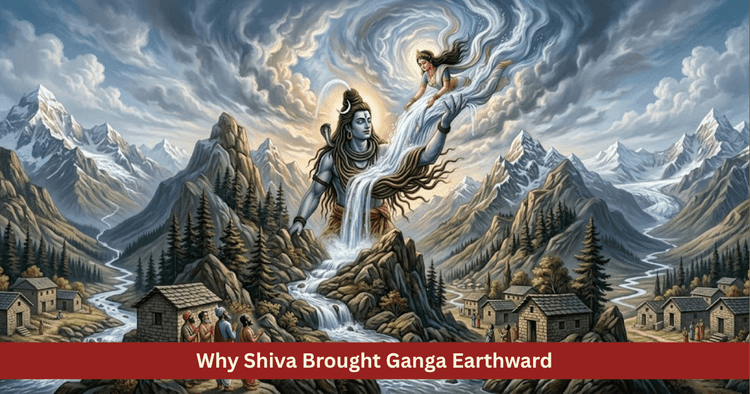
Table of Contents
Where the river of heaven touches humanity
Ganga is not merely a river. She is revered as Mother, goddess, compassion and a living current of liberation. In her waters one sees not only physical purification but also the washing away of sin, the upliftment of ancestors and the elevation of the soul. That is why the question becomes so profound. If Ganga originally belonged to the divine realms, why did she not remain in heaven. Why did Shiva allow her to flow upon earth.
The answer is hidden not only in story but in the very heart of Sanatana philosophy. The descent of Ganga teaches that the highest form of divinity is not to remain distant but to enter a world burdened by sorrow and serve it. Shiva allowed Ganga to flow upon earth because earth is not only karmabhumi, meaning the field of action but also a field of redemption. Where beings are bound, grace must descend.
A brief view of the descent of Ganga
| Aspect | Meaning |
|---|---|
| Essential nature of Ganga | Divine, pure, liberating current |
| Reason for descent to earth | Liberation of beings and establishment of dharma |
| Role of Shiva | Holding the fierce torrent and making it compassionate |
| Role of Bhagiratha | Tapas, resolve and devotion to ancestors |
| Spiritual message | Heavenly grace descending into human life |
Main points of this sacred episode
- The coming of Ganga to earth was not only a physical event
- It opened a path beyond sin, karma and the bondage of death
- Shiva balanced overwhelming power and made it accessible to humanity
- Bhagiratha's tapas invited divine grace to earth
- Ganga made earth as sacred as heaven
Did Ganga descend only for the sons of Sagara
The most well known background of Ganga's descent is the liberation of the 60,000 sons of King Sagara. Burnt to ashes by the fiery power of Sage Kapila, they could not attain peace. The gods declared that only the touch of Ganga's waters could grant them release. This indication is very deep. It means that some bondages are not broken by action alone but by grace.
If Ganga had remained in heaven, how would those restless souls have found liberation. Her descent to earth was therefore an act of profound compassion. By holding Ganga, Shiva ensured that she would not remain the river of one realm alone but become the path of release for all who are bound by ignorance, sin, grief and unfinished karma.
Message of the Sagara episode
- Ancestral duty cannot be ignored
- Divine grace can bring peace even to lost souls
- Liberation comes not only through knowledge but also through grace
- Shiva and Ganga together open the gate of release
Why did Shiva hold Ganga in his matted locks
The force of Ganga is described as so immense that if she had fallen directly from heaven to earth, the earth could not have borne the impact. Here Shiva's role is not only that of a god but of a cosmic regulator. He receives a force that in its direct form could have been destructive. By holding her in his jata, meaning matted locks, he transforms her into a gentle and life giving current.
This moment carries deep philosophical meaning. When divine energy descends directly upon an unprepared vessel, it can become overwhelming. But the same force, when filtered through the Shiva principle, meaning stability, tapas, compassion and self mastery, becomes a blessing for the world. Thus Shiva did not merely restrain Ganga. He transformed ungoverned power into grace that could nourish life.
Spiritual meaning of the matted locks
| Symbol | Indication |
|---|---|
| Shiva's jata | Restraint, capacity to hold, yogic stability |
| Force of Ganga | Intense descent of divine consciousness |
| Gentle release | Power transformed into compassion |
| Protection of earth | Balance for the welfare of the world |
Lesson for spiritual practice
- Power requires worthiness to be held
- Without compassion, energy can become harsh
- The Shiva principle alone can make overwhelming force life giving
Why did Ganga need to flow on earth
Earth is called karmabhumi in the Sanatana tradition. It is the realm where beings act, learn, fall, rise, become bound and strive for liberation. If Ganga had remained in heaven alone, divine purity would have stayed distant from human life. Her descent removes that distance. Liberation is no longer something postponed to another world. It becomes a living possibility within this life.
That is why Ganga is not merely a river. She is available grace. She proves that the Divine does not abandon the human being in the field of karma. It enters that very field. Ganga flowing on earth declares that one does not need to wait for death to receive heavenly purification. Through bathing, remembrance, japa, tarpan, service and devotion, a person may sanctify life while still living.
Why Ganga had to descend to earth
- To turn karmabhumi into a field of grace
- To offer direct purification to living beings
- To reduce the distance between heaven and earth
- To make dharma accessible to all
- To connect the idea of moksha with present life
The mystery of Bhagiratha's tapas
Bhagiratha is remembered not merely as a king but as the embodiment of resolve that makes the impossible possible. He performed extraordinary tapas for the liberation of his ancestors. This austerity was not for personal gain. It was driven by lineage, dharma and the desire to bring a divine current to earth. That is why the phrase Bhagirathaprayatna is still used for supreme effort.
Shiva agreed to bear Ganga because Bhagiratha's prayer was free from selfishness and full of shraddha, meaning reverent faith and sacred responsibility. The story teaches that when human effort is pure, sustained and dedicated to the welfare of others, even the gods respond. Bhagiratha represents human striving. Shiva represents divine response. Ganga descends between them as the current of compassion.
The message of Bhagirathaprayatna
- Long tapas never goes in vain
- Devotion to ancestors is an important dimension of dharma
- Pure resolve moves even the gods
- Human effort can invite divine grace
Ganga is not only for the soul but also for the earth
There is also a deeply practical side to the descent of Ganga. She is not only a giver of liberation but also a giver of life. The land, agriculture, civilization, sacred cities, pilgrimage culture and collective memory of northern India are intimately tied to her flow. In this sense Ganga nourishes both the spiritual and material dimensions of existence.
This conveys a major philosophical truth. In the Sanatana view, spirituality and nature are not separate. The same river that purifies the soul also sustains the body and the social order. Therefore Ganga flowing on earth shows that divine grace is not limited to other worldly liberation. It also appears as food, water, survival, fertile land and living culture.
The two fold role of Ganga
| Dimension | Role |
|---|---|
| Spiritual | Cleansing of sin, tarpan, moksha, pilgrimage |
| Material | Water, agriculture, life, civilization, nourishment |
| Cultural | Pilgrimage tradition, samskara, festival life |
| Philosophical | Unity of divinity and nature |
Does Ganga wash away sin or transform karma
This is a subtle question. The scriptural understanding is not that Ganga mechanically purifies a person without inner change. The touch of Ganga is linked not only with outer water but with the state of the inner heart. If there is shraddha, remorse, remembrance and dharmic awareness, then bathing in her waters, beholding her or even remembering her name is considered transformative.
So Ganga is not only a river that washes away sin. She is also a current that awakens consciousness. She reminds the human being that one is greater than one's faults and still capable of renewal. Shiva allowed her to flow on earth so that human beings may fall and rise again. In every age, under every burden of sin, the opportunity for purification remains open.
How to understand Ganga's principle of purification
- Bathing of the body alone is not enough
- Faith, remembrance and inner transformation are necessary
- Ganga offers the opportunity of forgiveness
- She opens a path of renewal within life itself
Ganga and the flow of dharma
To see Ganga only as a river would reduce her full spiritual meaning. She is also a symbol of speech, memory, pilgrimage, tradition and the ongoing flow of dharma. Just as her waters do not remain fixed in one place, truth and dharma too must remain in living movement. Where dharma stagnates, there is dryness. Where it flows, there is life and awakening.
In this sense, Ganga's descent to earth also symbolizes the availability of higher wisdom to the world. If divine truth remained locked in heaven, how would humanity receive it. Ganga stands as the declaration that the highest principle must descend for the welfare of all. She is the stream of knowledge moving from the divine to the human.
How Ganga becomes a symbol of dharma
- Flowing truth
- Compassion that serves the world
- A stream of purification and sacred memory
- Higher wisdom descending into human life
- The living basis of pilgrimage culture
Why did Shiva not keep Ganga in heaven
The deepest answer to this question is that in the Sanatana vision, the highest form of divinity is service. If Ganga had remained in heaven, she would certainly have remained worshipped but by flowing on earth she became Lokamata, the mother of the people. There her glory became complete. There she became the refuge of saint and sinner, king and mendicant, householders and renunciates, animals, birds, land and lineage alike.
Shiva himself is detached, yet wholly dedicated to the welfare of the world. He dwells in Kailasa, yet is also Vishvanatha, the Lord of all. In the same way, Ganga coming from heaven to earth proves that greatness does not lie in remaining above. It lies in descending and touching life. True power is that which protects, purifies and flows without discrimination.
The essence of this question
- Remaining in heaven was glory
- Flowing on earth was compassion
- Shiva chose compassion over distant greatness
- Ganga's purpose was not only worship but upliftment
What does this story say to modern life
The story of Ganga's descent remains deeply relevant even today. Human life is still burdened by karma, stress, guilt, ancestral weight, mental impurity and spiritual thirst. In such a time Ganga reminds us that grace is still available. Purification is still possible. If there is Bhagiratha like resolve within and Shiva like capacity to hold, divinity can still descend upon the dry ground of life.
This story also teaches that anyone who has power should not merely remain elevated. Power must become useful. Knowledge must descend. Compassion must become available. Dharma must reach ordinary life. This is the secret of Ganga and the fullness of Shiva's compassion.
Lessons for modern life
- Recognize the impurities within
- Practice regular purification through sadhana
- Honor ancestors and tradition
- Bring compassion into action
- Turn strength into service
Where grace chooses to flow
The descent of Ganga teaches that divine compassion is never meant to remain remote. It comes where it is most needed. From the liberation of the sons of Sagara to the tapas of Bhagiratha, from Shiva's matted locks to the sanctification of human life, every layer of this story repeats one truth. The goal of divinity is not only height but descent. Not only glory but usefulness. Not only power but service.
That is why Ganga even today is far more than a river. She is the reminder that heaven can touch earth. She is the assurance that the path of liberation is still open. And she also reveals that Shiva's greatest glory lies not only in destruction but in the compassionate mastery through which he held Ganga, guided her and finally released her for humanity.
FAQ
Why did Shiva allow Ganga to descend to earth
Shiva allowed Ganga to descend so that the sons of Sagara could be liberated, humanity could receive purification and the earth could become sanctified by divine grace.
What is the meaning of holding Ganga in Shiva's matted locks
It means that Shiva transformed overwhelming divine force into a balanced, compassionate current for the welfare of the world.
Is Ganga only a river that removes sin
No, Ganga is not only a purifier of sin but also a symbol of consciousness, faith, sacred memory, liberation and inner transformation.
What is the importance of Bhagirathaprayatna
Bhagirathaprayatna symbolizes pure resolve, long tapas, devotion to ancestors and extraordinary effort undertaken for the welfare of others.
What does Ganga flowing on earth spiritually represent
It shows that divine grace can descend into human life and that purification, dharma and moksha remain possible while one is still living.
Get your accurate Kundali
Generate KundaliDid you like it?
Author

Pt. Nilesh Sharma (63)
Experience: 20
Consults About: Family Planning, Career
Clients In: Punjab, Haryana, Delhi
Share this article with friends and family
About ZODIAQ
ZODIAQ is an online Vedic Astrology platform. It connects clients seeking astrological advice to experienced astrologers with deep knowledge. Our users also generate kundali and perform kundali milan for free. ZODIAQ also offers services to the Astrologers. Astrologers utilize various offerings by ZODIAQ to serve their clients effectively.
If you are a User
Consult with experienced astrologers and seek their guidance. You can also order handwritten Janm Patrika report with life prediction prepared by experienced astrologers. Generate accurate Kundali, perform Kundali Matching and check horoscope and muhurat. Utilize our online library for all the necessary astrological and spiritual information.
If you are an Astrologer
Create accurate kundali for your clients and perform Kundali Matching for up to 5 people at a time. Write comprehensive Janm Patrika report for your clients with ZODIAQ. Check client details anytime by saving it in client directory. Become more productive by tracking how many clients you guide every day.
WELCOME TO
ZODIAQ
Right Decisions at the right time with ZODIAQ
