Why Shiva Holds Opposites
By Pt. Nilesh Sharma
Wonder of dissolution creation renunciation kindness
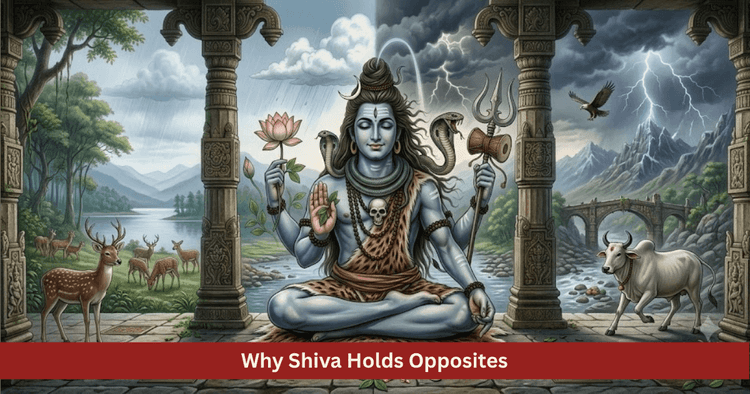
Table of Contents
Life Truth Opening from Rudrashtakam
These lines of the Rudrashtakam remember Lord Shiva:
Namami shamishan nirvana rupam Vibhum vyapakam brahma veda svarupam.
The meaning is salutations to Shiva who is the tranquil Ishana, of the nature of nirvana, all pervading and of the form of Brahman and Veda. Shiva is not only a deity worshipped in temples. He is a living symbol of the deeper truths of life. Among Hindu deities Shiva stands apart because he holds qualities that appear completely opposite to each other.
He dwells in the quiet Himalaya yet holds power that can shake the universe. He appears fierce yet is known for kindness. He dissolves the world yet protects it at the same time. Because of this wonder of balance many spiritual traditions describe him as the god of opposites.
Core Summary
| Aspect | One Pole | Other Pole |
|---|---|---|
| Role | Dissolution | New creation |
| Life | Yogic renunciation | Household love |
| Form | Fierce radiance | Bholenath compassion |
| State | Ascetic simplicity | Cosmic fullness |
| Message | Ending is needed | Beginning is possible |
Four Reasons at a Glance
- The destroyer who creates new beginnings
- The Adiyogi who is complete in family life
- Fierce form with a gentle heart
- The ascetic whose symbols are full of life
Life Itself Moves on Opposite Poles
The world runs on contrasts. Joy and sorrow, creation and dissolution, silence and chaos exist together. Shiva is the harmonising power between these extremes. When a seeker understands these opposites, the seeker does not only read a story. The seeker understands a philosophy of life.
The message of Shiva is that contradiction is not a defect. It is a doorway to wholeness. One who sees only one side understands incompletely. One who joins both sides in one awareness moves near the spirit of Shiva.
The Destroyer Who Creates New Beginnings
In the Hindu trinity Shiva is often introduced as the destroyer. Brahma creates the universe, Vishnu preserves it and Shiva dissolves it. At first glance destruction sounds negative. Yet in Vedic philosophy destruction is not chaos. It is transformation.
In the cycle of life old structures, outdated beliefs and stagnant energies must end so that new possibilities can arise. The role of Shiva is to clear what no longer serves. His cosmic dance known as the Tandava symbolises this rhythm of dissolution followed by renewal.
Life Message of the Tandava
- An end is not only termination
- Dissolution creates empty space
- In empty space new creation becomes possible
- Change needs discernment not fear
This truth appears even in daily life. A plan fails and a new direction opens. A hard phase passes and maturity arrives. One chapter closes and another begins. Shiva reminds that endings are not always losses. At times they are the doorway of a new creation.
| Cycle | Meaning | Sign for the Seeker |
|---|---|---|
| Creation | Beginning | Fresh resolve |
| Preservation | Sustaining | Patience and protection |
| Dissolution | Merging | Leaving the unnecessary |
| Renewal | New life | Hope and practice |
The Adiyogi Who Is Also a Householder
Shiva is called Adiyogi, the first yogi. He is regarded as the primal teacher of meditation and spiritual awakening. Seated in deep samadhi on Mount Kailasa, Shiva appears detached from the world and immersed in absolute stillness.
Yet Shiva is not only an ascetic. He is the devoted consort of Goddess Parvati and the father of Ganesha and Kartikeya. His family represents wisdom, strength and divine energy. The usual image of a renunciate is one who leaves the world. Shiva holds meditation and family life together.
Lesson of This Duality for Modern Life
- Spirituality does not demand abandonment of relationships
- Inner peace is possible even amid duties
- Meditation and family can support each other
- Renunciation is a state of mind not only a place
This duality makes Shiva a bridge. On one side stands spiritual depth. On the other side stands worldly responsibility. Shiva shows that a person can pursue growth, meditation and awareness while still caring for family and fulfilling duties in the world.
| Form | Symbol | Life Application |
|---|---|---|
| Adiyogi | Silence and meditation | Self observation |
| Householder Shiva | Love and duty | Balance in relationships |
| Union with Parvati | Yoga of power and consciousness | Cooperation |
| Divine sons | Discernment and strength | The next generation |
How Fierce Form and Gentle Heart Are One
The outer form of Shiva may appear intimidating at first. Ash from cremation grounds on the body, snakes as ornaments and the trident as a symbol of power and dissolution. Fierce forms such as Bhairava indicate unstoppable cosmic energy.
Yet Shiva is known as Bholenath, the innocent lord who is easily pleased. Devotees believe he listens quickly to sincere prayer and grants blessings without demanding complicated ritual. His compassion is considered limitless.
He accepts everyone. His companions include animals, spirits and beings who stand outside social norms. This symbolises that Shiva does not judge by status, background or appearance.
Balance of Power and Compassion
- True power does not misuse itself
- Compassion is discernment not weakness
- Fierceness destroys injustice
- Softness becomes support for the devotee
This contrast reflects a universal truth. Real strength often comes with kindness. One who truly understands power does not abuse it. The most powerful force in the universe can also be the most compassionate. This is the secret of Shiva.
| Form | Outer Sign | Inner Meaning |
|---|---|---|
| Ash | Remembrance of the cremation ground | Ego reduced to ash |
| Snake | Fear worn as ornament | Mastery over desire |
| Trident | Three powers | Control of will action and knowledge |
| Bholenath | Simple gladness | Easy grace |
| Bhairava | Fierce protection | Destruction of ignorance |
The Ascetic Whose Symbols Are Full of Life
Shiva lives the simple life of a wandering ascetic. Minimal clothing, meditation in the mountains and almost no personal possession. This reflects detachment from material desire and worldly distraction.
Yet his form carries powerful symbols linked with life and the universe.
Main Symbols and Meanings
| Symbol | Meaning | Life Message |
|---|---|---|
| Ganga from the matted hair | Purity and life giving flow | Purity nourishes the earth |
| Crescent moon on the head | Time and cycles of change | Respect for time |
| Third eye | Vision beyond illusion | Wisdom that ends ignorance |
| Snake at the neck | Victory over primal fear | Harmony with nature |
| Damaru | Sound and rhythm of creation | Power in sacred word |
The Ganga flows from his hair and nourishes the earth. The moon indicates time and changing cycles. The third eye is wisdom that sees beyond delusion and ignorance. The snake becomes a sign of mastery rather than threat. Shiva does not live in fear of the forces of nature. He lives in harmony with them.
This joining of renunciation and cosmic symbolism shows that Shiva embodies both emptiness and fullness. He renounces worldly attachment yet holds the entire universe within his presence.
Are Opposites a Barrier in Sadhana
Many seekers think the spiritual path must be of one colour alone. Either full renunciation or full enjoyment. Shiva breaks this division. He teaches that consciousness can be vast enough for silence and music, dissolution and protection, firmness and tenderness to live together.
Four Practices for the Seeker
- Keep courage to leave what is unnecessary
- Join meditation with family and duty
- Govern strength with compassion
- Remain grateful to life even in simplicity
Message of Shiva in a Psychological Light
The human mind is also filled with opposite feelings. At times anger rises. At times compassion rises. At times solitude is needed. At times relationship is needed. Shiva does not ask that these feelings be crushed. He asks that they be digested in awareness.
When a person clings to only one side, tension grows. When a person witnesses both sides, balance arrives. The spiritual meaning of the third eye is this very awareness that rises above partiality and sees truth.
Vedic and Astrological Indications
In the Vedic view Shiva is linked with rudra radiance, purification and transformation. The Moon influences the mind and the moon on the head of Shiva indicates cycles of time and mind. Water in the form of Ganga is a symbol of purification of feeling. Ash is remembrance of impermanence. The snake is regarded as a sign of mastery over primal force.
These symbols are stories of consciousness more than mere outer marks. They remind the seeker that outer worship becomes complete when opposites find harmony within.
One Path for Householder and Seeker
Shiva neither makes renunciation compulsory nor treats the world only as bondage. He asks whether the mind is aware. Whether action is pure. Whether power is joined with compassion. Whether renunciation is free of ego.
- Even while living at home keep a moment of silence
- Awaken service rather than dominance in relationships
- Treat failure as transformation not only loss
- Adopt simplicity without turning away from life
- Steady the mind with Om Namah Shivaya
Om Namah Shivaya means respectful salutations to Shiva. This salutation is also a prayer for harmony between opposite qualities.
What to Practise and What to Avoid
| Practise | Avoid |
|---|---|
| Treat an ending as a door to beginning | Fear every change |
| Hold meditation and duty together | Leave responsibility in the name of spirituality |
| Keep kindness with strength | Treat harshness alone as power |
| Live the meaning of symbols | Adopt only outer costume |
| Accept opposites | Imprison life in one colour |
One Thread Through Four Reasons
Shiva is called the god of opposites because he holds the full truth of life. Without dissolution creation becomes stale. Without renunciation household life becomes blind indulgence. Without fierceness compassion may become unsafe. Without simplicity symbols become burden.
Shiva binds all these in one consciousness. He is the quiet of the mountain and the motion of the Tandava. He is the impermanence of ash and the immortal stream of the Ganga. He is the roar of Bhairava and the smile of Bholenath.
Quiet Remembrance of Harmony
When two opposite directions pull life at once, remembrance of Shiva helps. If loss appears on one side, ask which new beginning is hidden. If duty presses on one side, ask where inner silence can be saved. If anger rises on one side, ask where compassion should be placed. If renunciation pulls on one side, ask where gratitude toward life should awaken.
Shiva answers in one word. Harmony. Opposites are not to be erased. They are to be digested in awareness. In that digestion the seeker moves toward the nirvana nature remembered by the Rudrashtakam.
FAQ
Why is Shiva called the god of opposites
Because he holds together dissolution and creation, renunciation and household life, fierceness and compassion, simplicity and cosmic fullness.
How can destruction be understood positively
In the Vedic view destruction is transformation that removes what is old and unhelpful and opens the path for a new beginning.
Is Shiva only an ideal of renunciation
No, while being Adiyogi he also fully lives household dharma with Parvati, Ganesha and Kartikeya.
How are Bholenath and Bhairava reconciled
Bhairava is fierce toward injustice and ignorance. Bholenath is gentle toward the sincere devotee. Both are sides of the same power.
What do Ganga, the moon and the third eye teach
Ganga teaches purity, the moon teaches cycles of time and the third eye teaches wisdom beyond illusion.
Get your accurate Kundali
Generate KundaliDid you like it?
Author

Pt. Nilesh Sharma (63)
Experience: 20
Consults About: Family Planning, Career
Clients In: Punjab, Haryana, Delhi
Share this article with friends and family
About ZODIAQ
ZODIAQ is an online Vedic Astrology platform. It connects clients seeking astrological advice to experienced astrologers with deep knowledge. Our users also generate kundali and perform kundali milan for free. ZODIAQ also offers services to the Astrologers. Astrologers utilize various offerings by ZODIAQ to serve their clients effectively.
If you are a User
Consult with experienced astrologers and seek their guidance. You can also order handwritten Janm Patrika report with life prediction prepared by experienced astrologers. Generate accurate Kundali, perform Kundali Matching and check horoscope and muhurat. Utilize our online library for all the necessary astrological and spiritual information.
If you are an Astrologer
Create accurate kundali for your clients and perform Kundali Matching for up to 5 people at a time. Write comprehensive Janm Patrika report for your clients with ZODIAQ. Check client details anytime by saving it in client directory. Become more productive by tracking how many clients you guide every day.
WELCOME TO
ZODIAQ
Right Decisions at the right time with ZODIAQ
