Why Devotees Clap in Shiva Temples
By Pt. Suvrat Sharma
Discover the spiritual truth and legend of Chandeshwar behind temple clapping
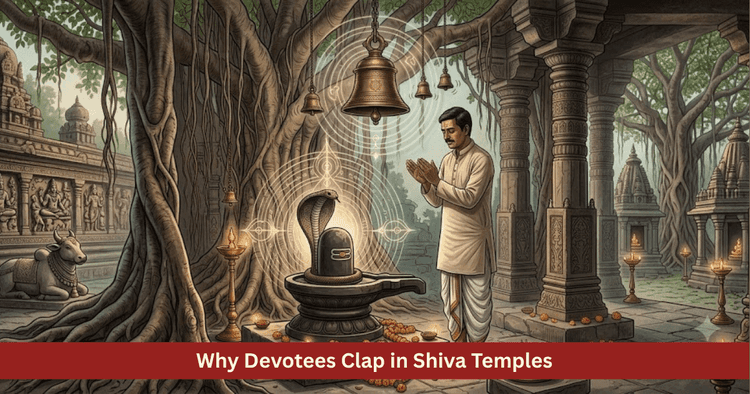
Table of Contents
Cosmic Vibrations in the Sacred Abode
Every sound and gesture in Indian spirituality holds a profound scientific meaning. Within the Sanatana tradition temples were not constructed merely as places of prayer but as vortexes of cosmic energy. When a seeker enters the temple of Lord Shiva the entire atmosphere is vibrant with a unique spiritual frequency. It is a widespread custom to clap three times near the Shivalinga or while exiting the temple after performing prayers. Most people repeat this simply as a habit passed down through generations without knowing the deeper context. However behind this seemingly simple act lies a magnificent narrative and a profound spiritual truth. This ancient ritual teaches the devotee the value of absolute honesty and complete surrender.
Rules and Significance of Clapping in Temples
Vedic culture mandates the adherence to specific guidelines to ensure the efficacy of any ritual. The tradition of clapping in a Shiva temple is directly connected to Chandeshwar who is the eternal guardian of Shiva. The table below elucidates the essential rules and the inner impact of this important ritual.
| Name of Ritual | Timing of Ritual | Method of Performance | Primary Spiritual Rule | Intended Benefit |
|---|---|---|---|---|
| Chandeshwar Smaran | After Darshan and Puja | Clapping three times with moderate sound | To maintain a mind completely free of greed | Affirmation of honesty and mental purity |
While performing this act the emotional state of the devotee must be pure because Mahadeva accepts nothing but inner cleanliness.
An Exemplary Account of Unflinching Devotion
Centuries ago in the southern province of Tamil Nadu there lived a young boy named Vichar Sharma. He was extremely simple in his worldly conduct but his soul possessed an immeasurable love for Lord Shiva. Once he witnessed some villagers treating cows with cruelty which deeply pushed his heart into sorrow. He did not view cows merely as animals but as the sacred embodiment of Nandi the divine vehicle of Mahadeva. From that very moment he took a firm resolve to serve those helpless cows. This compassion gradually transformed into an intense spiritual practice that altered the entire destiny of the young child.
Childhood Austerity and the Shivalinga of Sand
Vichar Sharma would take the cows to the forest for grazing every day. Pleased by the selfless service of the boy the cows began to yield milk abundantly on their own. Finding solitude on the riverbank the boy crafted a beautiful Shivalinga using the sacred sand of the river Ganga. He began to perform the daily ritual of Abhishekam by offering this milk over the sand Shivalinga. There was no grand structure or assembly of priests. There was only an innocent child and his silent communion with the divine. True devotion does not require any outward display because it creates its own energy in the vacuum. That stream of milk flowing over the sand was actually the manifestation of his tears and unbroken faith.
The Fire of Wrath and the Crisis of Faith
When the villagers observed Vichar Sharma pouring precious milk onto the dirt they failed to comprehend his elevated spiritual state. To their mundane vision it appeared as a sheer waste of valuable resources. The complaints eventually reached the ears of his father who arrived at the riverbank in a state of great fury. The boy was deeply immersed in meditation. Without understanding the depth of his faith the father kicked the vessel of milk and attempted to desecrate the Shivalinga. In that dynamic moment the meditation of the boy was broken and his gentle nature assumed a fierce form. The act of his father had shaken his very soul. He picked up a simple stick lying nearby which became an invincible weapon through the power of his faith. In a surge of intense emotion and deep pain he struck his father. This action might appear improper from a worldly perspective but it was an ultimate effort to protect his devotion.
The Divine Manifestation and the Status of Chandeshwar
The moment the blow was struck the entire earth seemed to stand still in silence. Suddenly the sand Shivalinga burst open and Lord Shiva manifested himself from within. There was no anger on the countenance of Mahadeva but rather a calm and compassionate smile. He had witnessed the inner integrity of the child which transcended all social restrictions. Shiva stepped forward and embraced the boy closely. With his divine touch he restored the life of the father and dissolved all negativity from his mind. Mahadeva then bestowed a new identity upon the child naming him Chandeshwar. He was appointed as the eternal custodian of all the wealth and properties of Shiva.
The Ultimate Truth of Leaving Empty Handed
Even today the practice of clapping or dusting hands after visiting a Shiva temple remains intricately linked to Chandeshwar Mahadeva. Chandeshwar is revered as the guardian of the assets of Shiva. By clapping the devotee symbolically conveys to Chandeshwar that they are not taking away any material wealth or greed from the temple. This serves as a reminder that human beings enter this world empty handed and shall depart in the exact same manner. One must only carry back the blessings and spiritual peace from the temple. This subtle gesture inspires the human mind to stay away from avarice and walk the path of truth.
FAQ
Why do devotees clap after visiting a Shiva temple
By clapping in a Shiva temple devotees inform Chandeshwar the guardian of the wealth of Shiva that they are not carrying away any material objects but are returning only with divine blessings.
Who was Chandeshwar and what is his relationship with Lord Shiva
Chandeshwar was an ardent devotee of Lord Shiva in his past life as a boy named Vichar Sharma who pleased Mahadeva through his absolute devotion and was granted the status of the custodian of his wealth.
Did Vichar Sharma actually strike his own father
Yes when the father of Vichar Sharma angrily attempted to destroy the sand Shivalinga the boy struck his father in a state of intense emotion to protect the sanctity of his worship.
What lesson do we derive from this tradition of clapping
This tradition teaches us that we must always enter the abode of the divine with complete honesty and a pure heart because we come into this world with nothing and leave with nothing.
Get your accurate Kundali
Generate KundaliDid you like it?
Author
Pt. Suvrat Sharma (63)
Experience: 20
Consults About: Family Planning, Career
Clients In: Punjab, Haryana, Delhi
Share this article with friends and family
About ZODIAQ
ZODIAQ is an online Vedic Astrology platform. It connects clients seeking astrological advice to experienced astrologers with deep knowledge. Our users also generate kundali and perform kundali milan for free. ZODIAQ also offers services to the Astrologers. Astrologers utilize various offerings by ZODIAQ to serve their clients effectively.
If you are a User
Consult with experienced astrologers and seek their guidance. You can also order handwritten Janm Patrika report with life prediction prepared by experienced astrologers. Generate accurate Kundali, perform Kundali Matching and check horoscope and muhurat. Utilize our online library for all the necessary astrological and spiritual information.
If you are an Astrologer
Create accurate kundali for your clients and perform Kundali Matching for up to 5 people at a time. Write comprehensive Janm Patrika report for your clients with ZODIAQ. Check client details anytime by saving it in client directory. Become more productive by tracking how many clients you guide every day.
WELCOME TO
ZODIAQ
Right Decisions at the right time with ZODIAQ
