Why Lord Brahma Is Not Worshipped
By Pt. Amitabh Sharma
Discover the spiritual secret and astrological reasons behind the prohibition of Lord Brahmas worship
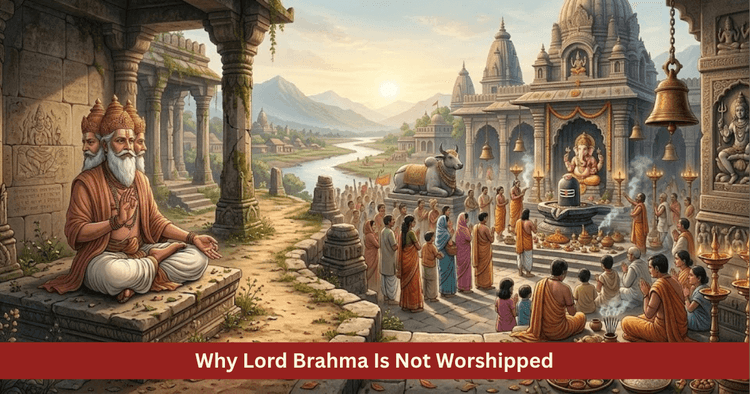
Table of Contents
Within the rich history of Sanatana Dharma and the sacred literature of Vedic philosophy, the position of the Trinity is considered supreme. Across all astrological combinations and spiritual practices of the cosmic wheel, the triangle of creation, preservation and transformation of the universe is universally acknowledged. Whenever the commencement of creation is discussed, the name of Lord Brahma is uttered with supreme respect. He is the first among the Trinity, being the creator of the universe, while Lord Vishnu functions as the preserver and Lord Shiva, the deity of deities, acts as the transformer. however a highly profound and astonishing question continuously echoes within the mind of every curious seeker for centuries as to why the worship of Lord Brahma remains nearly silent, whereas Lord Vishnu and Lord Shiva possess millions of temples, numerous festivals and unalloyed devotees throughout the entire world. Only a few scattered temples dedicated to him exist across the whole of India, among which the Pushkar pilgrimage of Rajasthan is considered the most prominent. In spite of this, every Hindu, consciously or unconsciously, definitely remembers him in his daily prayers, in sacred narratives and at the beginning of any new work. The principle of karma and the astrological perspective hidden behind this supernatural mystery are extremely deep, without understanding which it is completely impossible to know the subtle laws of creation.
To deeply comprehend the spiritual secrets and the astrological time cycle hidden within this highly sacred topic, it is necessary to observe the core dimensions of this form of Lord Brahma. The table below presents a subtle analysis of this specific context of the creator of the universe.
| Core Vedic Element | Subtle Spiritual Form | Astrological and Soul Impact |
|---|---|---|
| Commencement of Creation | Manifestation of cosmic consciousness | Center of the soul and creative energy of Lord Surya |
| Pushkar Pilgrimage | The only primary physical abode on Earth | Balance of the nectarous quality and water element of Chandra |
| Manifestation of Vedas | Gift of the supreme compendiums of knowledge and wisdom | Divine wisdom and excellence of intellect of Brihaspati |
| Prohibition of Worship | Global law of the dissolution of ego | Absolute surrender of Ketu and freedom from material attachment |
The Work of the Creator Ends the Moment It Begins
According to Vedic philosophy, creation, preservation and transformation are three such eternal powers that operate this entire universe. The primary responsibility of Lord Brahma is to grant momentum to this cosmic cycle of creation. The moment the flow of life commences upon this earth, his primary work within the cosmic arrangement gets completely accomplished.
- Lord Vishnu continuously nurtures, preserves and protects that manifested world.
- Lord Shiva merges that creation back into his supreme peace when its designated time is fulfilled.
- According to human nature, man always gets attracted toward the adoration of those powers that are actively connected with his daily life.
- People worship those who protect, bestow blessings and provide guidance during crises.
The role of Lord Brahma is like that divine spark that only ignites the fire rather than continuously burning as the flame itself. His work concludes even before the narrative of life unfolds completely. This is the reason why the number of his temples on the physical plane is extremely minimal, yet his remembrance remains eternal and immortal within the inner consciousness.
The Infallible Curse That Rendered the Creator Immortal in Silence
Ancient mythological texts and compendiums contain numerous narratives clarifying that Lord Brahma received a curse of not being widely worshipped on this earth. According to a prominent episode, when Lord Shiva assumed the form of a massive pillar of fire to prove his supremacy, Lord Brahma made a false claim of having discovered its upper limit, enraged by which Mahadeva cursed him to remain unadored in this world.
These narratives are not merely stories of some ordinary punishment, but the spiritual message hidden within them is extremely grave. It imparts the lesson to the entire animate inanimate world that the power of creation is divine and sacred only as long as it remains completely free from personal ego. This curse is in fact a symbolic ordinance which teaches that if a human being becomes arrogant of his creativity, he forgets the primal source of his powers. For this reason, the creation work of Lord Brahma is respected within Sanatana culture, but he is not made a medium for personal attachment or the fulfillment of material desires. This very silence of his is an indicator of his true immortality.
The Deity of Supreme Knowledge and Not the Fulfillment of Desires
Just like Lord Hanuman, Lord Brahma is also considered the ultimate bestower of the Vedas, who provides self realization and wisdom to human beings instead of merely fulfilling their material desires. It is described in detail within the Mundaka Upanishad how Lord Brahma gave the divine discourse of Brahma Vidya to mankind for the welfare of this creation.
- Knowledge is not an object that can be worshipped merely through external rituals or incense and lamps.
- Knowledge is that element which is lived in life, which is continuously studied and which is directly realized.
- Whenever a student acquires learning with complete concentration, that moment spontaneously becomes the worship of Lord Brahma.
- When a seeker sits in solitude and searches for truth, that contemplation itself is a sacred offering at the feet of the creator.
His true adoration does not reside within the clamor of rituals, but it is encapsulated within the awareness of human consciousness and spiritual realization. In the science of astrology as well, the supreme wisdom of the planet Jupiter is nurtured by this very element of knowledge.
The Subtle Transformation in Rituals From the Vedic Era to the Puranic Era
If we observe through the window of history, Lord Brahma held a central position as Prajapati during the Vedic era and his invocation was considered mandatory in every major yajna and offering. however as the cycle of time moved forward, the path of devotion manifested within the Sanatana tradition, which was far more personal and emotional.
Divine characters emerged in the form of Lord Vishnu and Lord Shiva who participated in the joys and sorrows of human beings, who loved, protected and granted forgiveness. The pastimes of their incarnations became a direct mirror of human life, establishing a highly deep emotional connection of the masses with them. In contrast, Lord Brahma continued to represent an extremely abstract and philosophical principle of creation, which was somewhat beyond the comprehension of ordinary mundane intellect. As religion shifted toward personal faith and narratives, the form of Lord Brahma gradually vanished from the visual ground of external rituals. Yet, his presence remains equally strong today in every Vedic mantra, in the fire of the yajna and in the belief that every new beginning is sacred.
Brahma and Brahman the Subtle Distinction Between the Creator and the Absolute Truth
Within the profound principles of Indian philosophy, an extremely subtle and important distinction is made between the creator deity Brahma and the all pervading supreme element Brahman. Lord Brahma constructs the visible and physical universe, whereas Brahman is that invisible, imperishable and eternal element that pervades every atom of this entire creation.
Over centuries of intellectual evolution, the focus of Sanatana saints and seekers shifted more toward realizing that supreme Brahman seated within themselves rather than worshipping an external creator. The practice of introverted meditation began to receive greater significance in comparison to the construction of physical temples. This journey of faith turned from the idol to the idea and from the outside to the inside. Thus, if observed with a subtle vision, the worship of Lord Brahma never truly ended, but it merely altered its direction. It emerged from the boundary of external stones to dissolve within the inner consciousness of man, where the entire creation itself is considered a form of God.
The Creator Whose Temples Are Scattered Throughout the Universe
Although the independent temples of Lord Brahma are physically extremely rare, his presence is invariably present within the ritual of every single temple. Whenever a new temple is constructed or the life consecration of idols is performed, the priests first invoke Lord Brahma as that divine architect who prepares the blueprint of this entire universe.
- Whether that temple belongs to Lord Vishnu, Lord Shiva or the direct Adi Shakti Mother Durga, taking the name of Lord Brahma at the commencement of worship is mandatory.
- From this perspective, every temple of this earth becomes his temple and every prayer becomes his remembrance.
- This deep silence and peace visible around Lord Brahma is not a void, but it is the purest and most intense form of consciousness.
- His temples may not appear tall in the form of stone shikhars, but they get constructed spontaneously at the beginning of every sacred act.
In astrological calculations as well, when we construct a new building, special attention is paid to the center space of the Vastu Purusha, known as the Brahmasthan, which serves as the axis of peace and prosperity for the home.
The Creative Power Flowing Continuously Within Every Living Being
This holy saga of Lord Brahma is not a narrative of absence or forgetfulness, but it is the direct truth of the continuous transformation of energy. He lives in this world at every place where a new idea takes birth, a new art assumes shape, a new discovery occurs or a new invention is accomplished.
Whenever a poet composes beautiful poetry with his pen, when a scientist imagines a new principle in his laboratory or when a small child nurtures new dreams in his eyes, the creative energy of Lord Brahma alone is flowing there. The scriptures hold the clear opinion that constructing a new and beneficial object with a selfless attitude is the truest and most real adoration of Lord Brahma. Giving birth to ideas, beauty and compassion is to honor that divine spark of creation itself. This is the reason why Hindu society has not been able to forget his name even today. It remembers his name with high respect not in the clamor, but in the extremely calm rhythm of life, in the first ray of every new dawn and in every sacred act of creation.
FAQ
Why is the most prominent temple of Lord Brahma situated specifically in Pushkar
According to mythological narratives, Lord Brahma dropped a lotus flower from his hand to select a place for performing a yajna on Earth, which fell in Pushkar. For this reason, his most sacred and primary temple is established there.
Did Lord Brahma possess ten heads and what is the secret of his four faces
No, Lord Brahma did not possess ten heads, but he has four faces which are direct symbols of the four directions, namely East, West, North and South and collectively represent the four Vedas, namely Rigveda, Yajurveda, Samaveda and Atharvaveda.
With which house and planet is Lord Brahma associated in the science of astrology
In astrology, Lord Brahma is associated with the ascendant house of a birth chart, representing spiritual origin and among planets, he is connected with the positive energy of Jupiter, the master of supreme wisdom and Surya, the significator of the soul.
What is the primary difference between Brahma and Supreme Brahman
Lord Brahma is a specific deity who constructs this physical universe through the attribute of Rajas, whereas the Supreme Brahman is that formless, unborn and infinite element which serves as the core foundation of the entire creation.
What is the significance of worshipping Lord Brahma in the construction of a new house
At the time of house construction, the exact center portion of the plot is considered the Brahmasthan where Lord Brahma resides. Worshipping this spot causes the flow of positive energy within the home and eliminates architectural defects.
Get your accurate Kundali
Generate KundaliDid you like it?
Author
Pt. Amitabh Sharma (56 Years)
Experience: 20
Consults About: Family Planning, Career
Clients In: Punjab, Haryana, Delhi
Share this article with friends and family
About ZODIAQ
ZODIAQ is an online Vedic Astrology platform. It connects clients seeking astrological advice to experienced astrologers with deep knowledge. Our users also generate kundali and perform kundali milan for free. ZODIAQ also offers services to the Astrologers. Astrologers utilize various offerings by ZODIAQ to serve their clients effectively.
If you are a User
Consult with experienced astrologers and seek their guidance. You can also order handwritten Janm Patrika report with life prediction prepared by experienced astrologers. Generate accurate Kundali, perform Kundali Matching and check horoscope and muhurat. Utilize our online library for all the necessary astrological and spiritual information.
If you are an Astrologer
Create accurate kundali for your clients and perform Kundali Matching for up to 5 people at a time. Write comprehensive Janm Patrika report for your clients with ZODIAQ. Check client details anytime by saving it in client directory. Become more productive by tracking how many clients you guide every day.
WELCOME TO
ZODIAQ
Right Decisions at the right time with ZODIAQ
