Gita Secrets Behind Root Cause Of Anger
By Pt. Suvrat Sharma
Understand the psychology of anger and its remedies through the eternal verses of the Holy Bhagavad Gita.
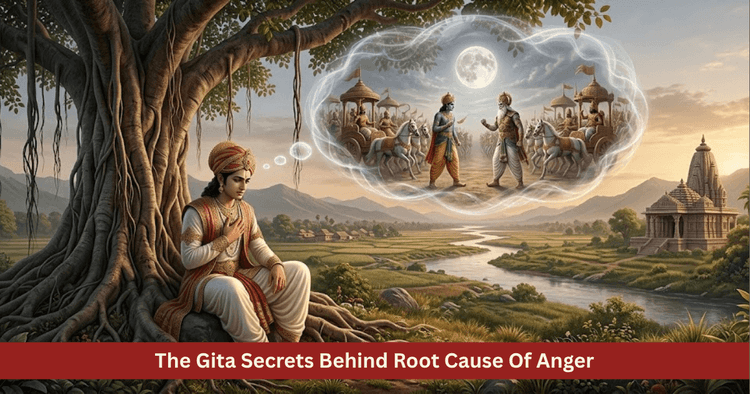
Table of Contents
Every human being in this world experiences anger at some point or another. It is often perceived as a display of power but in truth, it makes an individual extremely weak from within. In the Holy Bhagavad Gita, Lord Krishna has described anger as one of the three gateways to hell, which takes birth from unfulfilled desires and deep rooted ego. On the battlefield of Kurukshetra, when Arjuna was surrounded by delusion and grief, Sri Krishna taught him that real capability lies not in fighting others but in conquering oneself. When a person understands the origin of anger through Vedic spirituality and an astrological perspective, they realize that anger is not something to be suppressed. It is rather an energy that must be transformed into pure consciousness through self awareness.
Refuge In Silence Before Reacting
When anger begins to burn the inner soul, it is mandatory to become calm at that time instead of blaming external circumstances. Lord Krishna reminds Arjuna that a calm and steady mind is more powerful than thousands of weapons of the world. When emotions begin to rise with extreme speed, suppressing them forcefully at that time does not bring peace but becoming aware of them opens the path to liberation.
| Mental State | General Reaction | Vedic Rule of Gita | Astrological Remedy |
|---|---|---|---|
| Intense Anger | Shouting and uncontrolled behavior | Observing a moment of absolute silence | Drinking cold water to pacify Mars and Rahu |
| Mental Delusion | Blaming others for circumstances | Focusing attention on the breath | Performing Pranayama to strengthen the Moon |
| Gratification of Ego | Proving oneself right | Self analysis of deep desires | Meditating for the sattvic influence of the Sun |
An individual must step back to reduce the velocity of the fire of anger. Taking deep breaths balances the vital prana air present within the body and mind. Instead of making anger the identity of your existence, it should be viewed like dark clouds floating in the sky, which arrive and depart after some time. True wisdom awakens only in that momentary silence and the storm of mental unrest quietens on its own.
Look At The Root Cause Not The Reaction
The explosion of anger does not happen suddenly in a single moment but its roots flourish much earlier in the deep recesses of the heart. It is generally observed that the immediate cause is extremely ordinary but behind it lies hidden past pain, fear, insecurity or disappointment. This psychological truth has been beautifully explained in the sixty third verse of the second chapter of the Bhagavad Gita.
Krodhad bhavati sammohah sammohat smrti vibhramah Smrti bhramsad buddhi naso buddhi nasat pranasyati
The meaning of this shloka is that from anger arises complete delusion and from delusion comes confusion of memory. From confusion of memory comes the destruction of intellect and when the intellect is destroyed, a human being perishes completely. Sri Krishna explains that when a human being continuously thinks about worldly objects, attachment toward them is born. From attachment rises desire and when any obstacle comes in the fulfillment of those desires, anger is inevitably born. True strength does not lie in raising your voice higher but is inherent in observing your emotions without any prejudice.
Dawn Of Peace Through Relinquishing Ego
When the intellect is controlled by ego, the vision to perceive truth disappears completely. On the contrary, when spiritual wisdom awakens, humility gets integrated within a human being.
Ahankaram balam darpam kamam krodham ca samsritah Mam atma para dehesu pradvisanto abhyasuyakah
Through this verse, it has been made clear that those human beings who take refuge in ego, power, arrogance, lust and anger surely hate the indwelling Supreme Soul present within their own bodies and the bodies of others. As long as a person remains bound in the narrow circle of "me" and "mine", they cannot escape the fire of anger. The moment a human being distances himself from this false ego, forgiveness and compassion begin to flow within him. In that supreme silence of surrender, the heart accepts the truth that the restless intellect could never understand, that peace is not found in controlling situations but in leaving them to God.
Choosing Equanimity Over Control
True mental strength is not measured by how much control a person exercises over others. It is assessed by how stable a person remains from within even when circumstances around him are completely adverse.
- Equanimity of mind is the greatest protective shield of the world.
- Anger completely deludes the intellect and destroys the glow of the soul.
- Peace always originates from the inner soul, not from external objects.
- When the mind is conquered, the adversities of the external world become ineffective.
The core message of the Gita is that a human being should remain equal in pleasure and pain, gain and loss and victory and defeat. This is Samatvam Yoga, which makes an individual internally so strong that destructive emotions like anger cannot even enter inside him.
The Agitation Of Arjuna And Dialogue Of Sri Krishna
Just before the commencement of the great war of Kurukshetra, the mind of Arjuna was extremely agitated, angry and confused. The Gandiva bow was slipping from his hand and this situation was not due to any physical fear but because his intense emotions had completely covered his wisdom. Even in such a difficult situation, the Supreme Personality of Godhead, Lord Krishna, did not become angry with him, nor did He speak any harsh words to him.
On the contrary, bringing a gentle smile upon His face, He imparted the teachings of knowledge to Arjuna. He clarified that merely reacting is a symptom of ignorance, whereas understanding the situation in its totality is true knowledge. When patience is integrated into speech and compassion into listening, a human being effortlessly comes out of the labyrinth of internal conflict.
Effortless Acceptance Of Unalterable Truth
On many occasions, anger does not come due to the actions of others but originates from the rigid resistance hidden within us toward the present situation. Human beings often refuse to accept reality and wish that life would proceed according to their own desires.
Sri Krishna shows a higher path through Karma Yoga, according to which a human being must perform his duty with full dedication but should not maintain any anxiety or attachment toward its result. When a person gives up the stubbornness of running life on his own terms and begins to place unshakeable faith in the will of God, the path to supreme peace opens up. This feeling of acceptance is not cowardice or passive surrender but it is an extremely pure and powerful state of the inner soul.
The Truth Of The Self Destructive Fire Of Anger
The words of Lord Krishna continuously warn us that anger is not a strength but it is a tool of self destruction hidden in the illusion of power. The more we nurture it, the more it keeps hollowing us from within.
- Holding anger is like grasping a burning ember with the intent of throwing it at someone else but you are the one who gets burned first.
- Forgiveness, patience and compassion are the actual weapons possessed by wise human beings.
- Choosing wisdom over reaction elevates a human being above the situation.
- Controlling the velocity of anger is absolutely essential to safeguard destiny and the future.
True bliss does not lie in running away from anger but in recognizing its root cause and eliminating it from the very base. The Holy Bhagavad Gita teaches us that the incompleteness of desires and worldly attachment is the mother of anger. When we pause for a few moments and observe our emotions neutrally, anger dissolves spontaneously and its place is taken by eternal consciousness.
FAQ
What is the primary cause of the origin of anger according to the Bhagavad Gita?
According to the Bhagavad Gita, the primary cause of the origin of anger is excessive attachment toward worldly objects and the non-fulfillment of desires. When any obstruction comes in the longing of a human being, their ego gets hurt, which gives rise to anger.
How to attain mental balance immediately when anger arises?
Instead of reacting immediately when anger arises, one should practice silence for a few moments. Taking deep and long breaths creates a balance of the vital prana air in the body, which calms the excited nervous system and reawakens wisdom.
How are ego and anger interconnected as clarified in the Gita?
According to the Gita, the ego nourishes anger. When a human being considers himself the doer and tries to keep everything under his control and circumstances do not happen according to him, his ego gets wounded, which comes out in the form of intense anger.
Is suppressing anger considered a symptom of progress on the spiritual path?
No, suppressing anger forcefully is not the spiritual path because suppressed anger makes a human being diseased internally. The Gita instructs us to calm anger through awareness and knowledge instead of suppressing it and to transform it into positive energy.
What are the best remedies to develop a calm nature according to astrology and the Gita?
To develop a calm nature, practicing meditation daily, relinquishing attachment to the fruits of actions and accepting the will of God are the best methods. From an astrological perspective, a sattvic diet and Pranayama are highly beneficial to make the Moon and Mars favorable.
Get your accurate Kundali
Generate KundaliDid you like it?
Author
Pt. Suvrat Sharma (63)
Experience: 20
Consults About: Family Planning, Career
Clients In: Punjab, Haryana, Delhi
Share this article with friends and family
About ZODIAQ
ZODIAQ is an online Vedic Astrology platform. It connects clients seeking astrological advice to experienced astrologers with deep knowledge. Our users also generate kundali and perform kundali milan for free. ZODIAQ also offers services to the Astrologers. Astrologers utilize various offerings by ZODIAQ to serve their clients effectively.
If you are a User
Consult with experienced astrologers and seek their guidance. You can also order handwritten Janm Patrika report with life prediction prepared by experienced astrologers. Generate accurate Kundali, perform Kundali Matching and check horoscope and muhurat. Utilize our online library for all the necessary astrological and spiritual information.
If you are an Astrologer
Create accurate kundali for your clients and perform Kundali Matching for up to 5 people at a time. Write comprehensive Janm Patrika report for your clients with ZODIAQ. Check client details anytime by saving it in client directory. Become more productive by tracking how many clients you guide every day.
WELCOME TO
ZODIAQ
Right Decisions at the right time with ZODIAQ
