Ketu Transit in Sagittarius: Search for Truth and the Grace of the Teacher
By Pt. Sanjeev Sharma
Explore how Ketu in Sagittarius encourages inner spiritual inquiry, detachment from rigid tradition, and deep understanding of dharma.
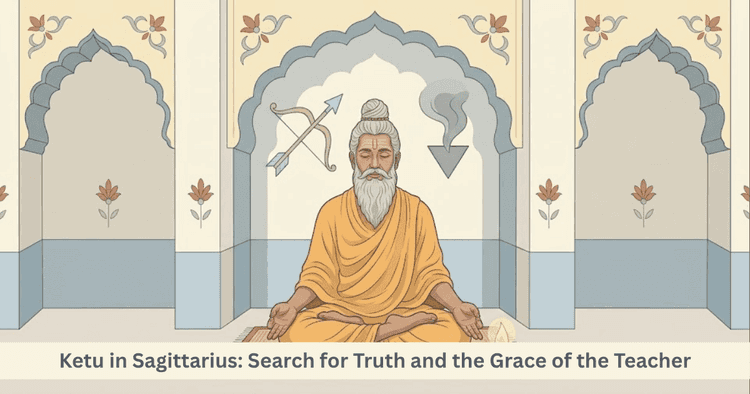
Table of Contents
When Ketu enters Sagittarius, the mind no longer remains satisfied with religious form alone. It begins seeking the living essence hidden behind belief. This is the period when life may stop moving only through inherited teachings and may start moving through inner testing, spiritual sensitivity and the urge to know what is truly real. Sagittarius is associated with dharma, philosophy, higher wisdom, pilgrimage, the grace of the teacher and direction in life. Ketu, on the other hand, signifies detachment, inner vision, spiritual refinement, distance from outer display and the subtle movement toward liberation. When these two become active together, a person’s way of relating to faith itself may begin to change.
According to the base indication, the transit of Ketu in Sagittarius can take a person away from traditional religion and rigid convention. This is the main tone of the transit. The mind may no longer feel satisfied merely because something is old, widely followed or part of a respected tradition. There may arise a strong urge to understand the essence behind the rule, the consciousness behind the teaching and whether the truth of it is being genuinely experienced within. That is why this can become a period of some distance on one side but also of deep spiritual maturity on the other.
Why is the transit of Ketu in Sagittarius considered so spiritual
In Vedic astrology, Ketu is regarded as a force that pulls a person away from outer attachment and toward inner truth. It creates detachment in the very area where the person once looked for certainty. Sagittarius is the sign of Guru, meaning Jupiter and is associated with dharma, scripture, philosophy, higher learning, life values and a wide spiritual vision. When Ketu enters this sign, a person may no longer feel content with religious identity alone. There may be a stronger urge to experience dharma, understand it and test its truth within.
That is why this transit can become not merely a time of disagreement but a time of spiritual purification. One’s perspective may begin changing. Ritual may begin feeling less important than essence. Outer structure may begin giving way to inward experience. If this process is lived with humility and discipline, the person may move toward genuine spiritual advancement.
Why does distance arise from traditional religion and rigid patterns
The base content clearly says that during this period a person may move away from traditional religion and rigid customs. This does not mean becoming anti religious. Its real meaning is that the person no longer feels satisfied with religion in a fixed or mechanical form. There may be a need to understand the purpose behind a practice. If something appears to continue merely out of habit while its living meaning has faded, the mind may naturally begin stepping away from it.
Such distance can often be necessary. When every teaching is accepted without reflection, dharma remains borrowed rather than lived. Ketu here can move the person from borrowed belief toward experienced truth. Yet if balance is missing, that same distance may turn into dry rebellion. That is why understanding is more important here than mere rejection.
During this period, these signs may become visible
- A tendency to question outer religious rules
- Less willingness to accept something only because it is traditional
- Mental distance from rigid customs
- Greater importance given to experience rather than form alone
Why does the mind move away from outer religious display
According to the base indication, during this time the person seeks the true essence of dharma rather than its outer display. This is one of the deepest parts of the transit. One may begin feeling that the amount of ritual, clothing, declarations or outer identity is not enough. A question may arise within, if there is no peace, compassion or truth within, then what is the value of outer display.
This question is not destructive. It is purifying. Ketu may move the person from the form of religion toward the element of religion. One may want to understand how practice enters life, how humility develops, how attachment reduces and how the soul’s experience matures. This is why the period may open the way toward living dharma more deeply.
What does it mean to search for the real essence of dharma
To search for the real essence of dharma means to understand that dharma is not only a collection of rules. It is a living way of being rooted in truth, compassion, restraint, right action, reverence, discernment and inner discipline. When Ketu enters Sagittarius, the person may strongly feel the need to understand this. There may be less interest in noise and more interest in inner spiritual substance.
At such a time, a person may feel drawn toward meditation, contemplation of scripture, satsanga, pilgrimage, silence, reflective writing or deeper self examination. There may be a desire to speak less and experience more. That is the subtle blessing of this transit, that it can transform dharma from habit into lived realization.
Why do long journeys and pilgrimage bring mental peace
The base content clearly says that long journeys or pilgrimages may bring mental peace. Sagittarius is associated with long travel, pilgrimage, journeys of faith, journeys of wisdom and experiences that widen perspective. When Ketu comes here, the mind may be drawn toward travel that offers inner quiet, sacred atmosphere or distance from worldly noise.
Such journeys are not merely changes of place. At times they become purifying processes. During the journey, a person may leave behind old thought patterns, notice inner burdens and begin understanding life from a clearer point of view. That is why pilgrimage or long travel in this period can become not just experience but also spiritual practice.
How can real peace be received through travel
If one travels during this period, it may be far more useful to live it not only as movement but also as inner retreat.
These points may be especially supportive
- Keep time for silence and observation during travel
- Do not only see the place but feel its inner atmosphere
- In pilgrimage, include inner prayer along with outer ritual
- Bring the experience back into life after returning
Why can there be ideological difference with the teacher or father
According to the base indication, there may be ideological differences with the teacher or father during this period. This is a sensitive yet natural aspect of the transit. Sagittarius is connected with the teacher, guidance, father like wisdom figures, inherited philosophy and life principles. Ketu may make the person less satisfied with ready made answers. If a teaching does not match lived truth, disagreement may arise.
Such difference is not always a sign of disrespect. At times it shows that a person is not only hearing but also thinking. Yet if humility is absent, the same difference may harden into emotional distance or ego based rejection. That is why during this time it is essential to live disagreement through respectful speech and patient dialogue.
Does disagreement always mean distance from the teacher
Not always. At times disagreement may simply mean that the person has moved beyond blind acceptance. If this process is lived with sincerity and reverence, the bond with the teacher does not break. It may even become more real. The person no longer imitates mechanically but receives through understanding. That itself is a sign of maturity.
Yes, if one starts opposing merely for the sake of opposition, growth may suffer. That is why it becomes important to distinguish between a question rising from the search for truth and a reaction rising only from ego. Ketu here asks for discernment.
Why is this a time to develop one’s own philosophy
The base content clearly says that this is a time to develop one’s own philosophy of life. This is one of the most important intellectual aspects of the transit. A person may no longer wish to lean only on the views of others. There can be a need to build personal understanding of life, dharma, truth, duty and knowledge. The question arises, what does my own consciousness know to be true.
This development will not happen instantly. It requires study, contemplation, lived experience, patience and inner honesty. One who grows through this process may later hold a much more balanced and mature vision. Faith will no longer remain shallow. Knowledge will no longer remain borrowed.
How does the movement toward higher knowledge take place
According to the base indication, this transit moves a person toward higher knowledge. This means the mind may no longer remain content with ordinary information. It may be drawn toward essence, first principles, self knowledge, liberation, karma, purpose and consciousness. Ketu can guide the person toward the silent side of knowledge where lived understanding matters more than mere verbal mastery.
During this time, a person may feel inclined toward serious scriptural study, meditation, yoga, Vedanta, inner silence, the teachings of a guide or philosophy in a deeper sense. The desire may no longer be only to know but to understand and embody. This is the unique influence of Ketu, that it can make knowledge existential rather than merely intellectual.
What is the real meaning of being led toward liberation
The final statement of the base content says that this transit moves the person toward moksha, meaning liberation. This does not mean physical withdrawal from life for everyone. Its real meaning is to begin understanding the nature of bondage, to loosen the grip of ego, to move away from false belief and to experience an inward freedom that is not dependent on outer conditions. The path toward liberation begins within.
Ketu in Sagittarius can show that knowing alone is not enough. One must also learn to let go. Belief alone is not enough. One must also experience. Remaining inside tradition alone is not enough. One must awaken in consciousness. This may become the first true taste of the path of liberation.
Which practices may be especially helpful now
If a person genuinely wishes to receive the higher potential of this transit, then practices that bring purification, silence and awareness can be especially helpful.
These points may be especially useful
- Regular meditation, mantra repetition or silence based discipline
- Limited but serious study of deeper scriptures
- Reflection on the words of the teacher without blind acceptance
- Making time for pilgrimage, solitude or self contemplation
A simple summary of this transit
The summary below may help in understanding the main effects of this transit
| Life Area | Possible Effect | What May Help |
|---|---|---|
| Dharma | Moving from outer form toward inner essence | Value experience more than display |
| Tradition | Questions around rigid conventions | Develop understanding before rejection |
| Teacher and Father | Possibility of ideological difference | Maintain respectful dialogue |
| Travel | Long journeys and pilgrimage giving peace | Join travel with self reflection |
| Knowledge | Attraction toward higher study and philosophy | Practice regular contemplation and study |
| Liberation Path | Beginning to understand and release bondage | Develop both detachment and awareness |
How can one use this energy in the best way
The transit of Ketu in Sagittarius can be a highly subtle, spiritual and transformative period. If during this time a person learns to understand dharma beyond outer display, develops personal thought while honoring the teacher principle, seeks peace through travel and begins living higher wisdom rather than merely discussing it, this period can become deeply enriching. This transit is not only about distance. It is about purification.
Those who live this phase consciously do not merely move away from tradition. They discover its real essence. They do not merely disagree. They develop a more mature view. They do not only travel. They return with greater inner quiet. This is the finest fruit of the period.
The true meaning of the search for truth
The search for truth does not mean asking questions alone. It means turning the question itself into practice. When Ketu enters Sagittarius, it asks why a person believes in dharma, why the teacher is accepted, how scripture is understood and on what basis life is being lived. If these questions are lived sincerely, a person may move from borrowed faith to awakened reverence.
This is the deeper message of the transit. Do not abandon dharma, understand it. Do not fight the teacher, enter into dialogue. Do not break tradition carelessly, first recognize its essence. Travel outwardly but also travel within. Gain knowledge but bring it into life. When detachment, discernment, reverence and self reflection move together, the subtle energy of Ketu can raise the person from confusion toward higher wisdom and the path of liberation. The transit of Ketu in Sagittarius reminds the native of this quiet, profound and illumined phase of life.
Frequently asked questions
Can the transit of Ketu in Sagittarius take a person away from traditional religion
Yes, during this transit a person may move away from outer religious form, rigid customs and fixed convention in order to understand their real essence.
Are pilgrimage and long journeys helpful during this time
Yes, according to the base indication, long journeys or pilgrimage can bring mental peace, self reflection and broader understanding.
Can there be disagreement with the teacher or father
Yes, ideological differences are possible, especially when a person is developing an independent view. Even then, respectful dialogue remains essential.
Does this transit lead a person toward higher knowledge
Yes, this period can strongly deepen the pull toward philosophy, scripture, spiritual understanding and higher wisdom.
What is the greatest lesson of this transit
The greatest lesson is that true dharma is not hidden in outer display but in the search for essence, awakened reverence, self reflection and the movement toward inner freedom.
Get your accurate Kundali
Generate KundaliDid you like it?
Author

Pt. Sanjeev Sharma (63)
Experience: 20
Consults About: Family Planning, Career
Clients In: Punjab, Haryana, Delhi
Share this article with friends and family
About ZODIAQ
ZODIAQ is an online Vedic Astrology platform. It connects clients seeking astrological advice to experienced astrologers with deep knowledge. Our users also generate kundali and perform kundali milan for free. ZODIAQ also offers services to the Astrologers. Astrologers utilize various offerings by ZODIAQ to serve their clients effectively.
If you are a User
Consult with experienced astrologers and seek their guidance. You can also order handwritten Janm Patrika report with life prediction prepared by experienced astrologers. Generate accurate Kundali, perform Kundali Matching and check horoscope and muhurat. Utilize our online library for all the necessary astrological and spiritual information.
If you are an Astrologer
Create accurate kundali for your clients and perform Kundali Matching for up to 5 people at a time. Write comprehensive Janm Patrika report for your clients with ZODIAQ. Check client details anytime by saving it in client directory. Become more productive by tracking how many clients you guide every day.
WELCOME TO
ZODIAQ
Right Decisions at the right time with ZODIAQ
