7 Reasons Why Hardly Anyone Worships Brahma Today
By Pt. Nilesh Sharma
Unraveling the Cosmic Mystery of the Forgotten Creator
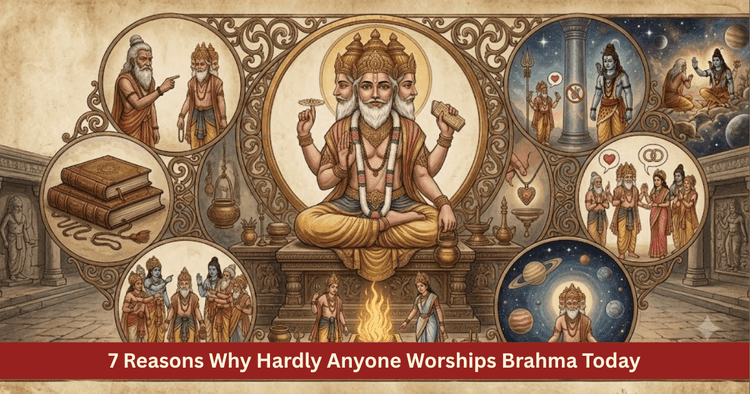
Table of Contents
The manifestation of this universe occurred from the supreme Vedic sentence Ekoham Bahusyam which means I am One and let me become many. The creator of this entire universe is the four faced Brahma who constructed the cosmic world with his pure consciousness. Among the Trinity of Sanatana tradition Brahma is revered as the architect of creation. It is a matter of great wonder that despite being the designer of the cosmos Brahma holds a negligible place in the daily prayers of common people. There are very few temples dedicated to him across India among which the Pushkar temple in Rajasthan is the most famous. No fasts are observed in his name and no grand festivals are celebrated unlike Vishnu and Shiva. To solve this deep spiritual and historical mystery it is essential to understand the sutras of the Puranas. There are seven highly important and undeniable reasons behind the absence of Brahma worship.
Table of Planetary and Ritual Guidelines
Since the independent worship of Brahma is not widely prevalent through specific annual fasts or festivals the historical contexts and guidelines of the holy Pushkar pilgrimage are provided below.
| Main Details | Vedic Rules and Astrological Beliefs |
|---|---|
| Primary Shrines | Pushkar Region Rajasthan |
| Recommended Time | Kartik Purnima Tithi |
| Prohibited Deeds | Independent Idol Installation and Daily Sankalpa |
| Allowed Rituals | Invocation of Ritvik on Brahmasan During Yajna |
| Core Reason | Irrevocable Puranic Curse of Shiva and Saraswati |
The Curse of Saraswati and Mahadeva
In mythological narratives the greatest and most famous reason for the absence of Brahma worship is considered to be a curse. According to the Puranas when Brahma manifested Saraswati for the creation of the universe he became attracted to the beauty of his own daughter. Due to this inappropriate act Mahadeva the protector of cosmic boundaries became extremely angry. Shiva punished Brahma by cutting off his fifth head and cursed him that he would never be worshipped on Earth. According to another legend Goddess Saraswati herself cursed Brahma to be deprived of public worship for violating cosmic discipline. These stories demonstrate that no matter how high a position one holds in Sanatana Dharma if someone violates their boundaries society and religion do not accept them.
Completion of Task with the Creation of the Universe
According to Vedic astrology and philosophy every deity is assigned a specific responsibility in the universe. Lord Vishnu is the preserver of creation who takes incarnations to protect dharma during times of crisis. Mahadeva is the lord of destruction who destroys untruth and paves the way for liberation. The primary task of Brahma was only to create the universe which has already been completed. In human life there is a daily need for protection and nurturing for which people seek the shelter of Vishnu and Shiva. The work of Brahma was to lay the foundation of creation after which his active role ended. Due to the lack of continuous utility his worship gradually disappeared with the wheel of time.
Finite Lifespan of Brahma
According to Sanatana time calculation the lifespan of Brahma is limited despite being immensely vast. One day of Brahma is equal to 4320000000 human years which is called a Kalpa. Brahma lives for 100 such years and after that he dissolves into the Supreme Brahman. Unlike Shiva and Vishnu Brahma is not unborn and eternal but is bound by the limitations of time. A devotee always wants to seek refuge in a power that is itself eternal and indestructible. How can one who is himself under the control of time free any soul from the cycle of birth and death. Due to this philosophical thinking the sages did not consider the devotion of Brahma necessary.
Association with Vedic Yajnas and the Impact of Bhakti Movement
In the ancient Vedic period Brahma was worshipped as Prajapati and his invocation was mandatory in every yajna. At the time of the conclusion of the sacrifice a share for Brahma was set aside separately because he was the witness of the yajna. When the Bhakti movement emerged in India during the medieval period complex rituals were replaced by simple personal love and devotion. People began to be attracted towards the incarnations of Vishnu and the spontaneous devotion of Shiva. The form of Brahma always remained intellectual and ritualistic which the general public could not internalize. When the practice of yajnas decreased the importance of Brahma also became limited only to the scriptures.
Absence of Temples and Idols
To keep the worship of any deity alive the continuity of temples and festivals is essential. While there are millions of temples of Shiva and Vishnu all over India the only living temple of Brahma is seen in Pushkar. The form of his idol which has four faces and holds the Vedas in hand remained merely symbolic. Brahma never got the place in sculpture and architecture that other deities received. When there were no temples the chanting of his mantras and rituals among the general public also stopped. The places of Brahma also disappeared from the routes of pilgrimage over time.
Philosophical Shifts in the Puranas
With the passage of time when the Puranas were composed the division of sects took place. Shaiva and Vaishnava sects interpreted the scriptures to prove their respective deities as supreme. There are many episodes in the Puranas where Brahma is shown originating from the navel of Vishnu or bowing down before Shiva. This religious hierarchy made the status of Brahma secondary. When society accepted that the blessings of the Trinity are obtained only by worshipping Vishnu or Shiva the need to worship Brahma separately ended completely.
Spiritual Sentiment of Detachment from the Material World
The ultimate goal of Sanatana Dharma is to attain moksha which means liberation from this earthly cycle of birth and death. Brahma himself is the creator of this material world which means he is the symbol of maya and bondage. If any soul worships Brahma they wish to be born again in this very world. On the contrary Shiva and Vishnu are the providers of detachment and liberation. A seeker desiring to be free from the world never gave priority to the worship of the creator of the world. Travelers walking on the path of salvation chose the path of dissolution and preservation instead of creation.
Silent Presence
Brahma may not be worshipped in temples but he is inherent in every particle of the entire creation. His presence is still mandatory in the pronunciation of every Vedic mantra and in every fire of yajna. The absence of his worship is not his insult but a profound spiritual message that we do not have to remain bound to the beginning. Construction is only a means and the goal is only that infinite truth which lies beyond this creation. Brahma is performing his cosmic duty silently without any desire for praise.
FAQ
Where is the main temple of Brahma Ji located in India
The most prominent and ancient temple of Brahma Ji in India is located in Pushkar Rajasthan where a very large fair is held on Kartik Purnima.
What curse did Lord Shiva give to Brahma Ji
Lord Shiva cursed Brahma Ji for violating boundaries and speaking untruth that he would never be worshipped on Earth.
Is Brahma Ji immortal
No according to Sanatana astrology Brahma Ji is not immortal and his lifespan is of 100 Brahma years after which he dissolves in Mahapralaya.
What is the role of Brahma Ji in Yajnas
In Vedic yajnas Brahma is considered the protector and witness of the sacrifice without whose permission no offering is considered complete.
What do the four faces of Brahma Ji symbolize
The four faces of Brahma Ji are considered symbols of the four directions and the knowledge of the four Vedas which are Rigveda Yajurveda Samaveda and Atharvaveda.
Get your accurate Kundali
Generate KundaliDid you like it?
Author
Pt. Nilesh Sharma (63)
Experience: 20
Consults About: Family Planning, Career
Clients In: Punjab, Haryana, Delhi
Share this article with friends and family
About ZODIAQ
ZODIAQ is an online Vedic Astrology platform. It connects clients seeking astrological advice to experienced astrologers with deep knowledge. Our users also generate kundali and perform kundali milan for free. ZODIAQ also offers services to the Astrologers. Astrologers utilize various offerings by ZODIAQ to serve their clients effectively.
If you are a User
Consult with experienced astrologers and seek their guidance. You can also order handwritten Janm Patrika report with life prediction prepared by experienced astrologers. Generate accurate Kundali, perform Kundali Matching and check horoscope and muhurat. Utilize our online library for all the necessary astrological and spiritual information.
If you are an Astrologer
Create accurate kundali for your clients and perform Kundali Matching for up to 5 people at a time. Write comprehensive Janm Patrika report for your clients with ZODIAQ. Check client details anytime by saving it in client directory. Become more productive by tracking how many clients you guide every day.
WELCOME TO
ZODIAQ
Right Decisions at the right time with ZODIAQ
