What Is Surya Gochar 2027 and When Will Sun Transit?
By Pt. Abhishek Sharma
Complete Vedic analysis of all twelve Sankrantis, Kharmas periods, dignity states and Nakshatra transits in the year 2027
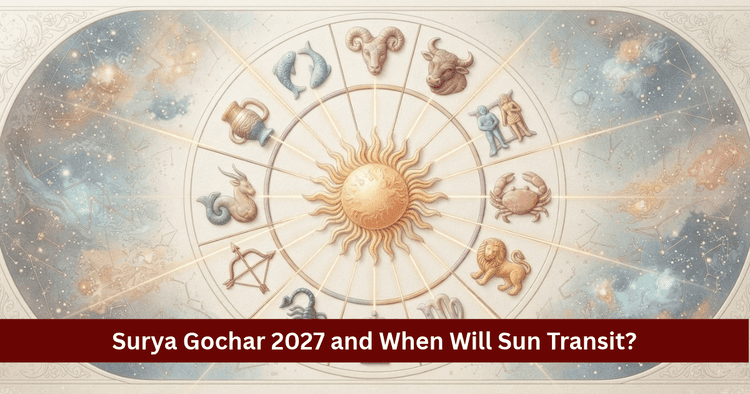
Table of Contents
The transition of the Sun from one zodiac sign to another is known as Surya Gochar or Sankranti in Vedic astrology. In the year 2027, Lord Surya will enter Capricorn on January 14, 2027, at 21:05 IST and reach Sagittarius on December 16, 2027, at 16:33 IST.
The Sun never turns retrograde and never enters a stationary state. This means it completes its journey through all twelve zodiac signs sequentially throughout the year without ever stepping backward. Based on Panchang and astronomical calculations, this transit guides seasons, solar months and human life energy.
Complete Date and Time Table of Sun Transit Across Twelve Signs
At the beginning of 2027, Lord Surya will reside in Sagittarius, having entered that sign on December 16, 2026. The table below provides accurate details of each Surya Sankranti according to the sidereal zodiac and Indian Standard Time. It also clarifies the daily speed of the Sun, the time taken to move one arcminute and the total duration of stay in each sign.
| Sun Transit (Sign) | Date and Time (IST) | Daily Speed | Time for One Arcminute | Total Duration in Sign |
|---|---|---|---|---|
| Capricorn | January 14, 2027, 21:05 | 1.0187 degrees per day | 24 minutes | 29 days 12 hours |
| Aquarius | February 13, 2027, 10:04 | 1.0112 degrees per day | 24 minutes | 29 days 20 hours |
| Pisces | March 15, 2027, 06:55 | 0.9969 degrees per day | 24 minutes | 30 days 8 hours |
| Aries | April 14, 2027, 15:23 | 0.9798 degrees per day | 24 minutes | 30 days 20 hours |
| Taurus | May 15, 2027, 12:14 | 0.9644 degrees per day | 25 minutes | 31 days 6 hours |
| Gemini | June 15, 2027, 18:50 | 0.9549 degrees per day | 25 minutes | 31 days 10 hours |
| Cancer | July 17, 2027, 05:42 | 0.9536 degrees per day | 25 minutes | 31 days 8 hours |
| Leo | August 17, 2027, 14:07 | 0.9609 degrees per day | 25 minutes | 30 days 23 hours |
| Virgo | September 17, 2027, 14:04 | 0.9749 degrees per day | 25 minutes | 30 days 11 hours |
| Libra | October 18, 2027, 02:03 | 0.9919 degrees per day | 24 minutes | 29 days 23 hours |
| Scorpio | November 17, 2027, 01:53 | 1.0074 degrees per day | 24 minutes | 29 days 14 hours |
| Sagittarius | December 16, 2027, 16:33 | 1.0171 degrees per day | 24 minutes | 29 days 10 hours |
This final stay in Sagittarius will continue into the next year and conclude on January 15, 2028, when the Sun reaches Capricorn. Adding all twelve stays from one Capricorn ingress to the next totals 365 days and 6 hours. This period of 365.26 days constitutes the complete solar cycle of the Vedic Panchang.
Why Is the Sun Stay Longest in the Middle of the Year?
The apparent speed of the Sun does not remain uniform throughout the year, which causes the mid-year solar months to be the longest. In 2027, the speed of the Sun will be slowest upon entering Cancer at 0.9536 degrees per day, whereas it will be fastest upon entering Capricorn at 1.0187 degrees per day.
From an astronomical perspective, the orbit of the Earth is elliptical rather than a perfect circle. Because of this, the Earth is closer to the Sun in January and the solar motion appears faster, while greater distance in July slows the apparent speed. If the average of the entry and exit speeds is calculated for each sign, the longest stays occur in the signs with the slowest motion.
- The three signs with the longest stays will be Gemini, Cancer and Taurus, where both entry and exit speeds remain below one degree per day.
- The three signs with the shortest stays will be Sagittarius, Capricorn and Scorpio, which the Sun crosses at a fast pace exceeding one degree per day.
- There is a full 2-day difference between the longest and shortest stays of the year, making it astronomically inaccurate to assume every solar month lasts 30 days.
Why Do Sankranti Timings Differ Across Various Panchangs?
Subtle differences in Ayanamsha calculations across various Panchangs can shift Sankranti timings by several minutes to over an hour. According to the normal motion of the Sun, covering one arcminute of longitude takes 24 to 25 minutes of clock time.
If a Panchang adopts an Ayanamsha value differing by just one arcminute from the standard Lahiri value, every sign ingress shifts earlier or later by about two dozen minutes. A difference of a few arcminutes can shift these timings by an hour or more. This is not a calculation error, rather it represents accurate results within each specific mathematical framework.
Regarding calendar dates, all twelve ingresses of 2027 are quite stable because none fall within one hour of midnight. Only two ingresses occur close to midnight. Scorpio Sankranti takes place on November 17, 2027, at 01:53 AM and Libra Sankranti occurs on October 18, 2027, at 02:03 AM. Since the Scorpio ingress is 1 hour and 53 minutes past midnight, which equals about 4 arcminutes of solar motion, some Panchangs using a slightly different zodiac framework may list Scorpio Sankranti on November 16.
What Changes in Sun Transit Timings Occur in 2027 Compared to 2026?
Compared to 2026, each solar ingress in 2027 occurs between 5 hours 54 minutes and 6 hours 16 minutes later on the clock. This shift is a direct result of the natural annual solar cycle of 365 days, 6 hours and 12 minutes.
After 365 calendar days, the remaining six hours push Sankranti timings forward every year. In most signs, the date remains identical and only the hour changes, yet in three specific signs this shift crosses the midnight boundary.
- Cancer Sankranti moves forward from July 16 in 2026 to July 17 in 2027.
- Libra Sankranti crosses midnight from October 17 to occur on October 18 in 2027.
- Scorpio Sankranti shifts from November 16 to take place early on November 17 in 2027.
This explains why solar dates copied from the previous year occasionally differ by a day, while clock timings inevitably change every single year.
When Will the Sun Be Exalted, Own Sign and Debilitated in 2027?
In Vedic astrology, the Sun represents the soul, father, authority and vital life force, possessing three primary dignity signs. In 2027, the Sun will sequentially enter its exaltation, own sign and debilitation states to influence universal energy.
| Solar Dignity State | Zodiac Sign | Duration (2027) | Astrological Significance |
|---|---|---|---|
| Exalted Sign | Aries | April 14 to May 15, 2027 | The Sun attains supreme strength and brilliance |
| Own Sign and Moolatrikona | Leo | August 17 to September 17, 2027 | The Sun remains completely empowered and stable in its own house |
| Debilitated Sign | Libra | October 18 to November 17, 2027 | Solar energy becomes gentle and self-confidence requires conscious effort |
Aries and Libra sit directly opposite each other in the zodiac, placing the exalted and debilitated stays exactly half a year apart. The actual results of these transits in an individual horoscope depend on the ascendant, Moon sign and ongoing planetary periods.
When Does Kharmas Occur in 2027?
When Lord Surya transits through the signs ruled by Jupiter, namely Sagittarius and Pisces, that period is known as Kharmas or Malamaas in Vedic tradition. It is believed that during this time solar radiance is dedicated to serving Jupiter, reducing the outward energy required for auspicious worldly ceremonies.
A total of three Kharmas periods touch the year 2027. The first period begins on December 16, 2026 and continues until the Sun enters Capricorn on January 14, 2027. The second period starts when the Sun enters Pisces on March 15, 2027 and lasts until Aries Sankranti on April 14, 2027. The third and final period begins with the Sagittarius ingress on December 16, 2027 and remains effective until January 15, 2028. Auspicious ceremonies like weddings, housewarmings and new business launches are avoided during these periods, whereas spiritual chanting, austerity and charity yield multiplied benefits.
What Is the Difference Between Sankranti Ingress Moment and Punya Kaal?
The exact astronomical moment when the Sun enters a new sign is called Sankranti Kaal, while the auspicious window designated for ritual bathing, charity and worship is known as Punya Kaal. The timings listed in the table strictly denote the astronomical moment of sign transition.
According to classical scriptures, the festival day of a Sankranti and its Maha Punya Kaal depend on the exact hour of solar ingress. If a Sankranti occurs after sunset or during the night, its Punya Kaal is observed after sunrise the following morning. Bathing in sacred rivers, offering water to the Sun and donating sesame, jaggery and garments hold immense spiritual merit on every Sankranti.
When Do Major Nakshatra Transits Happen During Sun Transit 2027?
The 27 Nakshatras share a deep bond with the 12 zodiac signs, creating three exact Nakshatra junctions during the annual solar transit. Across the entire zodiac, there are only three points where a zodiac sign and a Nakshatra begin simultaneously.
- On April 14, 2027, the Sun enters Ashwini Nakshatra simultaneously with Aries.
- On August 17, 2027, the Sun enters Magha Nakshatra simultaneously with Leo.
- On December 16, 2027, the Sun enters Mula Nakshatra simultaneously with Sagittarius.
Apart from these three junction points, a Nakshatra spans across the boundary on all other nine zodiac borders. According to Vedic astrology, Lord Surya is the ruling deity of Krittika, Uttara Phalguni and Uttara Ashadha Nakshatras. In 2027, the Sun enters Uttara Ashadha on January 11, Krittika on May 12 and Uttara Phalguni on September 14.
What Is the Difference Between Sun Sign and Moon Sign for Transit Results?
Everyone born during a specific solar month shares the same sidereal Sun sign, whereas Vedic astrology primarily analyzes planetary transits from the Moon sign. While the Sun stays in a sign for roughly one month, the Moon, representing the mind, stays in a sign for only about two and a quarter days.
Due to the rapid motion of the Moon, the natal Moon sign carries a much more subtle and personalized influence in a birth chart. therefore to understand the favorable or challenging outcomes of Surya Gochar, astrologers count the position of the transiting Sun from the house occupied by the Moon at birth. Offering water to Lord Surya from a copper vessel every morning and reciting the Aditya Hridaya Stotra provides vitality and well-being for all zodiac signs.
FAQ
When will the first Surya Sankranti take place in 2027?
The first Surya Sankranti of 2027 will occur on January 14, 2027, at 21:05 IST when Lord Surya leaves Sagittarius to enter Capricorn. From this day onward, the Sun begins its northward journey known as Uttarayana.
Does the Sun ever turn retrograde like other planets?
No, according to Vedic astrology and astronomy, the Sun and the Moon never turn retrograde. The Sun always moves forward in direct motion without pausing or stepping backward across all twelve zodiac signs.
When will the Sun be in its exalted and debilitated signs in 2027?
Lord Surya will reside in his exalted sign Aries from April 14, 2027, to May 15, 2027. Exactly six months later, he will transit his debilitated sign Libra from October 18, 2027, to November 17, 2027.
What are the Kharmas periods in 2027?
Three Kharmas periods touch the year 2027. The first runs from December 16, 2026, to January 14, 2027, the second from March 15, 2027, to April 14, 2027 and the third from December 16, 2027, to January 15, 2028.
Why do Sankranti timings vary slightly across different Panchangs?
Subtle differences in Ayanamsha calculations across various Panchangs can shift Sankranti timings by 24 minutes to an hour. Since the Sun takes about 24 to 25 minutes to travel one arcminute, this variation depends on the mathematical system used.
What does Sun Sign reveal about me?
My Sun SignDid you like it?
Author

Pt. Abhishek Sharma (63)
Experience: 20
Consults About: Family Planning, Career
Clients In: Punjab, Haryana, Delhi
Share this article with friends and family
About ZODIAQ
ZODIAQ is an online Vedic Astrology platform. It connects clients seeking astrological advice to experienced astrologers with deep knowledge. Our users also generate kundali and perform kundali milan for free. ZODIAQ also offers services to the Astrologers. Astrologers utilize various offerings by ZODIAQ to serve their clients effectively.
If you are a User
Consult with experienced astrologers and seek their guidance. You can also order handwritten Janm Patrika report with life prediction prepared by experienced astrologers. Generate accurate Kundali, perform Kundali Matching and check horoscope and muhurat. Utilize our online library for all the necessary astrological and spiritual information.
If you are an Astrologer
Create accurate kundali for your clients and perform Kundali Matching for up to 5 people at a time. Write comprehensive Janm Patrika report for your clients with ZODIAQ. Check client details anytime by saving it in client directory. Become more productive by tracking how many clients you guide every day.
WELCOME TO
ZODIAQ
Right Decisions at the right time with ZODIAQ