Death of Karna: Endings, Lineage and the Timeless Epic Journey
By Pt. Sanjeev Sharma
War, Curses, Promise, Lineage, Salvation & Moral Conflict
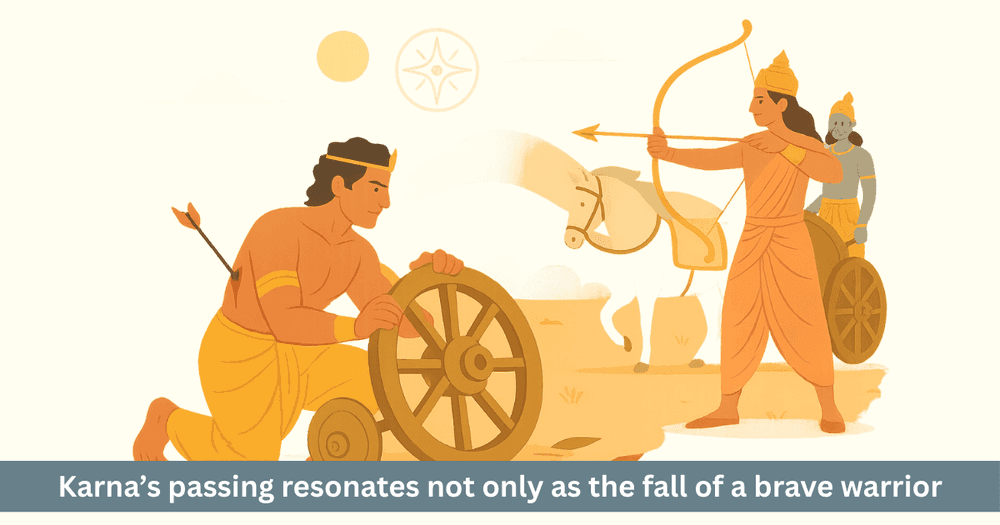
Table of Contents
Karna’s passing resonates not only as the fall of a brave warrior but as the culmination of society’s structures, dharma, vows, kinship and the saga of the soul. His last journey, from battlefield to Suryalok, the tales of his children to his ultimate liberation, melds history, mythology and philosophy into an extraordinary fusion.
The Seventeenth Day of War: Fate, Rivalry and Psychological Strain
Kurukshetra’s climactic day merged triumph and tragedy. Karna and Arjuna’s long-awaited duel set the scene for final reckoning: two giants of equal prowess, locked in a contest shaped by ambition, pain, vow and legacy.
The battlefield, saturated in blood and echoes, bore witness to Karna’s internal anguish, summoning his childhood disappointments, social rejection, loyalty, charity and promise.
Table: Final Duel’s Cultural and Psychological Setting
| Episode | Deep Meaning | Result / Impact |
|---|---|---|
| Final day | Decisive moment, rivalry, fate | Destiny, dignity, promise |
| Battlefield | Blood, grief, strife, exhaustion | Imperfection, societal tensions |
| Psychological strain | Ambition, competition, pride | Weight of defeat, emotional toll |
Epilogue: Every instant mirrors the struggle between human endeavor and destiny.
The Cycle of Curses: Earth Goddess, Parashurama and Fate’s Paradox
Then came the moment when Karna’s chariot wheel became stuck, a fulfillment of the curse given by the earth goddess, when Karna, as a compassionate child, drew ghee from the earth to help a young girl. Another curse, from Parashurama: the loss of the Brahmastra’s invocation in battle. At the penultimate moment, fate asserted its hold, undoing knowledge, strength and advantage.
Mahabharata testifies: curses, destiny and prophecy overrule talent and education, bringing even the greatest low at the appointed hour.
Table: Curses, Fate and the Decisive Moment
| Curse | Who Gave It | Battle Result |
|---|---|---|
| Earth goddess | For helping, taking ghee | Chariot stuck, loss of control |
| Memory sanction | Parashurama | Unable to invoke Brahmastra |
Epilogue: Knowledge, strength and will, all dissolve before destiny’s shadow.
The Ethics of the Battlefield: Struggle, Norms and the Arjuna-Krishna Decision
Karna, honoring war’s ethical code, requested Arjuna pause the duel to free his wheels. Krishna intervened, insisting that Kauravas had already violated dharma and that the time for restraint was past. The unfolding debate between morality, principle and strategy became embodied in their conversation.
Arjuna, guided by Krishna, loosed the Anjalika weapon, ending Karna just as he strove to right his chariot. How does one choose, between principle, oath and victory?
Table: Ethics, Norms and Death’s Dilemma
| Side / Principle | Narrative | Final Outcome |
|---|---|---|
| Human code of war | Principle, oath, paused engagement | Justice, collapse of code |
| Krishna’s logic | Strategy above all | Morality questioned |
| Arjuna’s discipline | Duty, obedience, mourning | Sadness, moral struggle |
Epilogue: The epic teaches: where values, oaths and war collide, universal truths must be unearthed.
Aftermath of Karna’s Death: Social, Familial and Emotional Consequence
After Karna’s fall, the Pandavas’ initial joy was replaced by profound guilt, as they discovered their true kinship with him. Yudhishthira, Bhima, Arjuna, Nakula, Sahadeva, all were racked by remorse and self-reproach.
Duryodhana, who had not wept for any brother, was inconsolable after Karna’s death. Krishna, who had orchestrated much, fell silent before Karna’s loyalty and principle. His death became the pivot for all the epic’s deepest moral and social dilemmas.
Table: Societal and Family Response
| Event | Description | Psychological Impact |
|---|---|---|
| Victory’s cost | Pandavas’ remorse, Duryodhana’s grief | Ethics, burden of guilt |
| Standard of dharma | Karna’s loyalty, solemn oath | Fear, sorrow, reflection |
Epilogue: Dharma’s burden, always deeper than winning or losing.
The Story of Karna’s Sons: Lineage, Battle and Post-Epic Struggle
Karna’s sons, Vrishasena, Sudama, Vrishaketu, Chitrasena, Satyasena, Sushena, Shatrunjaya, Dvipata, Banasena, Prasena, lived and died on Kurukshetra’s fields.
Eight perished in battle. Sudama was killed by Arjuna at Draupadi’s swayamvar. Prasena perished at Satyaki’s hands. Vrishasena, Shatrunjaya and Dvipata were struck down by Arjuna. Bhima slew Banasena; Nakula accounted for Chitrasena, Satyasena and Sushena.
Only Vrishaketu survived the war. Upon learning the truth of Karna’s lineage, Arjuna adopted Vrishaketu, who fought alongside him during the Ashvamedha Yagna, only to be slain by Babruvahana, Arjuna’s own son, in yet another cycle of tragic kinstrife.
Table: Karna’s Sons, Valor and Tragedy
| Name | Event / Fate | Impact / Ancestry |
|---|---|---|
| Sudama | Killed by Arjuna, childhood | Tragedy, early loss |
| Vrishasena, Shatrunjaya, Dvipata | Killed by Arjuna | Valor, loss, end of branch |
| Prasena | Satyaki’s blade | Battle’s cross-currents |
| Banasena | Killed by Bhima | Kinship’s sacrifice |
| Chitrasena, Satyasena, Sushena | Killed by Nakula | Total line erased |
| Vrishaketu | Survived, then slain by Babruvahana | Post-epic drama, legacy lost |
Epilogue: Kin, lineage and loss, a cycle repeated from father to son.
Soul’s Journey to Suryalok: Liberation, Mythic Meaning and Literary Presence
Mahabharata relates that Karna’s soul, with death, was uplifted to Suryalok, the godly realm, greeted in peace and restored dignity by his celestial father. This stage transcends mythology, offering symbolic redemption and moral reconciliation.
His sons, too, were cleansed and honored. The Pandavas, now burdened by regret, learned the weight of kinship and the tragic cost of incomplete truth. Yudhishthira found his victory stained with the sorrow of fraternal loss, while the epic’s lessons haunted every generation.
Table: Suryalok, Salvation and Epic Meaning
| Scene | Details | Cultural / Literary Impact |
|---|---|---|
| Soul’s release | Purification, ascension/emancipation | Redemption, closure |
| Divine reunion | Children received with honor | Model of ideal afterlife |
| Pandavas’ regret | Emotional collapse, remorse | Family truth, complex victory |
Epilogue: After struggle, the soul is lifted, complete purity and acceptance.
Legacy, Reflection and the Shifting Depths of Dharma
Karna’s death, his posterity and his soul’s release frame several of Mahabharata’s deepest themes: dharma’s ambiguity, fate’s implacability, loyalty’s weight and relationship’s complexity.
His journey remains the inspiration for endurance, charity, oath-keeping and sacrifice. Stories, songs, poems and cultural festivals across India retell his struggle against destiny, social boundaries and isolation, always insisting on the value of ideals above expediency.
Table: Legacy, Epic Significance and Modern Relevance
| Theme | Details | Societal / Literary Message |
|---|---|---|
| Dharma’s ambiguity | Principle, oath, trial | Justice, introspection, resonance |
| Strength of fate | Curses, prophecy, tragedy | Humility, patience, acceptance |
| Loyalty’s worth | Friendship, relationship, devotion | Value of connections, morality |
| Regret and salvation | Emotional complexity, truth found | Literature, spiritual awakening |
Epilogue: Karna’s legacy stands as a guidepost in every age, dharma, principle and the search for meaning.
Literary and Cultural Proliferation of Karna’s Tale
Karna’s journey lives beyond Mahabharata: in poetry, novels, drama and local song. His death, his sons’ fate and his ascension to Suryalok inspire works in Sanskrit, Hindi, Tamil, Bengali and more.
Temples, folk performances and village traditions mark Karna’s generosity and tragic end annually. Vrishaketu’s legacy, protected by Arjuna, remains a basis for stories of redemption and family.
Table: Cultural, Literary Manifestations of Karna’s Death
| Medium | Artistic Focus | Cultural Resonance |
|---|---|---|
| Epic poetry | Valor, dharma, regret | Inspiration, identity |
| Song/folklore | Charity, ascension, loss | Religious memory, idealization |
| Novels/literature | Dharma, conflict, legacy | Social awareness, education |
Epilogue: Literature and culture continually expand the meaning of Karna’s struggle and sacrifice.
Profound Moral and Psychological Insights: Regret, Atonement, Redemption
Karna’s death is not only a matter of battle and loss but of the psychology and morality underpinning every relationship. The remorse of the Pandavas, Duryodhana’s loneliness, Krishna’s silent contemplation, all illuminate the epic’s depth.
Karna’s entire life, shaped by curse, disadvantage, rivalry, promises and hope, ends with purification and self-realization. His tale endures as a symbol of pain, courage and spiritual transformation.
Table: Moral and Psychological Impact
| Subject | Details | Socio-cultural Insight |
|---|---|---|
| Remorse | Pandavas, Duryodhana, Krishna | Awareness, catharsis |
| Salvation | Ascension, acceptance, honor | Purity, enduring lesson |
| Dharma’s struggle | Complexity of rule and vow | Soul’s pursuit of truth |
| Self-realization | Conflict, acceptance, legacy | Growth, cultural resonance |
Epilogue: Karna’s story, humanity, dharma, consciousness and the ultimate aspiration for peace.
Frequently Asked Questions (FAQ)
Which curses were decisive in Karna’s death?
The earth goddess’s curse (chariot stuck) and Parashurama’s curse (lost memory of weapons) both played critical roles.
How many sons did Karna have; what was their fate?
Ten sons; nine died in battle, only Vrishaketu survived the war but was later killed in postwar campaigns.
What does the epic teach about Karna’s afterlife?
His soul reached Suryalok, purified, freed and honored as a divine warrior fulfilling the arc of redemption.
What was the emotional result for the Pandavas after learning of Karna’s lineage?
Their triumph was marked with pain, regret and a sense of loss, coloring all subsequent memory and legend.
What does Karna’s narrative offer to contemporary culture, psychology and literature?
It offers universal lessons, honor, endurance, charity and the necessity for critical self-examination beyond conventional success.
What does Sun Sign reveal about me?
My Sun SignDid you like it?
Author
Pt. Sanjeev Sharma (63)
Experience: 20
Consults About: Family Planning, Career
Clients In: Punjab, Haryana, Delhi
Share this article with friends and family
About ZODIAQ
ZODIAQ is an online Vedic Astrology platform. It connects clients seeking astrological advice to experienced astrologers with deep knowledge. Our users also generate kundali and perform kundali milan for free. ZODIAQ also offers services to the Astrologers. Astrologers utilize various offerings by ZODIAQ to serve their clients effectively.
If you are a User
Consult with experienced astrologers and seek their guidance. You can also order handwritten Janm Patrika report with life prediction prepared by experienced astrologers. Generate accurate Kundali, perform Kundali Matching and check horoscope and muhurat. Utilize our online library for all the necessary astrological and spiritual information.
If you are an Astrologer
Create accurate kundali for your clients and perform Kundali Matching for up to 5 people at a time. Write comprehensive Janm Patrika report for your clients with ZODIAQ. Check client details anytime by saving it in client directory. Become more productive by tracking how many clients you guide every day.
WELCOME TO
ZODIAQ
Right Decisions at the right time with ZODIAQ
500+
USERS
100K+
TRUSTED ASTROLOGERS
20K+
DOWNLOADS
