Krishna and Karna: The Epic of Destiny, Loyalty and Choice
By Pt. Nilesh Sharma
Dharma, Ethics, Friendship, Debt and the Dilemma of Choice
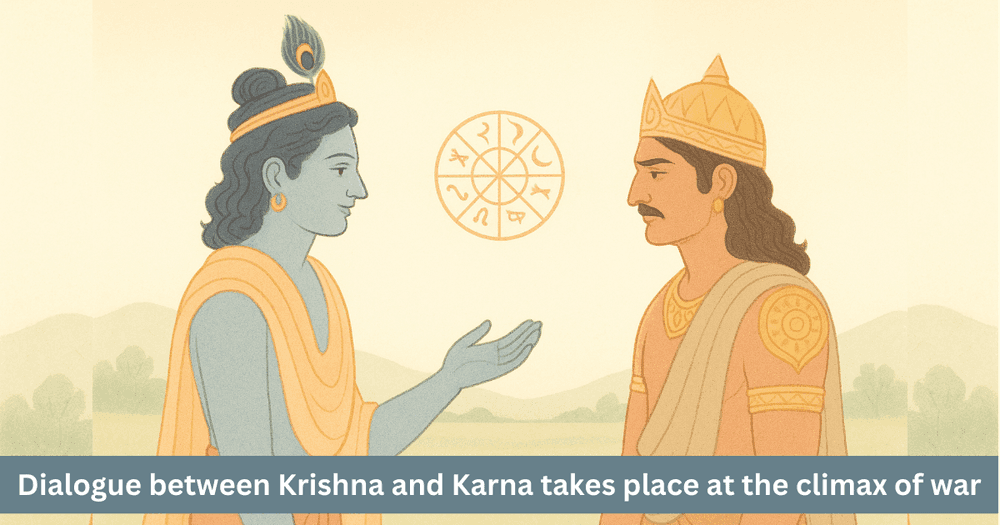
Table of Contents
The Mahabharata is not only a tale of war but a profound exploration of morality, duty and the shades of the human soul. In the swirl of blurred lines between hero and villain and dharma and adharma, the dialogue between Krishna and Karna before the war epitomizes destiny, loyalty and the burden of personal choice. Their conversation is among the most meditative, human and deliberative moments of the epic.
On the Eve of Kurukshetra: Depth and Destiny in Conversation
The meeting between Krishna and Karna occurs at a crossroads, on the eve of a war but also on the edge of revelation for Karna himself. Krishna, standing for a universal dharma, invites Karna: "You are Kunti’s firstborn. You will have the kingdom, the brothers you never knew, Draupadi as queen. Step to the side of light and justice, come to the Pandavas."
This was not simply a proposition for power or victory, it was a chance to explore the depths of Karna’s identity, suffering and longing. Karna responds, “They are not my brothers. Thank you for giving me my answer, at last I know who I am, Kunti’s eldest son.” All his life, Karna had been searching for legitimacy, kinship and acceptance. Now, at his life’s twilight, he at last receives the truth but too late for it to satisfy the wounds left by rejection.
Table: Psychological and Ethical Dimensions of the Dialogue
| Character | Dialogue / Argument | Psychological / Moral Analysis |
|---|---|---|
| Krishna | Dharma, identity, kingdom, kinship | Universal justice, strategy |
| Karna | Loyalty, scarred identity, vow, gratitude | Pain of rejection, meaning of loyalty |
Epilogue: This is not merely a moment in time but a meditation on history, psychology and destiny.
Birth, Rejection and the Meaning of Dharma
Karna’s life was a tapestry of being denied: abandoned at birth, raised by a charioteer, scorned by teachers and society, excluded from Draupadi’s hand and denied merit due to his “inferior” birth.
At Krishna’s offer, Karna is, for the first time, validated and included. But to him, dharma is not what society or history defines, it is the reparation for the hand that sheltered him, a loyalty to the one who stood with him in humiliation and pain.
Table: Birth, Rejection and Personal Dharma
| Episode | Details | Social / Psychological Effect |
|---|---|---|
| Raised as charioteer’s son | Lifelong exclusion, denied merit | Self-doubt, pain of outsiderhood |
| Draupadi’s rejection | Scorned at swayamvara for his caste | Deepest wound to dignity |
| Dronacharya’s ban | Excluded from learning | Continued frustration, self-worth |
Epilogue: For Karna, dharma is personal loyalty and repaying the debt of acceptance.
Justice, Codes and the Power of Undying Loyalty
Krishna presses Karna: “Why not stand for righteousness?” Karna answers: “You speak of a dharma that never stood by me. It was Duryodhana alone who respected me, who gave me rank and honor when I had none.” For Karna, the bond of gratitude to Duryodhana overrode all later revelations about him or the Pandavas.
Table: Justice, Loyalty and Debt
| Perspective | Details | Moral Message |
|---|---|---|
| Krishna’s Dharma | Universal, legalistic, family-based | Highest principle, cosmopolitan good |
| Karna’s Dharma | Loyalty to Duryodhana, gratitude | Debt repayment, living one’s own truth |
Epilogue: Codes are forged not only from duty but from the debts of kindness.
The Burden of Choice: Loyalty, Dharma and Personal Freedom
Karna’s greatest tragedy is that, even with full freedom, he had already bound himself. His sense of dharma, morality and personal choice was wedded to the debt he owed for kindness received.
Krishna reminded Karna that he was siding with those who would bring evil and destruction. Karna answered, “Even at the price of my life, I stand by a friend who saved me when all the world showed only contempt.” He had no interest in fame, kingship or victory, only in repaying the one act of acceptance that had ever been granted him.
Table: The Burden of Loyalty and Freedom
| Theme | Details | Social / Psychological Meaning |
|---|---|---|
| Loyalty’s price | Debt to Duryodhana, self-chosen bond | Definition of vow, cost of freedom |
| Freedom to choose | Karna’s awareness, yet chosen submission | Solitude, fate, tragic autonomy |
Epilogue: The heart finds tragedy not just when denied freedom but when it freely binds itself.
Shades of Morality: Karna, Krishna and the Gray Ethics of Mahabharata
The dialogue is more than just a clash between good and evil. Karna knows and accepts, Duryodhana’s failings. Krishna seeks to remind him of the broader view, the cosmic stakes of the war, the cost to the world.
Karna’s answer: the one who accepted him when all others rejected him had a pass to his last breath. Krishna: even when the cause is righteous, sometimes the greater virtue is the gratitude repaid to a friend.
Table: Morality, Friendship and Universal Dharma
| Side | Dialogue / Argument | Psychological / Social Lesson |
|---|---|---|
| Karna | Gratitude outweighs righteousness, even in error | Loyalty, debt, tragic triumph |
| Krishna | Justice above affiliation | Strategy, sacrifice for the greater good |
Epilogue: When ethical lines blur, Mahabharata’s message deepens.
Final Relief: Defeat, Loyalty and Closing the War
Karna died with no regret for forsaking kingship or glory, only indebtedness to a benefactor and the comfort of loyalty fulfilled. When the Pandavas learned the truth, their triumph turned hollow; brotherhood had been lost for far too long.
Krishna knew that not every winner is right; not every strategy can erase pain. For Duryodhana, losing Karna was the real loss. For the reader, Karna is the hero who lives in the margins, always asking, is it better to die for your truth than live with a borrowed "righteousness"?
Table: War, End and the Ethics Thereafter
| Character | Emotional Outcome and Aftermath | Meaning |
|---|---|---|
| Karna | Died in loyalty, not winning | Value of debt and principle |
| Pandavas | Burdened by shame, loss, brotherhood renewed | Pain of misplaced victory |
| Krishna | Compassionate, contemplative | Strategy, principle, empathy |
| Duryodhana | Broken by the loss, not by defeat | Value of sincere friendship |
Epilogue: Vows, gratitude and fidelity often eclipse victory and defeat.
Dialogue’s Cultural, Psychological and Social Afterlife
The drama, pathos and message of the Krishna-Karna dialogue is re-enacted in poetry, literature, TV, movies and contemporary dilemmas, within families, friendships and social struggles today.
Whenever personal pain meets public expectation, the questions of friendship, honor and the cost of loyalty resurface. Krishna’s universal view and Karna’s tragic, luminous loyalty together mirror the deep humanity and constant ambiguity, of all human relationships.
Table: Cultural and Literary Repercussions
| Medium | Presentation / Theme | Cultural Imprint |
|---|---|---|
| Epic poetry | Dharma, debate, tragedy | Inspiration, questioning, growth |
| Theater/novel | Dilemma, choice, friendship | Dialogue, values, reflection |
| Societal metaphor | Private debt vs. public morality | Introspection, social commentary |
Epilogue: The Krishna-Karna dialogue is a timeless parable for every era.
Deep Moral and Psychological Lessons: Reflection for All Ages
Karna’s tragic choice urges self-interrogation, the weighing of gratitude, conviction and principle. Loyalty, even when costly, achieves its own nobility. This dialogue asks of modern readers: when does the debt of acceptance outweigh formal codes of justice? Is any code more reliable than the honest gratitude for kindness in a world of indifference?
Table: Psychological / Moral Insights
| Issue | Depth and Exploration | Major Lesson |
|---|---|---|
| Loyalty vs. Dharma | Friendship over universal law | Relationships over systems |
| Dharma vs. Practicality | Justice, tradition, context | The evolution of values |
| Affirmation | The answer to rejection | The value of kindness, everywhere |
Epilogue: This dialogue, of loyalty, personal integrity and the price of choice, remains the Mahabharata’s most human, eternal lesson.
FAQ
What did Krishna offer Karna and why did Karna refuse?
Krishna offered the throne, kinship and Queen Draupadi. Karna refused for the sake of friendship and loyalty to Duryodhana.
How did Karna define his own “dharma”?
For Karna, dharma was loyalty, to repay the debt owed to the only one who had ever stood by him.
What insights do their conversations reveal about the Mahabharata’s central themes?
They illuminate dharma, fate, freedom, loyalty, gratitude and the painful ambiguity of right and wrong.
What does this episode teach modern readers?
That true greatness lies not only in winning or in being right but in remaining loyal to those who gave us kindness, even when the world thinks otherwise.
Was Karna a victim of fate or an emblem of choice?
Both, he exercised his agency to choose but remained bound by debts and relationships, as so many of us do.
What does moon sign reveal about me?
My Moon SignDid you like it?
Author

Pt. Nilesh Sharma (63)
Experience: 20
Consults About: Family Planning, Career
Clients In: Punjab, Haryana, Delhi
Share this article with friends and family
About ZODIAQ
ZODIAQ is an online Vedic Astrology platform. It connects clients seeking astrological advice to experienced astrologers with deep knowledge. Our users also generate kundali and perform kundali milan for free. ZODIAQ also offers services to the Astrologers. Astrologers utilize various offerings by ZODIAQ to serve their clients effectively.
If you are a User
Consult with experienced astrologers and seek their guidance. You can also order handwritten Janm Patrika report with life prediction prepared by experienced astrologers. Generate accurate Kundali, perform Kundali Matching and check horoscope and muhurat. Utilize our online library for all the necessary astrological and spiritual information.
If you are an Astrologer
Create accurate kundali for your clients and perform Kundali Matching for up to 5 people at a time. Write comprehensive Janm Patrika report for your clients with ZODIAQ. Check client details anytime by saving it in client directory. Become more productive by tracking how many clients you guide every day.
WELCOME TO
ZODIAQ
Right Decisions at the right time with ZODIAQ
500+
USERS
100K+
TRUSTED ASTROLOGERS
20K+
DOWNLOADS
