What is the Divine Life, Character and Eternal Message of Sita Devi?
By Pt. Nilesh Sharma
Birth, learning, marriage, exile, trials, vows and inspiration - the complete epic
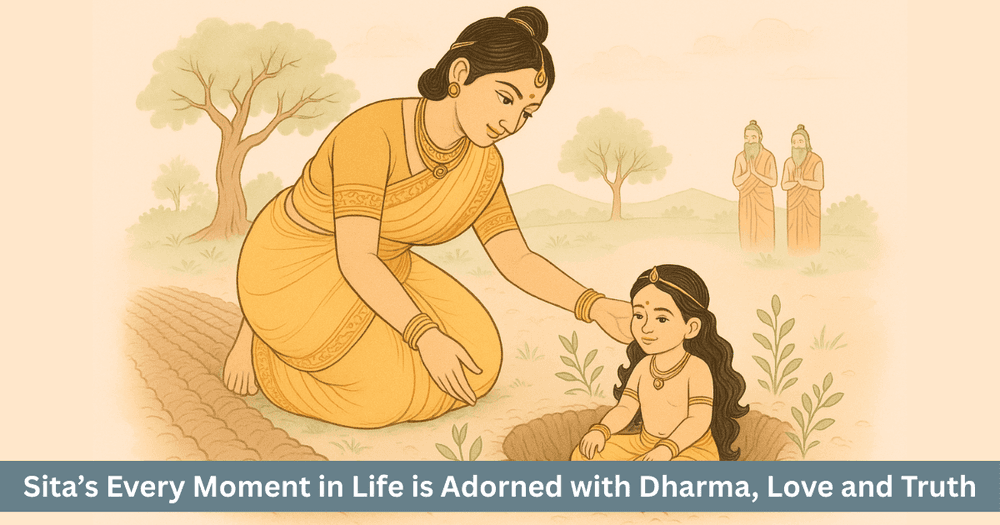
Table of Contents
Immeasurable faith, unblemished sacrifice and invincible feminine power-these epitomize Sita Devi. Each event, virtue and act of fortitude in her life reverberates across Vedic and modern times. Sita is not merely the consort of Lord Rama; she is inscribed in the deepest roots of Indian culture as a timeless inspiration. From her celestial birth to her merging with the earth, every moment is adorned with new blossoms of dharma, love and truth.
The birth of Sita: Miraculous descent from the heart of the earth
Ancient scriptures portray King Janaka as a devout, yogic and wise ruler. During a holoyajna on Mithila’s soil, Janaka himself took up the ritual of ploughing the earth. At a certain point, his plough became firmly lodged. With intrigue and wonder, the earth was excavated, revealing a goddess-like infant. Her radiance and calm astonished all the sages and Brahmins present.
Sita’s birth is regarded as a wondrous example of divinity, nature’s mystery and cosmic benevolence. She was named Sita-from the Sanskrit term “sita” meaning the furrow made by the plough.
King Janaka and his spiritual legacy
King Janaka was a unique practitioner of Vedanta and yoga. His celebrated philosophical dialogues with sage Yajnavalkya-known as the “Janaka-Yajnavalkya Samvad”-are treasured gems of the Indian Upanishads. Janaka’s approach, combining tolerance, deep meditation and rule bound by duty, earned him the titles “Videha” and “Rajarshi.”
Sita’s childhood: Love, education and nurturing
Sita received an upbringing rich in dignity and values. She studied the Vedas, economics, Ayurveda and the art of governance. With the blessings of Queen Sunayana and Janaka’s philosophical guidance, she developed a pure, sharp intellect.
She displayed affectionate care for birds, animals and trees from a young age. All the people lovingly called her “Janakanandini,” the beloved daughter of Janaka.
Wisdom, devotion and triple conduct: The unique personality of Sita
Sita exemplified modesty, humility, wisdom and complete surrender. She was not merely a Grihalakshmi but a living embodiment of yoga, dharma, penance and devotion. Vedas, Puranas and folk traditions illustrate how she interacted with men and women from all walks of life.
Sita’s perspective in Vedantic and Upanishadic discussions
The Upanishads reference Sita as one who wished to understand the mysteries of the soul, Brahman and nature. In Janaka’s kingdom, she took part in scholarly gatherings with sages, philosophers and yogis.
The svayamvara: The sacred test and wondrous marriage
King Janaka possessed Lord Shiva’s extraordinary bow, granted through divine alliance and the grace of ascetics. At Sita’s svayamvara, he declared that only the hero who could lift and string this bow would wed Sita. Princes from near and far arrived, yet none dared or managed to lift the bow.
Arrival of Rama and the mystery of bow-breaking
Accompanied by sage Vishwamitra and Lakshmana, Rama arrived in Mithila. In the great assembly Rama-with no arrogance and gentle humility-lifted the bow, strung it and broke it into three pieces.
This was proof not merely of physical strength but of Rama’s divinity.
Sita’s heartfelt surrender and the garland ceremony
After all uncertainties passed, Sita’s pure heart instantly chose Rama. In the presence of celestial beings, she placed the golden garland on Rama’s neck. Mithila’s people, nature and the gods themselves rejoiced in the grandeur of the occasion.
Scriptural and historical aspects
Folk traditions of Janakpur, Mithila and Nepal record the wedding’s songs, cuisine, traditional attire and festivities. Sage Valmiki, Tulsidas and the Kalki Purana depict this occasion with immense pride.
Grihastha life: Cultural and familial ideals
Sita, in Ayodhya, carried out the dharma, service and welfare of the entire royal family alongside Rama. She showed utmost respect towards King Dasharatha, Queen Kaushalya, Sumitra and Kaikeyi. With her friends and noble women of Ayodhya, she constantly upheld the practical aspects of dharma, artha, kama and moksha.
The role of Grihalakshmi in Indian society
Sita set a powerful standard for womanhood. Her education, devotion, humility and spirit of service continue to inspire women’s empowerment in Indian households.
Exile: An ocean of love, sacrifice and penance
Sita abandoned royal comfort without hesitation. In their exile, she, Rama and Lakshmana resided at places like Nandigram, Chitrakoot and Panchavati. Her presence filled the forest’s flowers, birds and ambience with a sacred energy and beauty.
The ascetic life of Sita in the forest
During exile Sita observed difficult vows and austerities. She subsisted on wild roots, fruits and cared for the helpless creatures of the forest. Her gratitude to life was evident in each moment.
Tales of hardship and trials
During attacks by Surpanakha, Maricha and Ravana, Sita inspired Rama to move ahead with courage. She stands today as an unparalleled symbol of chastity, duty and inner strength.
Abduction in Lanka: Dharma, resolve and unconquerable faith
Sita’s abduction by Ravana marked the zenith of conflict between dharma, strength and truth. Even imprisoned in Ashok Vatika, she never yielded to Ravana’s threats or enticements.
Hanuman’s advent and Rama’s message
Hanuman gave Sita the signet ring of Rama-a symbol of assurance, protection and rescue. Sita entrusted Hanuman with her jeweled hair ornament, which reached Rama as a message of faith.
Divine dialogues in Ashok Vatika
Sita sustained her spirit through recitation of ancient hymns, prayers and sacred verses. She performed stotras to goddess Parvati, Gauri and mother earth for strength and endurance.
Lanka’s defeat and the trial by fire: The ultimate measure of purity
After Ravana’s defeat, society and the royal court cast doubts upon Sita’s purity. The event was agonizing, yet Sita remained patient, ready for the agni pariksha.
Agni pariksha: Divinity, purity and worship
Sita entered the fire as an act of prima facie evidence of her unsullied chastity. The gods announced that she was the living embodiment of Lakshmi.
The trial by fire is scripturally understood as a reflection of feminine power, truth and unshakable faith.
Modern perspectives and social context
Even today, the trial by fire is challenged and discussed. Scholars, folk traditions and poets interpret this moment as a test of inner feminine might and cultural standards.
Return to Ayodhya and renewed doubts: Final surrender and merging into earth
Upon returning to Ayodhya, once again, her virtue was questioned. In the royal court, Sita invoked mother earth to bear witness to her truth. Immediately, a celestial throne appeared and Sita-hands folded-merged into the earth.
Temporal and divine significance
Her merging symbolizes not merely feminine sacrifice but the final truth, dharma and love that guide human life. Her supreme surrender continues to inspire every age with truth, faith and devotion.
Worship sites, temples and sacred shrines of Sita
Thousands of temples and sacred sites dedicated to Sita are found across India and Nepal, each reflecting her divine legacy, philosophy and reverence.
| Temple/Site | Location |
|---|---|
| Punaura Dham and Sita Kund | Bihar |
| Janakpur Temple | Nepal |
| Sita Mata Temple | Rajasthan |
| Sita Devi Temple | Kerala |
| Sita Mandir | Uttarakhand |
| Sita Temple | Haryana |
| Sheetla Mata Temple | Uttar Pradesh |
| Ram Sita Temple | Maharashtra |
| Sita Chhath Ghat | Jharkhand |
Worship and festivals at Sita’s temples
Festivals such as Sita Navami, Ramnavami, Vanvaasotsav, Wedding Festival and Agni Pariksha Day are all celebrated with overwhelming devotion. Devotees observe fasts, offer prayers, recite stories and hymns and perform aarti to honor Sita.
Festivals and vows: Tithi, muhurat and rules
Sita Navami is observed on the ninth day of the bright fortnight of the lunar month of Vaishakha. On this day, ritualistic bathing, fasting, offering flowers, grains, food, recitation of stories and hymns and special prayers are performed. Women perform vows for all sacred tasks in the name of Sita Devi.
| Festival/Vrat | Date/Season | Main Rituals |
|---|---|---|
| Sita Navami | Vaishakha Shukla Navami | Fasting, storytelling, worship, aarti |
| Vanvaas Festival | Chaitra-Ashadha | Ram-Sita couplet recitation |
| Wedding Festival | Margashirsha-Paush | Garland ceremony, hymns, aarti |
| Agni Pariksha Day | Ashwin | Fire prayer, story recitation |
Sita in Indian literature, art and culture
Every aspect of Sita’s story can be found in poetry, drama, painting, folk song, dance and devotional music. Her form is depicted in Mithila painting, Rajasthan’s Mandana art, Maharashtra’s Warli painting and more. Chastity, sacrifice, exile, penance and devotion-the very heart of folk tradition and Indian aesthetics.
Sita’s inspiration: For today’s women
The life of Sita Devi is more than a myth; it represents the zenith of womanhood, faith, resilience and self-reliance in Indian society. Her vows, penance, service, education and surrender empower family, society and culture with electrifying strength.
Vedic values and women’s empowerment
In modern times, Sita Devi’s teachings have guided women’s rights, social movements and families. Her ideals-patience, respect, self-confidence-shine as a torch in the new age.
Sita’s life is a profound spiritual guide. Her character and glory are worthy of immortal praise.
By walking the path of truth, dharma, love and sacrifice, she became a timeless standard for all. The worship, vows, stories and ideals associated with Sita bring light, strength and peace to all lives.
Her sacred life, inspiring sacrifice and divine glory will echo across ages as perennial hymns of devotion.
Frequently asked questions
Q1. Where and how was Sita born?
A: She was born during a sacred ploughing ritual in Mithila, emerging divinely from the furrow of the earth.
Q2. What was the svayamvara process at Mithila?
A: Only the hero who could lift and string Shiva’s bow would marry Sita; Rama performed this act with ease and the wedding followed.
Q3. What was Sita’s daily life like during exile?
A: She lived in leaf huts, ate roots and fruits, observed penance, performed worship and faced challenges with happiness and calm.
Q4. What is the deeper scriptural meaning of the trial by fire?
A: It symbolizes feminine strength, purity and unwavering faith in truth.
Q5. Where are Sita’s famous temples and shrines located?
A: In Bihar, Nepal, Rajasthan, Kerala, Uttarakhand, Haryana, Uttar Pradesh, Maharashtra and Jharkhand.
Q6. How are Sita Navami, wedding festival and exile celebrations observed?
A: Through vows, storytelling, worship, aarti, special hymns, offerings and rituals rooted in local traditions.
Get your accurate Kundali
Generate KundaliDid you like it?
Author

Pt. Nilesh Sharma (63)
Experience: 20
Consults About: Family Planning, Career
Clients In: Punjab, Haryana, Delhi
Share this article with friends and family
About ZODIAQ
ZODIAQ is an online Vedic Astrology platform. It connects clients seeking astrological advice to experienced astrologers with deep knowledge. Our users also generate kundali and perform kundali milan for free. ZODIAQ also offers services to the Astrologers. Astrologers utilize various offerings by ZODIAQ to serve their clients effectively.
If you are a User
Consult with experienced astrologers and seek their guidance. You can also order handwritten Janm Patrika report with life prediction prepared by experienced astrologers. Generate accurate Kundali, perform Kundali Matching and check horoscope and muhurat. Utilize our online library for all the necessary astrological and spiritual information.
If you are an Astrologer
Create accurate kundali for your clients and perform Kundali Matching for up to 5 people at a time. Write comprehensive Janm Patrika report for your clients with ZODIAQ. Check client details anytime by saving it in client directory. Become more productive by tracking how many clients you guide every day.
WELCOME TO
ZODIAQ
Right Decisions at the right time with ZODIAQ
500+
USERS
100K+
TRUSTED ASTROLOGERS
20K+
DOWNLOADS
