Vedic Hora vs Western Planetary Hours: Two Branches of the Same Ancient Tree
By Pt. Sanjeev Sharma
Identical Calculation Different Application: Deep Comparative Analysis of Two Astrological Traditions
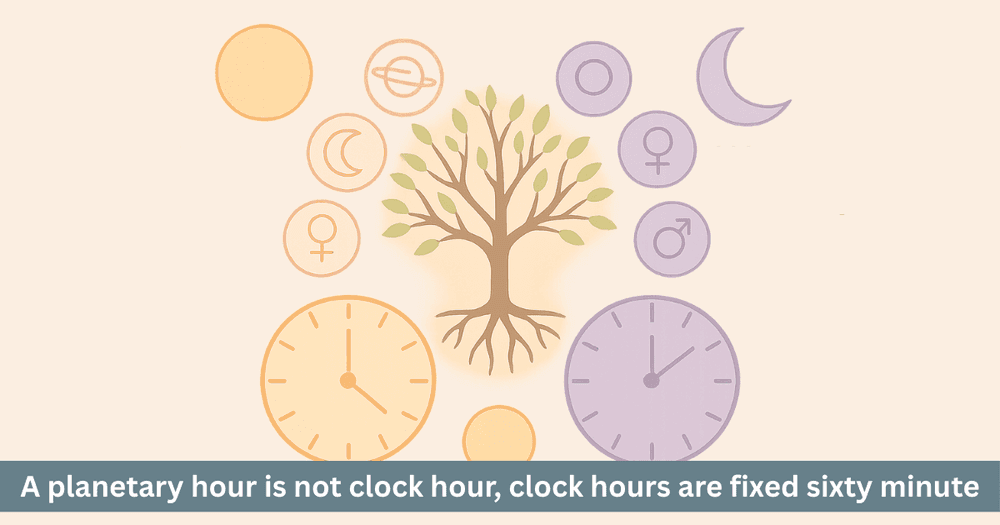
Table of Contents
For centuries, astrologers in India and Europe have independently yet identically developed systems to understand time not as mechanical clock units but as cosmic energy cycles. This discovery astonishes most modern practitioners that Vedic Hora and Western Planetary Hours are not competitors but siblings separated at birth, each inheriting the same foundational wisdom. The real confusion does not arise from the systems themselves but from modern misunderstandings about what time actually means in astrological contexts. Your Moon sign, which you can discover through online Vedic calculators using your exact birth time, location and date, reveals your emotional nature and personal rhythms. When you understand how these planetary timing systems interact with your Moon sign, their application becomes far more effective and personally resonant.
The Shared Foundation: Mathematics That Never Lies
Before understanding what a planetary hour is, we must clear a critical confusion. A planetary hour is not a clock hour. Clock hours are fixed sixty minute segments beginning at midnight. Planetary hours are variable segments based on sunrise and sunset governing specific planetary energies. Understanding this distinction is extremely necessary because most confusion begins right here.
The Astronomical Basis Identical in Both Systems
Both Vedic and Western systems follow identical mathematical principles. The first step is determining local sunrise and sunset for your precise location and date. Use astronomical calculations. For example sunrise at six thirty in the morning and sunset at five forty five in the evening. The second step is calculating day length. Subtract sunrise from sunset meaning five forty five in the evening minus six thirty in the morning equals eleven hours fifteen minutes equals six hundred seventy five minutes. This is your day length which varies seasonally. The third step is dividing the day into twelve equal parts. Six hundred seventy five minutes divided by twelve Horas gives fifty six minutes fifteen seconds per Hora. This is your daytime Hora duration. The fourth step is repeating for night. Calculate sunset to next sunrise. Divide by twelve to get nighttime Hora duration. For example twelve hours forty five minutes divided by twelve equals sixty three minutes forty five seconds per Hora. The fifth step is assigning planetary rulers. Begin at sunrise with the day ruling planet. Continue through Chaldean sequence. Repeat cycle throughout day and night.
Why both systems produce identical calculations is because the mathematical foundation is so universal that it could not be otherwise. Both Vedic and Western systems use actual sunrise and sunset times not fixed clock times. Both divide daylight into twelve equal segments. Both divide nighttime into twelve equal segments. Both use the same planetary sequence which is Chaldean order. Both begin with the day ruling planet at sunrise. The calculation is astronomy not opinion.
The Chaldean Order: The Unalterable Sequence
The Chaldean order represents the planets arranged by their apparent speed across Earth sky from slowest to fastest. This sequence is Saturn, Jupiter, Mars, Sun, Venus, Mercury and Moon. This sequence appears in both Vedic and Western systems without variation.
How the Day Begins
The first Hora after sunrise is always ruled by the planet that names the day. Sunday first Hora after sunrise is Sun Hora. Monday first Hora is Moon Hora. Tuesday first Hora is Mars Hora. Wednesday first Hora is Mercury Hora. Thursday first Hora is Jupiter Hora. Friday first Hora is Venus Hora. Saturday first Hora is Saturn Hora.
The Sequence in Action
On a Sunday, both systems sequence Horas identically. First Hora is Sun which is the day lord. Second Hora is Venus following the sequence Saturn Jupiter Mars Sun Venus. Third Hora is Mercury continuing the sequence. Fourth Hora is Moon. Fifth Hora is Saturn. Sixth Hora is Jupiter. Seventh Hora is Mars. Eighth Hora is Sun where the cycle repeats. Result is identical rulership, identical sequence and identical timing.
| Hora Number | Vedic Hora | Western Planetary Hour | Sequence Position |
|---|---|---|---|
| First | Sun | Sun | Day Lord |
| Second | Venus | Venus | Saturn to Jupiter Mars Sun Venus |
| Third | Mercury | Mercury | Toward Mercury |
| Fourth | Moon | Moon | Toward Moon |
| Fifth | Saturn | Saturn | Toward Saturn |
| Sixth | Jupiter | Jupiter | Toward Jupiter |
| Seventh | Mars | Mars | Toward Mars |
| Eighth | Sun | Sun | Cycle Repeats |
Where the Systems Truly Differ
Despite identical calculations, the systems diverged historically in how they are used and what they are combined with.
First Difference: Integration and Cultural Application
Vedic Hora in Indian tradition has deep integration level. It is a living system used daily in India for practical timing decisions. Panchang integration combines it with Tithi meaning lunar day, Nakshatra meaning lunar mansion, Yoga meaning lunar combination, Karana meaning half lunar day, Choghadiya meaning eight fold timing system and Rahu Kaal meaning inauspicious period. Its application is for Muhurta which is auspicious time selection for life events. Cultural context makes it integral to Hindu rituals, festivals and ceremonies. Practical use includes wedding timing, business launches, travel and medical procedures. Philosophy views time as a living cosmic entity with consciousness and energy.
Western Planetary Hours in European tradition has specialized integration level. It is a revival movement that largely disappeared from modern Western astrology but was preserved in traditional and ceremonial practices. Historical use was in medieval and Renaissance astrology and ceremonial magic. Modern revival shows practitioners of Hellenistic and traditional astrology are resurrecting the system. Application is for horary astrology, electional astrology and ritual magic. Cultural context is ceremonial magic traditions and Western esoteric practices. Practical use is timing rituals and performing magic during specific planetary hours. Philosophy follows mechanistic rhythms mapped onto fixed hours.
Second Difference: The Critical Distinction Between Planetary Hours and Clock Hours
This is where ninety percent of confusion arises. When people say Vedic Hora versus Western Hour they often mistakenly mean Vedic Hora versus modern clock hour. Modern Western astrology largely abandoned planetary hours in favor of clock hours. This was not because Western planetary hours were wrong but because industrialization made fixed clock hours convenient. Precision seemed easier with standard sixty minute blocks. Psychology astrology shifted focus away from timing to personality interpretation. Accessibility for untrained practitioners improved with simple clock based systems. But this does not mean Western planetary hours disappeared. They were preserved in traditional and Hellenistic astrology experiencing modern revival, ceremonial magic and occultism and serious practitioners seeking deep timing knowledge.
| Concept | Planetary Hour Both Systems | Modern Clock Hour |
|---|---|---|
| Basis | Sunrise and sunset at your location | Midnight arbitrary convention |
| Duration | Variable fifty five to sixty five minutes | Fixed always sixty minutes |
| Planetary Ruler | Changes throughout day | No planetary ruler in modern use |
| Purpose | Cosmic timing | Scheduling trains meetings |
| Seasonal Change | Duration changes with seasons | Stays exactly sixty minutes year round |
| Geographic Variation | Different at different latitudes | Same worldwide |
Practical Calculation Comparison
Thursday October thirty first two thousand twenty five in Delhi India provides a specific example.
Vedic Hora Calculation
First step is astronomical data. Sunrise six thirty seven in the morning. Sunset five thirty one in the evening. Day length ten hours fifty four minutes equals six hundred fifty four minutes. Each daytime Hora is six hundred fifty four divided by twelve equals fifty four minutes thirty seconds. Second step is day ruling planet. Thursday equals Jupiter day. First Hora at sunrise equals Jupiter Hora. Third step is sequence through day. First Hora is six thirty seven to seven thirty one thirty morning lasting fifty four thirty for Jupiter which is auspicious. Second Hora is seven thirty one thirty to eight twenty six for Mars which is challenging. Third Hora is eight twenty six to nine twenty thirty for Sun which is authority. Fourth Hora is nine twenty thirty to ten fifteen for Venus which is harmony. Fifth Hora is ten fifteen to eleven nine thirty for Mercury which is commerce. Sixth Hora is eleven nine thirty to twelve four afternoon for Moon which is emotional. Seventh Hora is twelve four to twelve fifty eight thirty for Saturn which is discipline. Eighth Hora is twelve fifty eight thirty to one fifty three afternoon for Jupiter which is auspicious repeating and so on until sunset.
Western Planetary Hour Calculation
First step is astronomical data. Same sunrise and sunset six thirty seven morning to five thirty one evening. Same day length six hundred fifty four minutes. Each hour fifty four minutes thirty seconds. Second step is day ruling planet. Thursday equals Jupiter. First hour at sunrise equals Jupiter Hour. Third step is sequence through day. First hour is six thirty seven to seven thirty one thirty morning lasting fifty four thirty for Jupiter which is expansion. Second hour is seven thirty one thirty to eight twenty six for Mars which is action. Third hour is eight twenty six to nine twenty thirty for Sun which is vitality. Fourth hour is nine twenty thirty to ten fifteen for Venus which is love. Fifth hour is ten fifteen to eleven nine thirty for Mercury which is communication. Sixth hour is eleven nine thirty to twelve four afternoon for Moon which is emotion. Seventh hour is twelve four to twelve fifty eight thirty for Saturn which is restriction. Eighth hour is twelve fifty eight thirty to one fifty three afternoon for Jupiter which is expansion repeating and so on. Result is that calculations are identical. Planetary rulers are identical. Times are identical. Only differences are in nomenclature and interpretive emphasis.
Key Differences in Application and Philosophy
Third Difference: Integration with Other Systems
In Vedic approach, Hora is never used alone. It is combined with Tithi which is lunar day, Nakshatra which is lunar mansion, Yoga which is lunar angle combination, Choghadiya which is eight fold daily division and Rahu Kaal which is approximately ninety minute inauspicious period daily. Vedic integration example shows that if you want to schedule a wedding, you check Hora and select Venus Hora for love. You check Tithi and select auspicious lunar day. You check Nakshatra and select auspicious lunar mansion. You confirm Yoga for auspicious combination. You confirm Choghadiya for green light time. You select auspicious weekday. You avoid Rahu Kaal which is inauspicious window. Result is highly refined multi validated timing.
| System | Meaning | Integration with Hora |
|---|---|---|
| Tithi | Lunar day twenty nine point five to thirty days per month | Combined for auspiciousness strength |
| Nakshatra | Lunar mansion twenty seven divisions | Provides additional timing refinement |
| Yoga | Lunar angle combinations | Adds auspicious or inauspicious quality |
| Choghadiya | Eight fold daily division | Provides universal traffic light |
| Rahu Kaal | Approximately ninety minute inauspicious period daily | Avoided regardless of Hora |
In Western approach, planetary hours are used differently. Focus is on the planet symbolic correspondence. Method is performing action during the hour of the planet that symbolizes your goal. For example perform love ritual during Venus hour on Friday which is Venus day. Integration is often combined with astrological aspects and lunar phases but not systematically with Hora plus Tithi plus Nakshatra etc.
Fourth Difference: Philosophical Orientation
Vedic philosophy views time not merely as measurement but as a conscious cosmic entity called Kaal. Each moment carries planetary consciousness. Time flows with intelligence and intention. Aligning with right time means aligning with cosmic will. Multiple layers of timing create resonance with the universe.
Western philosophy views time as mechanistic rhythm that can be mapped and measured. Planetary hours represent cyclic patterns of influence. Aligning with planetary hours means synchronizing with natural cycles. Emphasis is on predictable patterns rather than cosmic consciousness.
Modern Manifestations
Today Vedic Hora status is living and daily practice. Panchang apps calculate Hora automatically. It is used daily for Muhurta meaning auspicious timing. It is integrated with other timing systems automatically. It is part of living Hindu ritual and cultural practice. It is widely taught in Vedic astrology schools. It is accessible to general population through apps. Modern use examples are when is the auspicious time for my marriage, when should I start my business, when should I schedule my surgery and what time should we name the baby.
Today Western Planetary Hours status is specialized revival. They are preserved in traditional and Hellenistic astrology. They are used in ceremonial magic and occultism. They are being revived by serious practitioners. They are less accessible to general population. They require understanding of calculation or access to specialized software. There is growing modern interest among alternative practitioners. Modern use examples are when is the best time to perform this Venus ritual, I should start this project during Mercury hour, this ritual must occur during Jupiter hour and use this time for magical workings.
Practical Comparison Table
| Aspect | Vedic Hora | Western Planetary Hours |
|---|---|---|
| Origin | Ancient Vedic and Indian tradition | Ancient Hellenistic and Babylonian tradition |
| Calculation | Sunrise and sunset divided by twelve | Sunrise and sunset divided by twelve |
| Mathematical Result | Identical | Identical |
| Planetary Sequence | Chaldean order | Chaldean order |
| First Hour Ruler | Day ruling planet | Day ruling planet |
| Day Length Variation | Accounts for seasonal changes | Accounts for seasonal changes |
| Duration Per Hora | Variable fifty five to sixty five minutes typical | Variable fifty five to sixty five minutes typical |
| Geographic Adaptation | Yes uses local sunrise and sunset | Yes uses local sunrise and sunset |
| Integration Level | Deep combined with tithi nakshatra choghadiya | Moderate used independently or with lunar phases |
| Primary Application | Muhurta auspicious timing for events | Ritual magic electional astrology |
| Modern Usage | Common integrated in apps | Specialized revival movement |
| Philosophical Basis | Cosmic consciousness living time | Mechanistic cycles natural rhythms |
| Cultural Context | Indian rituals and practices | Western magical traditions |
| Accessibility | High Panchang apps everywhere | Lower requires specialized knowledge or software |
Integration with Your Moon Sign
Your Moon sign affects how you experience and respond to planetary hours. When your action aligns with both the appropriate Hora and your Moon sign natural affinity, effectiveness multiplies exponentially.
| Moon Sign | Emotional Nature | Natural Affinity | Best Horas for This Sign |
|---|---|---|---|
| Aries Moon | Bold and impatient | Mars energy | Mars Hora for action and Jupiter for wisdom |
| Taurus Moon | Stable and sensual | Venus energy | Venus Hora for stability and Jupiter for growth |
| Gemini Moon | Communicative and curious | Mercury energy | Mercury Hora for learning and Venus for creativity |
| Cancer Moon | Emotional and nurturing | Moon energy | Moon Hora for family and Jupiter for expansion |
| Leo Moon | Creative and confident | Sun energy | Sun Hora for visibility and Venus for creativity |
| Virgo Moon | Analytical and practical | Mercury energy | Mercury Hora for analysis and Saturn for structure |
| Libra Moon | Balanced and diplomatic | Venus energy | Venus Hora for relationships and Mercury for communication |
| Scorpio Moon | Intense and transformative | Mars energy | Mars Hora for intensity and Saturn for depth |
| Sagittarius Moon | Expansive and philosophical | Jupiter energy | Jupiter Hora for expansion and Mercury for learning |
| Capricorn Moon | Disciplined and responsible | Saturn energy | Saturn Hora for work and Jupiter for wisdom |
| Aquarius Moon | Innovative and humanitarian | Saturn and Jupiter | Saturn for structure and Jupiter for innovation |
| Pisces Moon | Intuitive and spiritual | Jupiter and Moon | Jupiter Hora for spirituality and Moon for intuition |
The Real Question: Which System Should You Use
Choose Vedic Hora if you want comprehensive multi layered timing. Choose Vedic Hora if you need to integrate with Indian rituals or traditions. Choose Vedic Hora if you are seeking Muhurta meaning auspicious moment selection. Choose Vedic Hora if you want maximum predictive accuracy. Choose Vedic Hora if you need seasonal and geographic adaptation. Choose Vedic Hora if you prefer readily available apps and resources. Choose Vedic Hora if you value integration with tithi nakshatra and choghadiya. Best for weddings business launches medical procedures and major life events in Indian context.
Choose Western Planetary Hours if you practice ceremonial magic or ritual work. Choose Western Planetary Hours if you value mechanistic simplicity over complexity. Choose Western Planetary Hours if you are practicing traditional Western astrology. Choose Western Planetary Hours if you want symbolic correspondence focus such as Venus hour for love ritual. Choose Western Planetary Hours if you are part of esoteric or occult traditions. Choose Western Planetary Hours if you prefer easier scheduling in modern context. Best for ritual magic electional astrology and symbolic magical work.
The Optimal Path Forward
Use both systems together. For timing major events use Vedic Hora with full integration meaning tithi nakshatra and choghadiya. For ritualistic work use Western Planetary Hours with symbolic correspondence. For maximum effect ensure both systems indicate the same favorable planet. For scientific validation calculate both systems and confirm alignment.
One Wisdom Two Expressions
The profound truth underlying this comparison is simple yet revolutionary. Vedic Hora and Western Planetary Hours are not competitors but the same ancient wisdom expressed through different cultural lenses. Both systems calculate time identically based on sunrise and sunset. Both use the same planetary sequence which is Chaldean order. Both follow the same mathematical principles. Both produce identical timing results. Both reflect the same cosmic understanding that time is not uniform but alive with planetary energy. The differences meaning Vedic integration with tithi and nakshatra versus Western focus on ritual correspondence represent different applications of the same fundamental truth.
The Real Challenge for Modern Practitioners
The true distinction is not between systems but between planetary hours meaning variable cosmic and meaningful versus clock hours meaning fixed arbitrary and mechanical. Modern society conditions us to think in clock hours. But when you want to align your actions with cosmic support, you must shift your consciousness to think in planetary hours. Whether you call it Hora or Planetary Hour or temporal hour, the cosmic principle remains identical. Time itself is ruled by planets and aligning your actions with these planetary rhythms multiplies success.
Final Wisdom
Use whichever system resonates with your cultural context and spiritual tradition. But more importantly understand that you are accessing the same ancient cosmic wisdom that guided sages and magicians for millennia. The planets do not care whether you call them Hora or Planetary Hours. They only respond to alignment. Both systems connect you to the living pulse of time where each moment holds a unique planetary signature. When you work with this knowledge, you are not merely managing time but dancing with time.
Frequently Asked Questions
Question One: Do Vedic Hora and Western Planetary Hours truly produce identical calculations?
Yes absolutely. Both systems use identical mathematical principles. Both use sunrise and sunset times at your location. Both divide daylight into twelve equal parts and night into twelve equal parts. Both use Chaldean order meaning Saturn Jupiter Mars Sun Venus Mercury Moon. Both begin with the day ruling planet at sunrise. If you calculate Thursday in Delhi, both Vedic Hora and Western Planetary Hours will give you exactly the same times and planetary rulers. The difference is only in nomenclature and cultural application not in calculation.
Question Two: Then what is the main difference between Vedic Hora and Western Planetary Hours?
The main difference is in integration level. Vedic Hora is never used alone. It is always combined with Tithi meaning lunar day, Nakshatra meaning lunar mansion, Yoga meaning lunar combination and Choghadiya meaning eight fold timing system. This multi layered approach creates highly refined Muhurta meaning auspicious timing. Western Planetary Hours are used more independently focusing on symbolic correspondence. For example using Venus hour for love magic. The second difference is cultural context. Vedic Hora is alive in Indian daily life and rituals while Western Planetary Hours are seeing specialized revival in traditional astrology and ceremonial magic.
Question Three: Why should I use planetary hours instead of clock hours?
Clock hours are arbitrary human conventions starting at midnight and always lasting sixty minutes. They do not care about geographic location or season. Planetary hours are based on cosmic reality. They use actual sunrise and sunset at your location. They change with seasons. Most importantly each planetary hour is ruled by a specific planet which brings special energy to that time period. When you align important actions with planetary hours you gain cosmic support. Doing a wedding in Venus Hora or starting a business in Jupiter Hora is not superstition but alignment with planetary energies validated over thousands of years.
Question Four: Can I use both systems together?
Yes and this is actually the optimal approach. For major life events like marriage business launch or medical procedures use Vedic Hora with full integration meaning check tithi nakshatra yoga and choghadiya. This gives you the most refined timing. If you practice ritual work or Western magic use Western Planetary Hours for symbolic correspondence. For maximum effect ensure both systems indicate the same favorable planet. For example if both systems indicate Jupiter Hora or Jupiter Hour and Choghadiya is also auspicious you know this is a highly powerful time. Using both systems gives an additional layer of validation.
Question Five: How does my Moon sign work with planetary hours?
Your Moon sign represents your emotional nature and intuition. Certain planetary hours naturally resonate better with your Moon sign. For example if your Moon sign is Aries which is ruled by Mars, your actions during Mars Hora will be more powerful. If your Moon sign is Taurus which is ruled by Venus, Venus Hora is especially favorable for you. To understand which planetary hours are best for you, know your Moon sign. You can find your Moon sign using online Vedic calculators with your exact birth time location and date. When your action aligns with both the appropriate Hora and your Moon sign natural affinity, effectiveness multiplies rapidly.
What does Lagna Sign reveal about me?
My Lagna SignDid you like it?
Author

Pt. Sanjeev Sharma (63)
Experience: 20
Consults About: Family Planning, Career
Clients In: Punjab, Haryana, Delhi
Share this article with friends and family
WELCOME TO
ZODIAQ
Right Decisions at the right time with ZODIAQ
500+
USERS
100K+
TRUSTED ASTROLOGERS
20K+
DOWNLOADS
